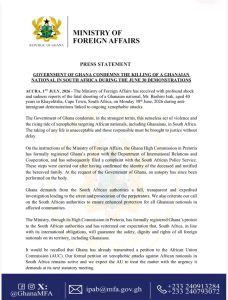
The Government of Ghana has condemned the killing of a Ghanaian national in South Africa during anti-immigrant demonstrations, describing the incident as a senseless act of violence and calling for the immediate arrest and prosecution of those responsible.Ghana Regional News
In a press statement issued by the Ministry of Foreign Affairs on Wednesday, July 1, 2026, the government said it had received “profound shock and sadness” over the fatal shooting of Mr. Bashiru Isak, a 40-year-old Ghanaian, in Khayelitsha, Cape Town, on Monday, June 30, 2026.
According to the statement, Mr. Isak was killed during demonstrations linked to ongoing xenophobic attacks targeting foreign nationals in South Africa.
“The Government of Ghana condemns, in the strongest terms, this senseless act of violence and the rising tide of xenophobia targeting African nationals, including Ghanaians, in South Africa. The taking of any life is unacceptable, and those responsible must be brought to justice without delay,” the ministry stated.
The statement disclosed that, acting on the instructions of the Ministry of Foreign Affairs, the Ghana High Commission in Pretoria has formally lodged Ghana’s protest with South Africa’s Department of International Relations and Cooperation.
The High Commission has also filed an official complaint with the South African Police Service after confirming the identity of the deceased and notifying his family.
Ghana is therefore demanding a comprehensive, transparent and expedited investigation into the killing, insisting that authorities in South Africa ensure those responsible are identified, arrested and prosecuted.
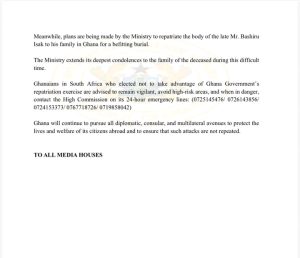
Beyond the investigation, the government also urged South African authorities to strengthen security measures for Ghanaian nationals and other foreign residents who may be vulnerable to xenophobic attacks.
“We also reiterate our call on the South African authorities to ensure enhanced protection for all Ghanaian nationals in affected communities.”