
The Democratic Republic of Congo has secured a place in the decisive final of the FIFA Intercontinental Play-offs, the mini-tournament that will award the last two tickets to the expanded 48-team 2026 World Cup co-hosted by Canada, Mexico and the United States.
The official draw, held by FIFA on November 20, 2025 in Zurich, confirmed the match-ups and handed DR Congo a major advantage: as one of the two highest-ranked teams among the six participants (69th in the latest FIFA men’s rankings released on November 19), the Leopards received a direct bye to the Pathway 1 final and now need only one victory to reach their first World Cup in over half a century.
These play-offs, officially called the FIFA World Cup 26 Play-Off Tournament, bring together representatives from Asia, Africa, South America, Oceania and an additional CONCACAF slot after more than two years of qualifying across five confederations (UEFA has its own separate process).
Forty-two teams are already qualified, including the three hosts and traditional heavyweights such as Argentina, Brazil and Germany, leaving just these dramatic knockout matches to complete the line-up three months before the tournament begins on June 11, 2026.
DR Congo earned their place by finishing as the best runners-up in African qualifying, dramatically eliminating Cameroon and Nigeria on penalties in the final CAF rounds. Their only previous World Cup appearance came in 1974, when a youthful Zaire side left the tournament winless after the group stage.
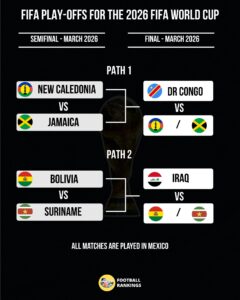
The six-team event is split into two independent single-elimination pathways, each containing three nations. The two top seeds, DR Congo and Iraq (56th in the world), go straight to their respective finals, while the remaining four teams contest semifinals. Every match is a single 90-minute game on neutral territory with no second legs; finals can go directly to penalties if required. The winner of each pathway books its ticket to the World Cup.
In Pathway 1, DR Congo will face the winner of the semifinal between Jamaica and New Caledonia, scheduled for March 26, 2026 at a Mexican venue.
Jamaica, ranked 59th, reached this stage after narrow successes over Curaçao and Haiti in CONCACAF qualifying and will rely on Premier League stars Leon Bailey and Michail Antonio plus their trademark high-pressing game.
They have appeared at only one previous World Cup, in 1998, where they lost all three matches but won admirers worldwide. New Caledonia, ranked 149th and representing Oceania after losing the regional final to New Zealand, are a Pacific island nation of just 270,000 people making their debut at this level.
Although massive underdogs, they can call on France-based professionals and the legacy of 1998 world champion Christian Karembeu, who was born there. The winner will then meet DR Congo in the Pathway 1 final on March 31.
The parallel Pathway 2 sees Iraq waiting for the survivor of Bolivia versus Suriname, also on March 26.
Bolivia, 85th in the rankings, endured a tough CONMEBOL campaign played partly at extreme altitude but still possess experienced players adapting to sea-level football; their last World Cup was 1994.
Suriname, ranked 142nd, produced one of the surprises of CONCACAF qualifying with a late surge powered by Dutch league talents such as Sheraldo Becker and Ridgeciano Haps, and a victory would mark their first-ever World Cup appearance.
Iraq, who last played at the finals in 1986, will contest the Pathway 2 final on March 31 carrying the highest ranking in the entire play-off field and recent momentum from Asian Cup success and a tight victory over the UAE.
All four matches will be staged in Mexico as a dress rehearsal for the 2026 tournament itself. The modern Estadio Akron in Guadalajara and Estadio BBVA in Monterrey will each host one semifinal and one final, with kick-off times to be confirmed but planned for evening slots to suit global audiences.
FIFA President Gianni Infantino described the venues as iconic stages ready to deliver thrilling drama while testing logistics ahead of the main event.
For DR Congo, coached by Sébastien Desabre and built around European-based attackers like Cedric Bakambu and Yannick Bolasie, the dream is now 90 minutes away.
A victory would deliver Africa its fourth qualifier through the play-offs and end a 52-year wait. Across both pathways, nations from vastly different footballing cultures will collide in a pressure-packed format where a single result can change history.
With the full 48-team World Cup draw set for December 5 in Washington, D.C., the road to 2026 now runs decisively through Mexico next March.