
football manager known for his calm demeanor and deep tactical knowledge, has formally announced his departure from his role as head coach of Ghana’s national team, the Black Stars, following their exit from the 2026 FIFA World Cup in the Round of 32 stage.
The 73-year-old took on the position on a short-term contract earlier this year, with the primary mission of guiding the team through the expanded tournament hosted across the United States, Canada, and Mexico.
His time in charge came to an end after a tightly contested 1-0 defeat to Colombia, which brought Ghana’s campaign to a close and left fans and analysts reflecting on what might have been in a competition filled with high expectations for African representation.
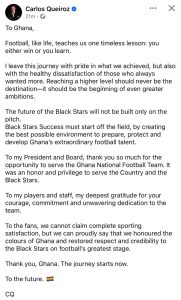
In a thoughtful and gracious farewell message directed at the entire nation, Queiroz reflected on the highs and lows of the journey with characteristic wisdom. He reminded everyone that football, much like life itself, teaches the timeless lesson that you either win or you learn from the experience.
While expressing pride in the progress made and the respect restored to Ghanaian football on the world’s biggest stage, he acknowledged the healthy dissatisfaction that comes when ambitions for more remain unfulfilled.
The coach extended sincere thanks to the Ghana Football Association’s leadership for giving him the opportunity to serve, to his players and technical staff for their dedication and resilience amid challenges such as injuries and the pressures of elite competition, and above all to the passionate supporters whose energy fueled the team throughout.
A key element of Queiroz’s parting words centered on the bigger picture for Ghanaian football’s development. He emphasized that the long-term success of the Black Stars will not be achieved merely through performances on the pitch alone.
Instead, true progress must begin off the field by building robust systems to identify, nurture, protect, and prepare the country’s abundant young talent. He pointed to the need for greater maturity and experience within the squad, noting that enthusiasm alone cannot always withstand the intense demands of knockout-stage football at this level.
This message has sparked conversations about investing in infrastructure, youth academies, and professional environments that can sustain the team beyond any single tournament cycle.
During his relatively brief stint, Queiroz instilled a renewed sense of discipline and clarity in the squad. He selected a balanced 26-man roster that mixed established stars like captain Jordan Ayew, Thomas Partey, and Iñaki Williams with promising talents, aiming to blend creativity with structure.
The team showed moments of promise in the group phase but found it difficult to maintain control and composure when it mattered most in the knockout rounds. In post-match comments, the coach openly admitted regrets and the wish that certain moments could be approached differently, while highlighting uncontrollable factors like injuries that impacted preparations.