
In a decisive move aimed at strengthening the fight against discrimination and unsporting conduct on the football pitch, The International Football Association Board (IFAB) has unanimously approved two significant amendments to the Laws of the Game proposed by FIFA.
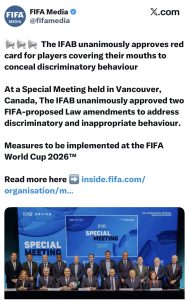
These changes, finalized during a Special Meeting held in Vancouver, Canada, on Tuesday, represent a firm commitment by football’s lawmakers to promote respect, transparency, and fair play, particularly in high-stakes environments where tensions can escalate quickly between players.
The headline development from the meeting is the introduction of a potential red card for any player who covers their mouth with their hand, shirt, or arm while engaging in a confrontational situation with an opponent.
This measure directly targets attempts to conceal discriminatory, abusive, insulting, or otherwise inappropriate language that might otherwise go undetected by referees, assistant referees, or even television cameras and lip-reading technology.
By making such concealment sanctionable at the discretion of the competition organizer, IFAB and FIFA seek to remove a longstanding tactic that has allowed players to allegedly utter offensive remarks—ranging from racial slurs to homophobic insults—while shielding themselves from immediate consequences or clear video evidence.
This rule change has gained particular urgency following several high-profile incidents in recent months, most notably a confrontation during a UEFA Champions League match earlier in 2026 involving Benfica’s young Argentine winger Gianluca Prestianni and Real Madrid superstar Vinícius Júnior.
In that case, Prestianni was accused of directing discriminatory language toward Vinícius while covering his mouth, an action that sparked widespread debate, an official UEFA investigation, and ultimately a six-match ban for discriminatory (specifically homophobic) conduct, despite the player’s denial of racial abuse.
Such episodes have highlighted how the simple gesture of hiding one’s mouth has increasingly been used as a shield for unacceptable behavior, undermining the spirit of the game and eroding trust among players, fans, and officials.
With the new amendment in place, referees at the FIFA World Cup 2026 will have clearer authority to intervene swiftly, issuing a straight red card where they or the competition organizers deem the mouth-covering to be part of a confrontational exchange that risks concealing prohibited speech.
Complementing this measure is a second amendment that addresses another form of disruptive and inappropriate behavior: players unilaterally leaving the field of play in protest against a referee’s decision, or team officials inciting or encouraging such walk-offs.
Under the updated rules, this act of dissent can now also result in a red card, sending the offending player off immediately and reducing their team to ten players for the remainder of the match. The intention here is to curb theatrical or petulant protests that disrupt the flow of the game, show disrespect to match officials, and set a poor example for younger players and spectators.
By treating these protests as serious misconduct warranting the ultimate on-field sanction, IFAB aims to reinforce the authority of referees and discourage teams from pressuring officials through collective or individual acts of defiance.
Both amendments were approved unanimously by IFAB members during the Vancouver gathering, reflecting broad consensus among the game’s key stakeholders—including representatives from FIFA, the four British football associations, and other board participants—on the need for stronger deterrents against behaviors that damage the integrity and image of football.
Importantly, these changes are being introduced as competition-specific opt-ins rather than mandatory alterations across all levels of the sport. As such, they will be implemented for the first time at the FIFA World Cup 2026™, the world’s most prestigious tournament, which will be co-hosted by Canada, Mexico, and the United States starting in June.
This targeted rollout allows FIFA to test and refine the practical application of the rules in a high-visibility setting before any potential wider adoption, while sending a powerful message that the biggest stage in football will no longer tolerate attempts to hide discrimination or undermine refereeing decisions.
FIFA President Gianni Infantino and other senior figures, including Pierluigi Collina as Chairman of the FIFA Referees Committee, have emphasized that these measures are part of a broader effort to protect the respect and values of the game.
They align with ongoing initiatives to combat all forms of discrimination, ensure greater accountability on the pitch, and make football a more inclusive and positive environment. Referees will receive specific guidance on how to interpret “confrontational situations” and when mouth-covering crosses the threshold for a red card, with video assistant referee (VAR) support likely playing a role in reviewing borderline cases where intent or context needs clarification.
The timing of the announcement, just days before the FIFA Congress in the same Canadian city, underscores the momentum behind these reforms. While some may argue that the rules grant referees additional discretionary power that could lead to controversy or inconsistent application, supporters view them as essential evolutionary steps in response to modern challenges—such as sophisticated attempts to evade detection in an era of omnipresent cameras and heightened sensitivity to social issues.
Players and coaches will need to adapt quickly, rethinking old habits around on-pitch arguments and protests, as the consequences at the World Cup could prove decisive in tight matches where a red card might shift the entire dynamic of a game.