
By Nana Ama Asantewaa Kwarko
The Presidential Special Envoy on Reparations, H.E. Dr Ekwow Spio-Garbrah, has backed calls for a unified “Made in Africa” brand to give products manufactured across the continent a stronger identity on the global market.
The former Trade and Industry Minister endorsed the proposal by Ing. Prof. Douglas Boateng, convener of the Boardroom Governance Summit 2026, held at the Labadi Beach Hotel in Accra on Thursday, November 12.
Prof. Boateng argued that African manufacturers would benefit from a common continental identity, citing the United States, where products manufactured in different states are marketed under the collective “Made in USA” label rather than individual state identities.
Using footwear produced in Ghana as an example, he suggested that African products could similarly bear a “Made in Africa” label while retaining details of their country of manufacture.
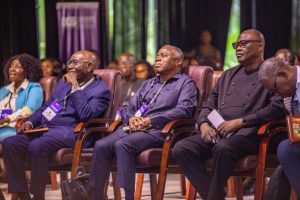
Dr Spio-Garbrah, who chaired the summit, welcomed the proposal and encouraged governments, businesses and other stakeholders to support efforts to make it a reality.
Drawing on his experience as Trade and Industry Minister under the previous Mahama administration, he recalled the earlier efforts to strengthen national branding and promote locally manufactured goods.
He referred to the Brand Ghana Council and the Made-in-Ghana Committee, both of which he chaired between 2014 and 2017, and recounted how the institutions ceased functioning following the change of government in January 2017.
Checks into the history of the two bodies show that the 18-member Made-in-Ghana Committee was inaugurated by President John Dramani Mahama in December 2014 to promote local industries, encourage domestic consumption and reduce dependence on imports.
The initiative contributed to the development of a Made-in-Ghana policy, approved by Cabinet in March 2016 and launched later that year, encouraging public institutions to prioritise locally manufactured goods and services.
The Brand Ghana Council, meanwhile, focused on strengthening the country’s national image and international reputation.
Although the institutions subsequently became inactive, the Akufo-Addo administration’s 2017 Budget Statement indicated its intention to intensify promotion of Made-in-Ghana products, demonstrating continued policy interest in supporting local industries.
The National Democratic Congress, in its 2024 election manifesto, subsequently pledged to reinstate both the Brand Ghana Council and the Made-in-Ghana Committee.
The Ministry of Trade, Agribusiness and Industry’s 2026 Budget Estimates also listed the operationalisation of the two institutions among its targets for 2025.
However, the ministry’s accompanying performance report did not indicate whether either body had been formally reconstituted.
The report instead highlighted engagement with government institutions and the private sector to promote local production and procurement, alongside Ghana’s participation in the Osaka World Expo.
Questions surrounding the country’s national branding structures have persisted over the years. In 2018, the Ghana Tourism Authority disclosed that the former Brand Ghana Office, a separate institution from the council, had ceased operating, with aspects of its work taken over by an inter-agency group.
In July 2025, the Chartered Institute of Marketing, Ghana, also proposed the establishment of a permanent Brand Ghana Council to ensure that national branding efforts are sustained across political administrations.
These developments reinforce the importance of strong institutional structures to support long-term trade and industrial policies.
The proposed continental brand could also complement the African Continental Free Trade Area (AfCFTA), which seeks to expand intra-African trade and strengthen regional manufacturing.
The African Union has already developed Made in Africa standards and guidelines, providing a potential framework for harmonising product quality, certification and origin requirements across the continent.
Dr Spio-Garbrah’s endorsement draws on decades of experience in trade, diplomacy and corporate governance.
He previously served as Ghana’s Ambassador to the United States and Mexico, Minister for Communications, Minister for Education and Minister for Trade and Industry.
He also served as Chief Executive Officer of the Commonwealth Telecommunications Organisation and chaired the Ghana Free Zones Board, among other corporate and international assignments.
Appointed Presidential Special Envoy on Reparations in October 2025, he currently leads diplomatic engagements aimed at advancing reparatory justice for Africans and people of African descent, including work on a proposed five-year action plan.
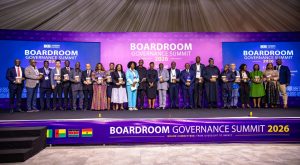
A major highlight of the summit was the unveiling of Prof. Boateng’s book, Practical Perspectives on the Committees of the Board, by H.E. Dr Spio-Garbrah alongside a representative of the Ghana Bar Association.
The publication examines the role of board committees in strengthening accountability, decision-making and institutional performance.
Dr Spio-Garbrah also stressed the importance of constructive disagreement in leadership, recalling an experience in Cabinet where discussion opened up only after he challenged a proposal.
The summit, held under the theme “Board Committees: From Oversight to Impact — The Conversations Every Board Must Have”, brought together business leaders, board chairpersons, policymakers and governance professionals to discuss effective leadership and institutional accountability.