
Stanley Martey, a representative of Ghana Water Limited, has explained that inadequate funding, rapid population growth, illegal mining, sand winning and other activities affecting water bodies continue to pose major challenges to the company’s ability to provide a consistent supply of potable water to households.
Speaking in an interview with Citizen Kofi Owusu on Ahotor Adekyee Mu Nsem in Accra, Mr. Martey said Ghana Water Limited has the responsibility to ensure that Ghanaians have access to safe and reliable water, but several challenges continue to affect the regular supply.
According to him, Ghana has the potential to ensure that residents receive water through their taps every day, but the country needs significant investment in treatment plants and other water infrastructure.
“Although we know what to do to get the taps flowing, money is the issue for us. We have not been able to build enough treatment plants that can provide water to our homes every day,” he said.
Mr. Martey explained that the Greater Accra Region currently relies on three major sources for treated water: the Weija Treatment Plant, the Kpone Treatment Plant and the desalination plant at Teshie.
According to him, the three sources collectively produce about 192 million gallons of water daily, while demand in the region is estimated to be between 220 million and 250 million gallons per day.
This gap between production and demand, he said, has forced Ghana Water Limited to ration the available water to ensure that as many communities as possible receive some supply.
“Because we have a deficit, what we are supposed to do is to share it small small for everyone to get some. Before we can bridge the gap for everyone to get enough water, we have to build new treatment plants,” he explained.
Population Growth Putting Pressure on Water Supply
Mr. Martey said the increasing population of Accra, coupled with migration and rapid development, has placed significant pressure on existing water infrastructure.
He noted that as more people move to Accra and new communities are developed, demand for water continues to increase, making it necessary for the country to expand its treatment and distribution systems.
“The more the population is growing, the more development is going on, so we need to also develop the water system to move according to the population,” he said.
Galamsey and Sand Winning Affecting Water Treatment
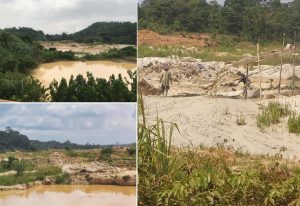
Mr. Martey also identified illegal mining, popularly known as galamsey, as one of the major threats to Ghana’s water resources.
According to him, the destruction and pollution of river bodies have made it increasingly difficult for Ghana Water Limited to obtain clean raw water for treatment.
Even when water is available, he explained, the company sometimes has to use more chemicals to treat the water to the required standard.
This, he said, has significantly increased the cost of producing potable water.
“Sometimes, we don’t even get enough water to treat for the people. Apart from galamsey, sand winning in some areas is also a major problem for us,” he added.
Mr. Martey further raised concerns about activities associated with fish farming on water bodies.
He explained that some of the feed given to fish ends up in the water, enriching the sediment and encouraging the rapid growth of aquatic weeds.
The excessive growth of aquatic weeds, he said, can change the colour and quality of raw water, forcing the company to use additional chemicals during the treatment process.
He stressed that many of the challenges confronting the water sector could be addressed if human activities that damage water bodies were changed.
“All these challenges can be stopped if we change our activities,” he said.
Ghana Needs Private-Sector Investment
Mr. Martey also called for increased private-sector participation and investment in the water sector, arguing that Ghana needs an approach similar to the Independent Power Producer (IPP) model used in the electricity sector.
He said Ghana Water Limited is a public company in which the government remains the majority shareholder, but the country has not yet reached the level where significant private-sector investment can be brought in to expand water production infrastructure.
He argued that private-sector participation could help bridge the gap between water production and demand.
“If ECG brought in IPPs, independent power producers, to help solve the electricity problem, the same way we as a water company have to do that to curb the situation,” he said.
Tariff Structure and Revenue Challenges
Mr. Martey further identified Ghana’s tariff structure as another major challenge affecting the company’s ability to generate sufficient revenue for its operations and expansion.
He explained that Ghana Water Limited does not have full control over the tariffs it charges customers because the Public Utilities Regulatory Commission (PURC) regulates water tariffs.
According to him, the company sometimes incurs a higher cost in producing water than the revenue it receives from selling it.
“What we have to do is for us to collect our own tariffs so we can be able to solve these issues. We don’t have control over our tariffs. We have an independent body that regulates how we should sell the water,” he said.
Mr. Martey said the disparity between the cost of production and regulated tariffs results in revenue losses for the company, making it difficult to undertake critical maintenance and expand infrastructure.
He explained that some funds that should be used for maintenance are instead required to meet the increasing cost of treating polluted raw water.
“The cost of production is more than the tariffs given to us to sell the water, so the money given to us to do maintenance is used to treat the water,” he stated.
He therefore called for urgent investment in water treatment infrastructure, improved protection of water bodies, stronger regulation of activities such as galamsey and sand winning, and reforms that would enable Ghana Water Limited to generate adequate revenue to maintain and expand its operations.
Mr. Martey stressed that water is essential to life and that Ghana’s water infrastructure must expand alongside population growth and economic development if the country is to achieve a reliable daily water supply.
Story by Stephen Kwaku Owusu Mintah/Ahotoronline/Accra