
Ghana’s football crisis deepened on Tuesday night at the Accra Sports Stadium. The Black Stars led The Gambia 2-0 inside 33 minutes, then collapsed in a manner that has become painfully familiar: two goals conceded before half-time, two more after the break, and a 4-2 home defeat that leaves a four-time African champion bottom of Group C with zero points from two 2027 Africa Cup of Nations qualifiers.
The result was not an isolated embarrassment. It was the latest chapter in a long slide that has already cost Ghana a place at AFCON 2025, sent FIFA rankings tumbling, and now threatens another absence from the continental finals in Kenya, Uganda and Tanzania next year.
The backlash has been immediate and fierce.
Calls for a massive shake-up have landed on the Ghana Football Association and its president, Kurt Okraku, who has led the organisation since 2019. They have also reached the Presidency, Parliament and the Sports Ministry.
How a 2-0 lead became a 2-4 humiliation
Ghana entered the match under pressure after a 2-0 loss away to Côte d’Ivoire in Bouaké five days earlier. Carlos Queiroz made three changes. The early signs suggested those changes had worked.
In the 27th minute Jerome Opoku was fouled in the box. Ernest Nuamah converted the penalty. Six minutes later Felix Afena-Gyan, starting for the first time in years, bent a free-kick beyond the wall. Accra Sports Stadium believed. Two-nil, home soil, a struggling but still proud football nation suddenly looking like itself again.
The Gambia did not fold. Gideon Mensah conceded a penalty. Mohamed Badamosi scored it in the 37th minute. Five minutes later Omar Colley equalised after Ghana failed to deal with a throw-in. Half-time: 2-2. The two-goal cushion had lasted nine minutes.
After the interval Ghana still had most of the ball. They created little of quality. In the 68th minute another defensive mix-up, again involving Mensah, allowed Ebrima Colley to put the Scorpions ahead. Deep in stoppage time Colley scored again on the counter. Four-two. The Gambia’s first win over Ghana in 33 years. Ghana’s first time conceding four goals in an AFCON qualifier.
Gambia coach Johnathan McKinstry said afterwards he was not surprised. His team had already beaten Somalia. They now sit level with Côte d’Ivoire on six points. Ghana sit last, having conceded six goals in two games.
Qualification is no longer a formality
Group C is brutal: Côte d’Ivoire, Ghana, The Gambia and Somalia. The top two qualify. After two matchdays the table is already tilted.
Ghana still have four games left: a November double-header against Somalia, home and away, and a March 2027 pair against Côte d’Ivoire at home and The Gambia away. Twelve points remain available. Winning all four would give them 12 points and a realistic chance of second place. Anything less, especially another slip against Somalia, would leave them needing favours.
The broader context is worse. Ghana have not won an AFCON qualifier since beating the Central African Republic in September 2023. They went winless through the entire 2025 qualifying campaign and missed the finals for the first time in two decades. The current eight-match winless run in AFCON qualifying is historic for a country that once treated the tournament as a birthright.
Queiroz cannot hide from the numbers
Carlos Queiroz was first appointed in April 2026 after Otto Addo was sacked 72 days before the World Cup. He steered Ghana to the last 32, then stepped down. The GFA brought him back in early September for the AFCON qualifiers.
His record across both spells now reads: seven matches, one win against Panama at the World Cup, two draws, four defeats. Five goals scored, ten conceded. After the Gambia game he took responsibility, asked fans to support the players rather than blame them, and insisted the Black Stars themselves were never a problem. He also said resignation would be the easy option and would not fix deeper issues.
That last point is the one that matters. Coaches have come and gone under Okraku — C.K. Akonnor, Milovan Rajevac, Chris Hughton, Otto Addo twice, now Queiroz again. The results have not improved. The pattern is the same: early promise or a brief World Cup campaign, then collapse in the competitions that actually define African football.
The storm around Kurt Okraku and the GFA
The GFA president has become the lightning rod. An angry fan tried to confront him at the stadium after the final whistle. Journalists, former administrators and politicians have piled on.
Sports journalist Daniel Koranteng called on President John Mahama to sack Okraku. Former NSA board chairman Seth Panwum and King Faisal owner Alhaji Grusah demanded resignations from Okraku and the Black Stars management committee.
Communications Minister Sam George went further: disband the Black Stars, sack the FA, and accept a two-year FIFA ban if that is what it takes to rebuild properly. “Truth hurts, but the patchwork is worse,” he wrote.
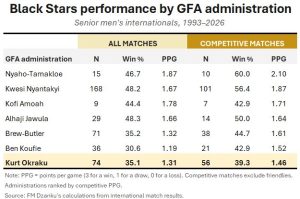
The statistical case against the current administration is stark. Analysis of more than three decades of results shows Ghana’s competitive win rate under Okraku at 39.3 percent and 1.46 points per game — the lowest among seven GFA presidencies examined.
Overall win rate across 74 matches sits at 35.1 percent. FIFA ranking has dropped from 47th in the world when he took office. Two winless AFCON tournaments in 2021 and 2023 were followed by complete failure to qualify in 2025.
Okraku’s defenders point to World Cup qualification in 2022 and 2026, some youth-programme work, and Dreams FC’s continental run. Critics counter that World Cup qualification papers over a domestic league in decline, a talent pipeline that exports players too early and too cheaply, a revolving door of coaches whose severance packages have already cost more than a million dollars, and a senior team that no longer looks organised or mentally resilient once the scoreboard turns against it.
A pattern of embarrassment across every national team
The 4-2 home collapse against The Gambia sits on a pile of tournament failures that now stretches across Ghana’s senior men, youth men and women’s teams. That is the part that makes the present crisis look systemic rather than merely a bad week under Queiroz.
Ghana last won the Africa Cup of Nations in 1982. That drought is now 44 years old. Between 2008 and 2017 Ghana reached at least the AFCON semi-finals six tournaments in a row, including two finals. Then the slide began. Round of 16 in 2019.
Group-stage exit in 2021 with no wins: a 1-0 loss to Morocco, a 1-1 draw with Gabon, and a 3-2 defeat to Comoros when Ghana needed a two-goal win to be safe. Group-stage exit again in 2023, again with no wins: 2-2 with Egypt, 1-2 to Cape Verde, and a 2-2 with Mozambique after throwing away a 2-0 lead in stoppage time.
Then came the historic low. Ghana failed to qualify for AFCON 2025, the first miss since 2004 and the first absence in 12 editions. Drawn with Angola, Sudan and Niger, the Black Stars finished bottom of Group F with no wins in six matches: 0-1 at home to Angola, 1-1 with Niger, 0-0 at home to Sudan, 0-2 away to Sudan, 1-1 in Angola, and 1-2 at home to Niger after Mohammed Kudus missed a late penalty. Three points. Three goals scored. Bottom of a group they were expected to win. The GFA issued a public apology.
The World Cup offered only partial cover. Ghana went out in the group stage in Qatar 2022. In 2026 they reached the last 32 and lost 1-0 to Colombia, managing no shots on target. That campaign is now being used to defend the current administration. It does not cancel the AFCON record: no knockout win since 2017, no tournament win at AFCON since 2019, no qualification at all in 2025, and now 0-2 and 2-4 to open the road to 2027.
The youth factory has stalled with it. The Black Satellites have missed four consecutive FIFA U-20 World Cups — 2017, 2019, 2023 and 2025 — despite winning the 2021 U-20 AFCON. At the 2025 U-20 AFCON they were eliminated in the quarter-finals by hosts Egypt on penalties after a 2-2 draw. In 2027 U-20 AFCON qualifying they sat third behind Burkina Faso and Nigeria after a 4-2 loss to Nigeria and a 1-1 with Burkina Faso.
The Black Starlets were once among Africa’s most decorated youth sides. They have not been at a FIFA U-17 World Cup since 2017. They missed the U-17 AFCON in 2019, 2021 and 2023. They finally returned to the 2026 U-17 AFCON after beating Nigeria 2-0 in the WAFU-B semi-final, ending an eight-year wait.
Then the old fragility returned. Ghana finished level with Algeria on points, goal difference and goals scored and were eliminated from the quarter-finals by a drawing of lots. In the World Cup playoff they twice surrendered the lead against Uganda and lost 8-7 on penalties. The U-17 World Cup absence now stretches to nine years. All six goals they conceded in that AFCON campaign came in second halves.
The Black Meteors have not reached the Olympic Games since 2004. That is five successive Olympic cycles missed: 2008, 2012, 2016, 2020 and 2024. A country that once treated youth World Cups and Olympic football as a regular stage now treats qualification as an event.
The women’s programme still reaches tournaments. That makes the manner of the exits more revealing, not less. The Black Queens won bronze at the 2024/25 WAFCON after a penalty loss to hosts Morocco in the semi-final and a shootout win over South Africa. In 2026 they reached the quarter-finals again and lost 2-1 to debutants Malawi after leading through Chantelle Boye-Hlorkah.
A Doris Boaduwaa goal was ruled out by VAR. Rose Kadzere scored the winner in the 79th minute. Malawi, playing their first WAFCON, knocked Ghana out of automatic 2027 Women’s World Cup qualification. Ghana then beat Ivory Coast 2-1 in the African playoff and dropped into the inter-confederation playoffs.
The Black Princesses have now gone out at the group stage of the FIFA U-20 Women’s World Cup on eight consecutive occasions since their 2010 debut. In Poland in September 2026 they were beaten 4-0 by France and finished bottom of their group. Eight tournaments. Zero knockout games.
Even the successes have been stained by administration. Black Queens players boycotted training before an October 2025 WAFCON qualifier over unpaid bonuses reported at $9,500 a player. They issued another demand for outstanding WAFCON and per-diem payments on the eve of the 2026 World Cup playoff. Qualification without professionalism is not a development model. It is a warning.
A 4-2 home defeat can be a bad night. A senior team that has now produced two winless AFCON group stages, a first qualifying failure in two decades, a World Cup last-32 exit with no shot on target, and an eight-game AFCON qualifying drought ending in a home collapse to The Gambia is not having a bad night. It is living with a culture of late collapse and a low tournament floor.
Government is needed — but not as a wrecking ball
The demand for state action is already coming from inside government. Sam George stated the most extreme version in public: disband the Black Stars, sack the FA, and accept a two-year FIFA ban if that is the price of a real rebuild. Alhaji Grusah said government should sack the leadership if they will not resign, claiming FIFA cannot sanction Ghana.
Manhyia South MP Nana Agyei Baffour Awuah had already warned that football had collapsed under the current GFA and that government may have to intervene if the situation is not salvaged.
That is not only fan noise. It is elected officials saying the GFA can no longer be left to self-correct.
FIFA statutes still bar third-party interference in the running of a member association. A president cannot lawfully sack a GFA president the way he sacks a minister. A minister cannot dissolve Congress and appoint a new FA board by press release.
If Ghana does that unilaterally, FIFA can suspend the association: no Black Stars matches, no club football in CAF competitions, no FIFA development money, no international calendar. That is the risk Sam George is openly willing to take. It is also the risk that would punish players and clubs first, not the officials who created the mess.
Ghana has been here before. In 2018, after Anas Aremeyaw Anas’s Number 12 exposé, the government moved to dissolve the GFA. FIFA warned about interference. The way through was not a permanent state takeover. It was a normalisation process coordinated with FIFA, followed by new elections that produced the current administration in 2019.
Government also supplied evidence that FIFA used in the lifetime ban of Kwesi Nyantakyi. The precedent is clear: the state can act against corruption and protect public money. It cannot simply seize the FA and expect Zurich to applaud.
Anyone now telling President Mahama to sack Okraku tonight is asking for a gesture, not a solution. A banned Ghana would miss the rest of the 2027 AFCON qualifiers and deepen the isolation the rebuild is supposed to cure.
The useful intervention is narrower and harder. It is also the only version that can survive FIFA scrutiny.
National-team camps, bonuses, World Cup tickets, stadium use and Sports Ministry grants are public expenditure. Sports Minister Kofi Iddie Adams has already been answering questions on World Cup budgets, ticket purchases and coaching costs. That audit trail should now be widened. Every cedi released to the GFA and national-team apparatus since the last AFCON failure should be published. FIFA can object to the state picking the next FA president. It has a much weaker case against Ghana auditing money that came from the Consolidated Fund.
Unpaid Black Queens bonuses belong in that file. A federation that cannot pay women on time while running a senior men’s programme into the ground has a governance problem the state is entitled to expose.
Government does not have to fund failure with no strings. Future releases for camps, travel and match-day operations can be tied to published technical plans, independent performance reviews, and a cap on the coach-and-committee carousel. Adams has spoken about performance-based rewards rather than automatic winning bonuses. That principle should apply to the whole national-team management structure, not only players.
Adams has also been pushing a National Sports Policy through validation, Cabinet and Parliament. If that document is more than a workshop slogan, it should set statutory duties on youth development, school sport, stadium standards and financial reporting for federations that take public money. Policy is how a government reforms football without appointing the next GFA Executive Council.
Accra Sports Stadium and other match venues are state assets. FIFA inspections have already embarrassed Ghana. A government serious about salvage funds pitches, floodlights, medical rooms and training centres — and requires the GFA to use them under transparent booking and safety rules. That is nation-building, not interference.
The GFA is elected by its own Congress. Government cannot lawfully replace that electorate. It can demand that Congress meet, publish the association’s competitive record since 2019, and explain why statutes were changed in 2025 to open a possible third term for Okraku while the senior team and youth sides were sliding. MPs on the Youth and Sports Committee can summon the FA and the ministry together. Voters can then see who is defending the status quo.
Should evidence of financial misconduct or statutory paralysis appear — not just bad results — the 2018 route remains the only safe nuclear option: a FIFA-recognised normalisation committee, a fixed timetable, and fresh elections.
A two-year “let FIFA ban us” holiday would halt Black Stars qualifying, punish Hearts, Kotoko and every Ghanaian side in CAF competitions, and freeze the women’s World Cup playoff path. That is demolition. Salvage requires a planned rebuild with the teams still able to play.
President Mahama is being asked to intervene because the public no longer trusts the GFA to mark its own homework. World Cup qualification in 2022 and 2026 bought the current leadership time. AFCON 2021, 2023 and 2025 spent that time. The Gambia result spent the rest.
Silence from the Presidency now reads as permission.
Reckless dissolution reads as panic. The middle path is the one government actually has the tools for: audit the public funds, condition the next release of money, pass the sports policy, fix the stadiums, haul both the ministry and the FA before Parliament, and tell FIFA that Ghana is enforcing its own laws on public finance — not appointing football officials by decree.
What has to change
This is not just one bad night. Ghana’s problems are structural. The domestic league lost credibility after match-fixing scandals and collapsing attendances. The best young players leave early; the money rarely returns in a way that strengthens clubs at home. Coaching standards have been acknowledged even by Okraku as poor. The national team has become a short-term project rather than the apex of a coherent system.
The 2-0 lead that evaporated in Accra was a perfect illustration. Ghana can still produce individual quality — Nuamah from the spot, Afena-Gyan from a free-kick. They cannot protect a lead, cannot deal with set pieces and second balls, and cannot recover psychologically once the first mistake is punished. Those are coaching and organisational failures as much as individual ones.
A massive shake-up, if it happens, cannot be limited to one man. It would need a new GFA leadership willing to stop treating the senior team as a marketing vehicle, a long-term technical director with real authority, investment in the league and youth structures that actually stay in Ghana, and a coach given time and a clear brief rather than another six-month firefighting contract.
Qualification for AFCON 2027 is still mathematically possible.
Ghana must beat Somalia twice and then take points off the two teams currently sitting on six points. That is the short-term task. The longer one is whether the country still possesses the institutions capable of producing a Black Stars side that does not throw away two-goal leads at home to The Gambia.
The crowd in Accra already delivered its verdict on Tuesday night. The coming weeks will show whether the people who run Ghana football — and the government that funds the stadiums, the camps and the national humiliation — are prepared to hear it.
If the state pays for the Black Stars and still pretends the GFA is a private club beyond review, then the collapse is no longer only a football failure. It is a failure to protect a public asset.