
The Ghana Black Stars have a new leader at the helm as they gear up for one of the biggest stages in world football, the FIFA World Cup in just a few days.
Carlos Queiroz, the seasoned Portuguese tactician, steps into the role of head coach following the departure of Otto Addo, bringing with him decades of high-level experience across clubs and national teams on multiple continents.
His appointment, confirmed just over a week ago, marks a significant moment for Ghanaian football, as the four-time African champions prepare to compete in the expanded 2026 FIFA World Cup, set to kick off on June 11 in the United States, Canada, and Mexico.
On Thursday, April 23, 2026, at 1:00 pm, Queiroz will face the media for the first time in his new position during a press conference at the Alisa Hotel in Accra. This event serves as his official unveiling, offering fans, journalists, and stakeholders the chance to hear directly from the man tasked with shaping the team’s immediate future.
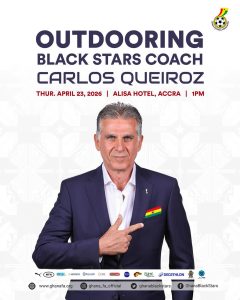
Expect him to outline his vision for the Black Stars, detail his preferred playing style and technical philosophy, discuss squad selection priorities, and field questions about the challenges ahead.
With only a couple of months until the tournament begins, the session will likely focus on how he plans to integrate the squad quickly, build cohesion, and address any lingering issues from recent campaigns.
Queiroz arrives with a resume that few coaches can match in terms of World Cup pedigree. Born in Mozambique but deeply rooted in Portuguese football, he first gained prominence as a youth coach, guiding Portugal’s Under-20 side to back-to-back FIFA World Youth Championship titles in 1989 and 1991.
Those triumphs helped nurture what became known as the Golden Generation, players like Luís Figo and Rui Costa who later shone on the senior stage. His senior international breakthroughs include qualifying South Africa for the 2002 World Cup and leading Portugal to the knockout rounds in 2010, where they reached the round of 16.
Perhaps his most notable achievement came during a lengthy spell with Iran, where he served as the longest-tenured coach in the country’s history. He guided them to three consecutive World Cup appearances (2014, 2018, and 2022), forging a disciplined, organized, and defensively resilient unit that often punched above its weight against stronger opponents.
His time with other national teams—such as Colombia, Egypt (where he reached the Africa Cup of Nations final in 2021), Qatar, and most recently Oman—further demonstrates his adaptability across different football cultures, player profiles, and competitive demands.
At club level, he has managed Sporting CP (winning the Portuguese Cup and Super Cup), had a spell at Real Madrid during the early Galácticos era (securing the Spanish Super Cup), and served two successful stints as Sir Alex Ferguson’s assistant at Manchester United, contributing to Premier League titles and the 2008 Champions League victory.
What stands out about Queiroz is his emphasis on structure, tactical discipline, and maximizing limited resources. He is known for setting up compact, hard-to-break-down teams that rely on organization, counter-attacking efficiency, and collective effort rather than individual flair alone.
His sessions are often described as detailed and methodical, focusing on shape, transitions, and set-piece execution. In environments where star power might be uneven or squad depth tested, this pragmatic approach has proven effective time and again.
For Ghana, which boasts talented players like Mohammed Kudus, Thomas Partey, Jordan Ayew, and others scattered across Europe’s top leagues, Queiroz’s methods could provide the tactical framework needed to turn potential into consistent performances.
Ghana earned their ticket to the 2026 World Cup by topping their African qualifying group with a solid campaign, finishing well clear of challengers like Madagascar. This will be their fifth appearance at the global finals, following outings in 2006 (where they reached the quarter-finals), 2010, 2014, and 2022.
However, recent World Cup showings have been disappointing, with early group-stage exits in the last two tournaments highlighting the need for better preparation, cohesion, and results against top-tier opposition.
The expanded 48-team format in 2026 offers more opportunities for progression from the group stage, but the draw has placed Ghana in a competitive pool featuring strong sides like England and Croatia alongside Panama.
Expectations must remain realistic given the short timeframe Queiroz has to work with the squad—friendly matches and training camps will be crucial in the coming weeks.
The timing of his arrival adds both urgency and excitement. With the tournament looming, there is little room for a lengthy rebuilding process. Queiroz will need to assess the current crop of players swiftly, identify any gaps in fitness or form, and instill his preferred system—often built around a solid defensive foundation with quick transitions forward.
Supporters hope his vast experience in navigating World Cup pressures, qualifying campaigns, and multicultural squads will help restore confidence and competitiveness. Past coaches have faced criticism for tactical rigidity or failure to get the best out of key individuals; Queiroz’s track record suggests he can blend discipline with motivation, drawing on lessons from working alongside legends like Ferguson while adapting to African football’s unique rhythms and passions.
In Ghana, football is more than a sport—it is a national unifier, a source of pride, and a platform for dreams. The Black Stars have historically produced moments of magic, from dramatic comebacks to heroic defensive displays.
Queiroz’s appointment has sparked a mix of optimism and calls for patience. Some see him as the steady hand needed to steady the ship after a period of transition, while others urge measured expectations given the compressed preparation window and the quality of opposition awaiting in North America.
His ability to communicate effectively, build trust within the camp, and make quick, impactful decisions on squad composition and strategy will be under the microscope from day one.
As the press conference approaches, the football community in Accra and beyond will be tuned in, eager for insights into how the new era will unfold. Will Queiroz favor a more defensive setup to frustrate stronger teams, or will he encourage the attacking flair that Ghanaian fans love?
How will he handle the integration of home-based players with those based abroad? What role will senior figures play in leadership, and how does he plan to freshen the squad without disrupting proven performers? These questions and more will likely dominate the conversation on Thursday.
Ultimately, Carlos Queiroz represents a bridge between proven international expertise and the aspirations of Ghanaian football. His journey from youth developer to World Cup veteran equips him with tools to elevate the Black Stars in a tournament that promises to be more inclusive yet fiercely competitive.
Success will hinge on rapid adaptation, smart selection, and fostering a united squad spirit. For now, all eyes turn to the Alisa Hotel, where the new coach will begin articulating the path forward—one that fans hope leads to memorable performances and renewed national pride when the World Cup whistle blows in June.
The coming months will test his methods, but his pedigree offers genuine reason for hope as Ghana steps onto the global stage once again.