
Forty-two years after one of the most painful chapters in Ghanaian football history, the Black Stars are back in Bouaké. Ghana’s squad landed in Côte d’Ivoire’s second city on Wednesday, 23 September 2026, a day before their opening 2027 Africa Cup of Nations qualifier against the Elephants at the Stade de la Paix.
The fixture is more than a Group C opener. It is a return to the ground where defending champions Ghana collapsed in 1984, finished third in their group, and watched a proud era begin to unravel. The city, the stadium, and the rivalry have all changed. The memory has not.
Ghana arrive under Carlos Queiroz after missing the 2025 AFCON in Morocco and exiting the 2026 World Cup in the last 32. Ivory Coast, three-time African champions and hosts of this first qualifier, begin a new cycle under returning coach Hervé Renard. Kick-off is 19:00 GMT on Thursday, 24 September. After that, Ghana fly home to face The Gambia in Accra on 29 September. Somalia complete the group.
For a generation of Ghanaian supporters, Bouaké is not just a venue. It is a word that still carries the weight of disappointment.
The Bouaké Debacle of 1984
Ivory Coast hosted the 1984 Africa Cup of Nations. Ghana arrived as four-time winners and holders after the 1982 triumph in Libya. The Black Stars of that era were still regarded as one of Africa’s aristocratic sides. Expectations at home were enormous. Anything short of another deep run would be treated as failure.
The eight-team tournament was split between Abidjan and Bouaké. Ghana were drawn in Group B with Nigeria, Algeria and debutants Malawi. All of those matches were staged at the then-Stade Municipal in Bouaké.
The campaign opened on 5 March 1984 with a 2-1 defeat to Nigeria. Henry Nwosu put the Super Eagles ahead. Samuel Opoku Nti equalised. Chibuzor Ehilegbu restored Nigeria’s lead before half-time. Three days later Algeria, already emerging as one of the continent’s most organised sides, won 2-0 through late goals from Djamel Menad and Tedj Bensaoula. A 1-0 victory over Malawi, scored by Seth Ampadu, arrived on the final matchday. It was too late. Ghana finished third with two points and were eliminated. Algeria topped the group. Nigeria went through in second.
The tournament became known in Ghana as the Bouaké Debacle. Reports from the camp spoke of disunity. Selection decisions were later criticised. Former great Mohammed Polo would recall an attack crowded with left-footed players and a late coaching change that unsettled the side. After the team returned home, then-head of state Jerry John Rawlings dissolved the senior national team. Ghana failed to qualify for the next three AFCONs. A golden generation had been broken in a single week in central Ivory Coast.
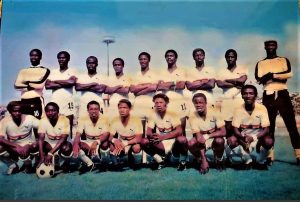
Ghana returned to Ivory Coast for the 2023 AFCON, but the Black Stars never played in Bouaké. All three group games were staged in Abidjan: a 1-2 loss to Cape Verde and a 2-2 draw with Egypt at the Stade Félix-Houphouët-Boigny, then a 2-2 draw with Mozambique at the Alassane Ouattara Stadium. Ghana finished third in Group B with two points and failed to reach the knockout stage. Forty-two years after the 1984 group-stage exit in Bouaké, another third-place finish on Ivorian soil ended in elimination. The Black Stars still have not played a competitive match in Bouaké itself since March 1984.
That is why this week’s trip feels different from an ordinary qualifier. The city has waited four decades for Ghana to come back.
A transformed stadium, same city
The venue has changed beyond recognition. Originally built for the 1984 tournament and later known as Stade Municipal, it was renamed Stade de la Paix after the 2007 peace process that followed Ivory Coast’s civil war. A major renovation completed ahead of the 2023 AFCON raised capacity to 40,000, added a roof and modern facilities, and turned the old municipal ground into one of the country’s flagship arenas.
Bouaké itself carries layered meaning. During the 2002–2007 conflict it served as the rebel capital of the north. Didier Drogba’s 2007 visit and a subsequent qualifier there became symbols of national reconciliation. The “Peace Stadium” name is not ornamental. It marks a city that once stood at the fault line of a divided country and later became a stage for unity.
Using Bouaké rather than Abidjan for this qualifier also spreads the national team beyond the commercial capital. Ivory Coast have made a habit of taking big matches to the country’s second city. For Ghana, the symbolism cuts the other way. The stands that once watched them fall as champions now wait for a much younger, much more patched-together Black Stars side.
Thursday’s match will be played under floodlights. Queiroz’s players were scheduled to hold their final training session at the stadium on Wednesday evening, giving them one night to walk the pitch their predecessors last used in 1984.
Two West African powers, two coaches with history
This is one of West Africa’s defining rivalries. Ghana have won the AFCON four times, the last of them in 1982. Ivory Coast have three titles, including the 2023 triumph on home soil. They have met in two AFCON finals. Both were goalless after extra time. Both were decided on penalties in Ivory Coast’s favour: 11-10 in Dakar in 1992, and 9-8 in Bata in 2015.
The 1992 final remains one of the most extraordinary nights in African football. Every outfield player and both goalkeepers took a penalty. The 2015 final, staged in Equatorial Guinea, again went the distance before the Elephants prevailed. Those two nights sit at the centre of the modern rivalry. Competitive meetings since then have been infrequent. A 2021 friendly in Cape Coast finished 0-0.
The coaches add another layer. Ghana are led by Carlos Queiroz, the Portuguese tactician who took charge before the 2026 World Cup and turned a struggling side into a compact, defensively stubborn unit. Ghana reached the last 32, drew 0-0 with England, and exited after a 1-0 defeat to Colombia. Queiroz has spoken of a “fantastic group” and of treating the next match as the only trophy that matters.
Ivory Coast are under Hervé Renard in his second spell. Renard won the 2015 AFCON with the Elephants — the same tournament in which Ghana were beaten on penalties in the final. He earlier lifted the trophy with Zambia in 2012. He returned after Emerse Faé’s contract was not renewed following Ivory Coast’s last-32 World Cup exit to Norway. Renard has called Thursday “a big clash in African football” and warned his players that Ghana will not be an easy opponent.
Two experienced European coaches, two former champions, one border, and a stadium that remembers Ghana’s lowest AFCON night. That is the setting.
A depleted Ghana side faces a difficult start
Qualification matters more than atmosphere. Ghana missed the 2025 AFCON in Morocco. The 2027 finals will be co-hosted by Kenya, Tanzania and Uganda. Group C also includes The Gambia and Somalia. Two teams advance from each group of four. Starting away to the defending African champions is the hardest possible opening.
Queiroz’s squad has been hit hard. Mohammed Kudus, Antoine Semenyo, Jordan Ayew, Thomas Partey, Baba Rahman, Alidu Seidu and Nathaniel Adjei are among those unavailable through injury or personal reasons. Kudus had been named after a long hamstring layoff that cost him the World Cup, then withdrew to complete his recovery. Semenyo’s absence removes another of Ghana’s most direct attacking threats. Captain Ayew’s withdrawal strips the side of leadership and experience in the final third.
The coach has responded by bringing in reinforcements. Osasuna defender Rockson Yeboah earns a first senior call-up after breaking into La Liga. Rahim Ibrahim of Slovan Bratislava is another new face. Brandon Thomas-Asante, Felix Afena-Gyan, Jonas Adjetey, Benjamin Tetteh and others have been added to cover the holes. Players who travelled include Abdul Fatawu Issahaku, Felix Afena-Gyan and Benjamin Tetteh. Eighteen players trained in Accra on Tuesday before the Wednesday flight.
Ivory Coast are not at full strength either. Amad Diallo is injured. Evann Guessand and Omar Diakité were omitted. Renard still has Franck Kessié, Ibrahim Sangaré, Nicolas Pépé and Real Madrid’s Yan Diomande available. Home advantage and a passionate Bouaké crowd will be significant. Predicted line-ups in the days before the match pointed to a Ghana side built around Fatawu, Thomas-Asante and Ernest Nuamah in attack, with a reshaped defence in front of Benjamin Asare.
Queiroz’s reputation rests on organisation. That quality will be tested immediately. A point in Bouaké would be valuable. A defeat would not end the campaign, but it would leave Ghana needing results against Gambia and Somalia and then a strong showing in the reverse fixture against Ivory Coast in March 2027.
More than three points
For Ghanaian football the trip is freighted with memory. The 1984 squad arrived as continental kings and left as also-rans. The 2023 squad arrived in the same country, played in a different city, finished third again, and went home early. The current side arrives as a team still rebuilding after missing one AFCON and exiting the World Cup in the last 32.
A positive result in Bouaké would not erase 1984. It would not rewrite 2023. It would, however, change the opening line of this qualifying story. Queiroz has framed it simply: you cannot stand on the roof without climbing the steps, and the first step is the next match.
The Black Stars have touched down. The stadium that once hosted their lowest AFCON moment now waits for them again. Forty-two years later, the ghosts of Bouaké will be watching.