
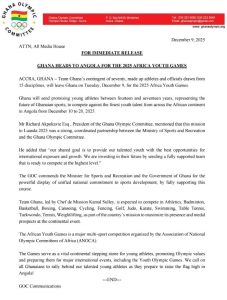
Team Ghana departed Kotoka International Airport this morning, December 9, 2025, bound for Luanda, Angola, carrying the hopes of a nation determined to see its next generation of stars rise on the continental stage.
The 70-member delegation—athletes aged fourteen to seventeen alongside coaches, medical staff and officials—will compete in the 4th African Youth Games from December 10 to 20 in what is Angola’s first time hosting a major multi-sport event on African soil.
The journey itself is a statement. Fully funded by the Government of Ghana through the Ministry of Sports and Recreation, the expedition removes every financial and logistical burden from the young athletes’ shoulders so they can focus solely on performance.
Speaking just hours before departure, Mr Richard Akpokavie Esq., President of the Ghana Olympic Committee, described the mission as the clearest evidence yet of genuine collaboration between his organisation and the Ministry. “We have moved from words to action,” he said. “This is a fully supported team travelling with everything it needs to compete at the highest level and return with pride, experience, and, we believe, medals.”
Leading the contingent is Chef de Mission Kamal Sulley, a calm and respected administrator who has overseen several successful international outings. Under his guidance, Ghana will field competitors in athletics, badminton, 3×3 basketball, boxing, canoeing, cycling, fencing, golf, judo, karate, swimming, table tennis, taekwondo, tennis and weightlifting.
The selection reflects both Ghana’s traditional strongholds—athletics and boxing have produced Olympic and Commonwealth champions in the past—and a deliberate push into emerging disciplines where the country believes it can surprise the continent.
These are not just any teenagers. Many have already dominated national school championships, shattered age-group records, or stood on podiums at West African junior events.
They are the best Ghana has identified in their age bracket, hand-picked after months of trials, training camps and monitoring. For most, Luanda will be their first taste of international competition outside ECOWAS or Commonwealth Youth Games, and the step up in standard will be steep.
They will face the finest fourteen- to seventeen-year-olds that Egypt, Nigeria, South Africa, Algeria and the host nation can produce, often in brand-new venues built specifically for these Games.
The African Youth Games, organised every four years by the Association of National Olympic Committees of Africa (ANOCA), have grown into much more than a junior tournament.
They are now recognised as the primary continental pathway to the Youth Olympic Games and, for a select few, a springboard to senior global success.
Past participants have gone on to win senior African titles, Commonwealth medals and even Olympic bronze and silver. Ghana knows this history well and views Luanda 2025 as critical investment in the production line that delivered the likes of Azumah Nelson, Ignatius Gaisah and the current senior Black Stars and Black Queens.
Angola has pulled out all the stops. New indoor arenas in Luanda and refurbished stadiums in Benguela and Cabinda will host the competitions, while the opening ceremony tomorrow evening is expected to blend Angolan cultural spectacle with the energy of over three thousand young athletes from all fifty-four African nations.
The weather—warm, humid, with the chance of sudden tropical downpours—will test endurance, especially for the track athletes and cyclists, but the Ghanaian camp has trained in similar conditions at Cape Coast and the Accra Sports Stadium to be ready.
Back home, the departure has been greeted with optimism tempered by realism. The Ghana Olympic Committee has not set a public medal target—wisely, given the youthfulness of the team—but officials speak privately of hoping to finish inside the top fifteen nations and to bring home at least five gold medals, particularly in boxing, weightlifting and the sprints.
More important than the final tally, they insist, is the experience these teenagers will gain: learning to manage nerves in a packed stadium, adapting to unfamiliar food and time zones, and measuring themselves against the best Africa has to offer.
Ten days in Luanda will shape careers, forge lifelong friendships across borders, and remind an entire continent that Ghana’s passion for sport burns as brightly in its youth as it ever has in its legends.