


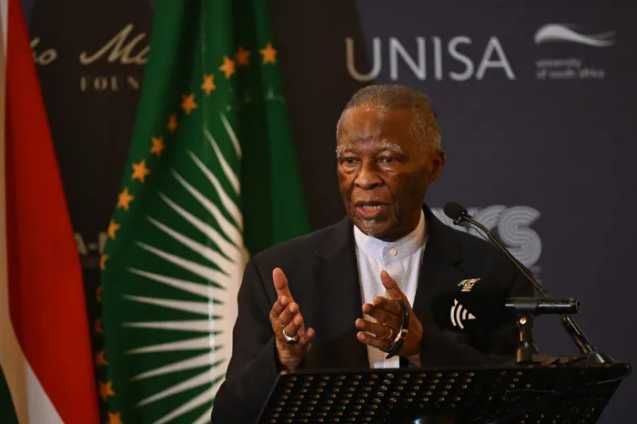
Former South African President Thabo Mbeki has launched a strong defence of African migrants.
He warns that growing hostility toward foreign nationals is based on a false narrative that distracts from the real causes of South Africa’s economic challenges.
Speaking at the Thabo Mbeki Foundation and AUDA-NEPAD Business Breakfast, Mbeki argued that undocumented African migrants are being unfairly blamed for unemployment and crime, while those responsible for the country’s economic decline escape scrutiny.
His remarks come days after nearly 300 Ghanaians voluntarily returned home from South Africa amid heightened fears following anti-immigrant protests and growing concerns about the safety of foreign nationals.
“We’ve got many problems here. The problem legitimately led to high levels of unemployment; that’s correct. High levels of crime, that’s correct. But the finger is being pointed at the wrong people,” Mbeki said.
He rejected suggestions that undocumented African migrants were responsible for South Africa’s unemployment crisis.
“The levels of high unemployment in this country are not due. They are not due to undocumented Africans. They are not,” he stressed.
Mbeki said South Africa’s economic difficulties were rooted in developments that long predated the current immigration debate.
“We know the history in detail of how South Africa, from 1994 to 2002, 2008, 2009, can’t go up like this. Growth rates reach 6% from 2009 onward, going in the opposite direction. It isn’t caused by undocumented immigrants.”
According to him, those truly responsible for the country’s economic decline have escaped public criticism because attention has been diverted elsewhere.
“The people who cause that will look at it, that decline, they are laughing in a corner there, because we’re pointing not at them, but we’re pointing somewhere else is wrong,” he said.
Mbeki predicted that migration into South Africa would continue regardless of political pressure or anti-immigrant sentiment.
“So, one prediction I will make is that the Africans will continue to come to South Africa. It doesn’t matter what you do,” he said.
He argued that South Africans must find practical ways of managing migration rather than turning migrants into scapegoats for broader structural problems.
“You are not going to solve the problem of unemployment here by shouting against undocumented Africans and leaving the culprit,” he said.
“The culprits are sitting here. I can even tell you their names, but we’re pointing fingers at the wrong people.”
In one of the strongest moments of his address, Mbeki accused anti-immigrant campaigners of pursuing the wrong targets.
“What are we doing to say to the South Africans, the positions you are taking on this and that are wrong? Here is the truth: you are busy chasing after ghosts, and you are leaving this devil.”
He urged South Africans to confront the real causes of unemployment and economic hardship rather than embrace what he described as fiction.
Mbeki also appealed for greater recognition of the historic bond between South Africans and the rest of the continent.
“People are beating drums about the wrong people and failing to understand an organic connection between these Africans on the continent and these Africans here, because we’re together in the same struggle, you can’t certainly turn against them,” he said.


