


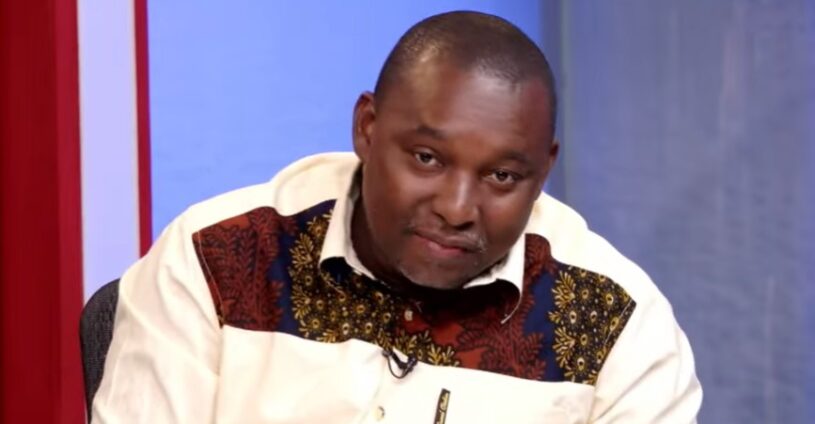
Solomon Owusu, Director of Communications of the United Party, has proposed that the government consider private-sector financing for the proposed expressway, arguing that such an arrangement could save about US$4 billion for the construction and rehabilitation of inner roads across the country.
Speaking on Ahotor FM’s Morning Show in Accra on Tuesday, September 15, 2026, Solomon Owusu said the United Party would continue to speak truth to power and support initiatives that are in the interest of Ghanaians.
He defended President John Dramani Mahama’s proposed expressway project and questioned why some politicians would seek to discourage the government from pursuing it.
He particularly criticised the immediate past Roads Minister, Asenso-Boakye, for writing to President Mahama to question the feasibility of the expressway project.
According to Solomon Owusu, Asenso-Boakye served as Roads Minister at a time when sections of the Accra-Kumasi road deteriorated, yet he is now questioning a major road project intended to improve transportation infrastructure.
He argued that Ghana’s major challenge is not necessarily a lack of resources but corruption, financial mismanagement and the misuse of public funds.
“Politicians have succeeded in making it look as if Ghana does not have money. They have made poverty appear to be part of our daily lives, as if without borrowing we cannot do anything,” he said.
Solomon Owusu maintained that Ghana could finance many of its development projects if public resources were properly managed, citing financial irregularities contained in reports of the Auditor-General.
He also questioned the expenditure of US$100 million on what he described as a project that amounted to “digging a hole,” arguing that resources could instead be directed towards roads that directly benefit the Ghanaian people.
He questioned whether the proposed expressway would cost about US$4 billion, and asked why the country could not mobilise such resources locally if there was proper financial management.
According to him, the expressway project is significant because, in his view, this is the first time Ghanaians are hearing that funding has already been secured for a major road project.
He also praised the government for involving the Ghana Armed Forces in road works, saying the speed at which the military has undertaken some projects demonstrates that alternative approaches to road construction can produce better results.
Solomon Owusu therefore called for delayed road contracts to be reviewed and, where necessary, terminated and reassigned to the Ghana Armed Forces or competent Ghanaian contractors.
He commended the Minister for Roads and Highways for regularly visiting project sites to inspect ongoing works, saying the minister’s presence on the ground is helping to put pressure on contractors to deliver.
He argued that contractors and engineers who fail to perform their responsibilities should not be allowed to continue holding onto road contracts.
He further welcomed President Mahama’s suggestion that some delayed road projects could be handed over to the Ghana Armed Forces, particularly where contractors have failed to complete projects within agreed timelines.
Solomon Owusu also called for proper inspection and certification of completed roads before contractors are paid, warning against situations where contractors claim to have completed projects only for the roads to deteriorate shortly afterwards.
He said the United Party’s priority is to ensure that capable Ghanaian contractors are given opportunities to execute road projects and deliver quality work.
On the expressway, he proposed that government should invite the private sector to finance and construct the project using their own resources.
According to him, private investors could be allowed to operate tolling arrangements for a specified period, such as 20 years, to recover their investment and settle their financing obligations.
He argued that this could allow government to preserve the estimated US$4 billion for the rehabilitation and construction of inner roads across the country.
“Give the private sector 20 years to toll the road and pay their debt, so that the four billion dollars can be used for our inner roads,” he proposed.
He stressed that the United Party would support the expressway whether it is financed directly by government or through private-sector participation, provided the arrangement serves the national interest.
Solomon Owusu further cautioned politicians against opposing the project purely for political reasons, insisting that initiatives that can improve Ghana’s road infrastructure and ease transportation challenges should receive bipartisan support.
Story by Stephen Kwaku Owusu Mintah/Ahotoronline/Accra.


