


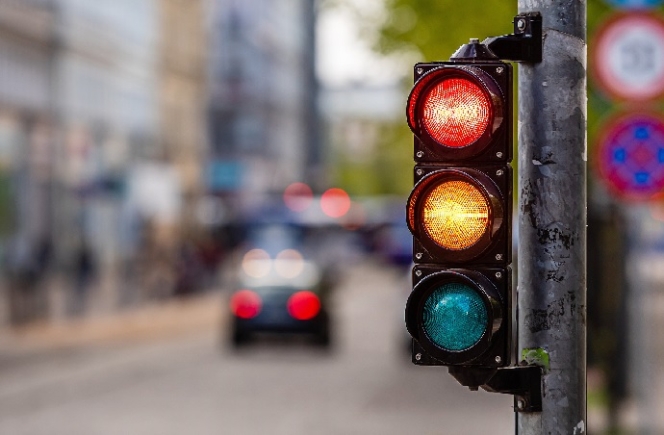
TEMA, Ghana, 19th September: Secretary-General of the Ghana Federation of Labour (GFL), Abraham Koomson, has questioned the decision by the Ghana Police Service to roll out its automated traffic law enforcement system, TRAFFITECH-GH, amid persistent malfunctioning traffic lights in parts of Accra and Tema.
According to Mr Koomson, authorities should first address the challenges confronting existing traffic management infrastructure before introducing a new technology-driven system to enforce road traffic regulations.
His comments follow the announcement by the Ghana Police Service that it will begin the full implementation of TRAFFITECH-GH from October 1, 2026, as part of efforts to improve compliance with road traffic laws.
The programme, being implemented through the Motor Traffic and Transport Department (MTTD), will deploy cameras and Personal Digital Assistant (PDA) devices to detect traffic offences on the country’s roads.
Under the system, offences captured by the technology will be reviewed before Electronic Notices of Violation (ENV) are issued to affected vehicle owners or drivers.
The electronic notices, which will be sent via SMS, will contain details of the traffic offence committed and the prescribed fine applicable to the violation.
The Police Service says the automated enforcement system is intended to strengthen enforcement, address indiscipline among road users and contribute to reducing road traffic crashes and related casualties.
The Service has consequently urged motorists, drivers and vehicle owners to comply with road traffic regulations and support the implementation of TRAFFITECH-GH.
However, speaking on Ahotor FM’s Yepe Ahunu programme on Saturday, September 19, 2026, Abraham Koomson expressed concern about the state of traffic lights in Accra and Tema.
He said several traffic lights in the two cities are not functioning properly, with some intersections having only the red and yellow lights working while the green lights remain dysfunctional.
Mr Koomson argued that the situation could create confusion and increase the risk of accidents, particularly at busy intersections.
He suggested that where traffic lights are not functioning, they should be switched off completely and traffic police officers deployed to direct the flow of vehicles until the faults are fixed.
He acknowledged that the Police Service’s decision to introduce an automated system to monitor road traffic offences is a positive step, but questioned whether the country had the capacity to properly maintain the technology once it is deployed.
Mr Koomson also expressed concern that Ghana may be moving too quickly to adopt a system modelled on practices used in other countries without first addressing some of the basic traffic management challenges confronting the country.
He called for the necessary infrastructure and maintenance systems to be put in place to ensure that the new enforcement regime is effective, reliable and fair to road users.


