


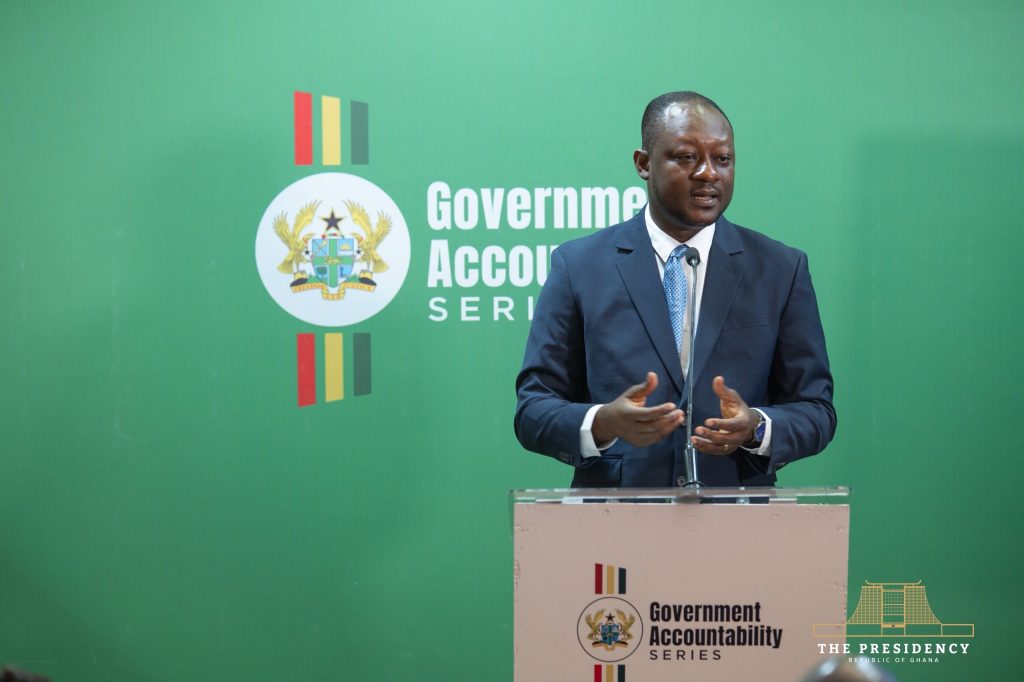
ACCRA, Ghana, 26th October: The Managing Director of the Tema Oil Refinery (TOR), Edmond Kombat, says the restoration of domestic refining operations has strengthened Ghana’s ability to withstand disruptions in international petroleum supplies.
He said the refinery’s renewed operations, alongside other domestic production and government interventions, helped protect the country from the full impact of international supply disruptions associated with the Iran conflict.
Mr Kombat made the remarks during the Government Accountability Series at the Presidency where he outlined the importance of local refining to Ghana’s energy security.
He cited President John Dramani Mahama’s remarks at the commissioning of TOR’s refurbished Crude Distillation Unit on August 1, 2026, that Ghanaian consumers were largely spared the effects of the Iran conflict on fuel supply because of the role played by the refinery.
According to Mr Kombat, without the restoration of TOR and other domestic production, fuel prices during the last two pricing windows could have ranged between GH¢22 and GH¢32 per litre.
The figure represents the Managing Director’s assessment of what prices could have been without those interventions.
Local refining and fuel security
Mr Kombat said TOR’s return to operations had strengthened Ghana’s petroleum supply chain by increasing the availability of locally refined products.
He explained that the refinery’s nameplate capacity of 45,000 barrels per stream day was equivalent to roughly 35 per cent of the 128,000 barrels of clean petroleum products Ghana imported daily in 2025.
He said increasing domestic refining capacity would reduce the volumes of finished products the country needs to import and help protect consumers when international supply chains face disruptions.
The refinery resumed crude processing on December 19, 2025, after years of inactivity.
Since May 2026, it has received several crude cargoes, including Bonga, Baleine, Bonnie Light and Ghana’s Jubilee Medium Sweet crude. It also received a 950,000-barrel cargo of Ghanaian Sankofa crude on September 25, 2026.
Mr Kombat said the renewed supply of crude reflected growing confidence among suppliers and business partners.
Stronger regional petroleum trade
The TOR Managing Director also disclosed that Burkina Faso’s national oil company had increased the share of its petroleum product movements through Ghana from 15 per cent in 2024 to 40 per cent as of October 2026.
He attributed the increase to improved cooperation between TOR, the National Petroleum Authority, the Bulk Oil Storage and Transportation Company and other petroleum service providers.
According to him, the refinery’s recovery has strengthened Ghana’s role in the supply of petroleum products to neighbouring countries, including those in the Sahel region.
He said management is also pursuing offtake partnerships to increase the supply of locally refined products, improve security of supply and support greater price stability at the pump.
TOR’s engagement with GOIL on September 2, 2026, is among the initiatives intended to advance those objectives.
More crude processing planned
Despite the progress, Mr Kombat acknowledged that TOR is not yet operating at its full capacity.
He said the refinery is processing about 28,000 barrels per day, with engineers working to increase throughput to between 45,000 and 55,000 barrels per day.
The company also has longer-term plans to expand capacity to 100,000 barrels per day and eventually 200,000 barrels per day.
Mr Kombat said the broader objective was to establish TOR as a commercially viable refinery capable of supporting Ghana’s energy security, industrial development and petroleum supply needs.
Story by: Emmanuel Romeo Tetteh(#RomeoWrites✍️) Presidential Affairs Correspondent | Ghana 🇬🇭


