


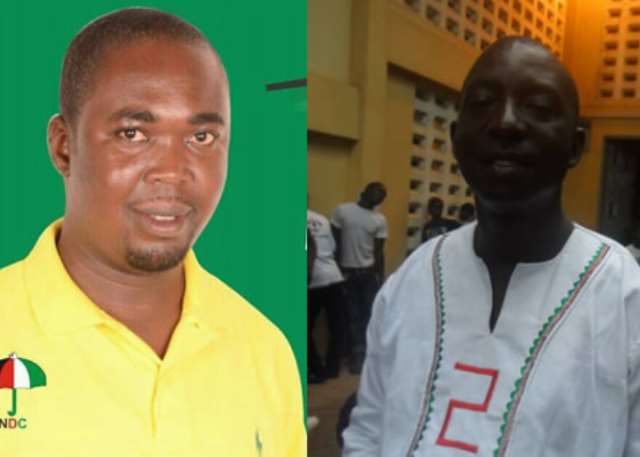
The contest for the Eastern Regional Chairmanship of the National Democratic Congress (NDC) brought together two familiar figures in the party’s regional political landscape: former Regional Chairman Bismark Tawiah Boateng and former Regional Secretary Dr. Mark Oliver-Kevor.
For the NDC, it was more than a contest between two personalities. It was a contest that brought questions of leadership, organisation and the future direction of the party into sharp focus in a region where the NDC has had to work persistently to strengthen its electoral fortunes.
Both men entered the race with considerable experience within the party.
Boateng was not a newcomer seeking to establish himself. He had previously occupied the regional chairmanship, having won the position in 2014 with 129 votes. His decision to return to the contest therefore carried the weight of previous experience and familiarity with the regional party structure.
Oliver-Kevor, meanwhile, brought his own record of party organisation to the race. He had previously served as Eastern Regional Secretary before putting himself forward for the chairmanship. His candidacy represented a progression from one of the region’s key organisational positions to the highest elected office in the regional party structure.
The stage was thus set for a contest between two experienced party actors—one seeking a return to the chairmanship and the other seeking to make the transition from secretary to chairman.
A contest of experience
Boateng’s case rested, in part, on his familiarity with the regional party structure.
Having previously served as chairman, he could point to first-hand experience of leading the party at the regional level, navigating its internal dynamics and working with constituency executives and grassroots supporters.
His return bid therefore presented delegates with a question of continuity: should the experience of a former regional chairman once again guide the party?
Oliver-Kevor offered a different proposition.
His tenure as Regional Secretary had placed him at the heart of the party’s organisational work. He had been involved in the coordination of party activities and maintained relationships within the regional structure.
His campaign consequently became a test of whether delegates were prepared to entrust the party’s leadership to a figure seeking to build on his experience as secretary and offer a different approach to regional administration.
The contrast gave the election much of its political significance: Boateng represented a return to a previously held position, while Oliver-Kevor sought elevation from regional secretary to chairman.
The numbers tell part of the story
When delegates finally went to the polls in November 2022, Oliver-Kevor emerged as the new Eastern Regional Chairman.
The outcome ended Boateng’s bid to return to the position and marked a significant step in Oliver-Kevor’s political journey within the regional party structure.
For Boateng, the result demonstrated that previous occupancy of the chairmanship and years of political experience did not automatically guarantee a return to office.
For Oliver-Kevor, victory represented the culmination of a progression through the regional party structure—from secretary to chairman.
Yet the figures from an internal party election tell only part of the story.
Behind every delegate vote are relationships, networks, expectations and perceptions about the direction a party should take. Internal elections are therefore as much about organisation and confidence as they are about the candidates themselves.
Beyond the personalities
The Boateng-Oliver-Kevor contest also reflected a broader question confronting the NDC in the Eastern Region: how to build a stronger, more cohesive and competitive party organisation.
The Eastern Region has traditionally been a challenging electoral environment for the NDC. That reality places considerable importance on the effectiveness of its regional and constituency structures, as well as its ability to mobilise supporters at the grassroots.
The regional chairman’s responsibilities consequently extend well beyond the internal administration of the party.
The position requires engagement with constituency executives, parliamentary candidates, elected representatives, activists and other stakeholders, while also managing competing interests within the party.
In that context, the contest was not simply about who would occupy the regional chairman’s office. It was also about which leadership could command the confidence of delegates and provide the organisational direction required to advance the party’s broader political objectives.
A relationship that predates the contest
Interestingly, the political relationship between Boateng and Oliver-Kevor predates their rivalry for the chairmanship.
The two men had previously operated within the same regional leadership structure and were both involved in the NDC’s regional activities.
That shared history adds another dimension to the contest.
They were not political outsiders confronting an unfamiliar organisation. Both had already established themselves within the party’s regional machinery and had experience of its internal workings.
Their eventual competition illustrates a familiar feature of political parties: individuals who work together within one leadership arrangement can, at a later stage, find themselves competing for the same position.
Political relationships evolve, ambitions change and alliances can be reshaped by the demands of internal party politics.
What the contest revealed
The election demonstrated that political experience can take different forms.
Boateng brought the experience of a former regional chairman. Oliver-Kevor brought experience from the position of regional secretary. Ultimately, however, it was the delegates who determined which candidate would lead the regional organisation.
The outcome also underlined the central role of delegates in shaping the leadership of Ghana’s political parties. However influential a candidate may appear within the wider political environment, an internal election is ultimately decided by those entitled to vote.
For the NDC in the Eastern Region, however, the challenge did not end with the declaration of the results.
The party had to manage the aftermath of the contest, reconcile competing interests and ensure that the energy generated by the election could be channelled into organisational work.
That is often the more difficult task following an internal political contest.
The bigger political question
The Boateng-Oliver-Kevor contest can be viewed as part of a recurring feature of Ghanaian party politics: internal elections frequently become occasions for parties to debate their direction through the personalities seeking leadership.
But the personalities are only one part of the equation.
The deeper questions concern the structures behind them.
Who can maintain an effective relationship with the grassroots? Who can bring competing interests together? How can internal disagreements be managed without weakening party structures? And how can regional organisation be translated into sustained electoral support?
These questions are particularly important for the NDC in the Eastern Region, where strengthening the party’s organisational base remains an ongoing political task.
Beyond the result
The November 2022 election provided the immediate answer to the question of who would lead the NDC in the Eastern Region, with Dr. Mark Oliver-Kevor emerging as Regional Chairman.
But the longer political significance of the Boateng-Oliver-Kevor contest lies beyond the result sheet.
It offers a window into the dynamics of internal party competition, leadership transition and the struggle to consolidate political organisations at the regional level.
For Boateng, the contest represented an attempt to reclaim a position he had previously held.
For Oliver-Kevor, it marked a transition into the region’s top elected party office.
For the NDC, however, the enduring challenge was—and remains—how to transform internal leadership contests into stronger structures, greater cohesion and an organisation capable of competing effectively across the Eastern Region.
The battle for the chairmanship may have ended at the ballot box. The larger battle for organisational strength, unity and electoral relevance continues.


