


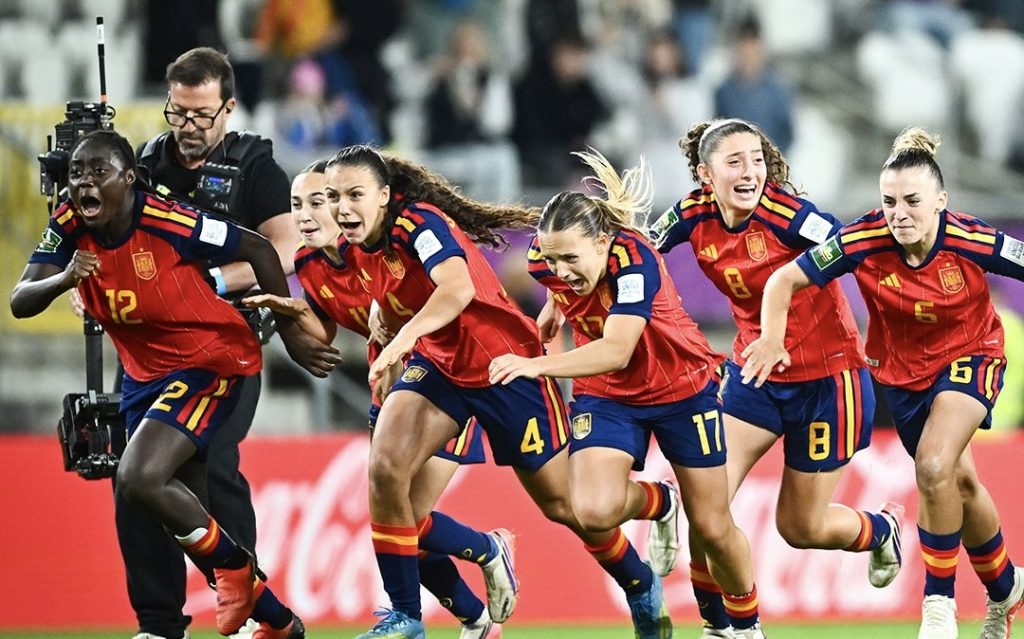
Spain are FIFA U-20 Women’s World Cup champions once again. In Łódź on Sunday, 27 September 2026, La Rojita defeated defending champions DPR Korea 4-3 on penalties after 120 minutes without a goal, reclaiming the title they first won in Costa Rica four years earlier and completing a night that felt both like revenge and like the latest chapter in a period of Spanish football that now stretches across almost every major stage.
The final was a meeting of two undefeated sides. Spain arrived with 21 goals scored and only one conceded through six matches; DPR Korea, winners in 2024, had scored 16 and had not been breached at all, becoming the first team in the history of the competition to keep a clean sheet through an entire tournament.
The match itself was tense, technical and largely defined by two outstanding goalkeepers. Pak Ju Gyong kept DPR Korea alive with a string of saves, denying Alba Cerrato, Pau Comendador, Rosalía Domínguez and, in extra time, the substitute Marisa García on more than one occasion.
At the other end Laia López, the Real Madrid goalkeeper, produced a vital first-half intervention when she rushed from her line to block Ho Kyong after a defensive error. Spain finished with 22 shots to nine and 69 percent possession, but the score stayed 0-0 through extra time.
The shootout reversed the script of the 2024 U-17 Women’s World Cup final, when many of the same players had lost to the same opponent on penalties. Ho Kyong scored first for DPR Korea. Marisa García equalised. López then saved from Choe Yon A. Celia Segura, Carla Julià and Daniela Agote all converted for Spain.
After Jon Il Chong made it 3-3, Agote put Spain 4-3 ahead and López saved the fifth Korean kick from Pak Il Sim. Spain had taken all four of their penalties. López was awarded the Golden Glove. Pau Comendador took the Golden Boot with six goals. Rosalía Domínguez was named player of the tournament. It was Spain’s second U-20 Women’s World Cup title.
The result sits inside a broader Spanish hegemony that has become difficult to overstate. In July the senior men’s team won the FIFA World Cup in the United States, beating Argentina 1-0 after extra time in East Rutherford through a Ferran Torres goal and becoming the first nation to hold the men’s and women’s senior World Cups at the same time.
The women had already won the 2023 World Cup in Australia and New Zealand. Luis de la Fuente’s men are also European champions from 2024, having beaten England in the Berlin final after a tournament in which they won every match. The women added the UEFA Women’s Nations League in 2024, beating France 2-0 in Seville, and retained it in 2025 by defeating Germany 3-0 on aggregate, with the decisive second leg won 3-0 in front of a record home crowd at the Metropolitano.
The conveyor belt beneath those senior sides has been just as productive. In July 2026 the men’s under-19 team won a record-extending tenth European title in Wales, beating Germany 2-0 in the final in Wrexham and going through the entire tournament without conceding.
The women’s under-19 side, many of whose players featured in Poland, won a fifth consecutive European Championship and an eighth overall, beating Germany 1-0 in Sarajevo through an Irune Dorado goal.
Several of those same names — López, Comendador, Domínguez, Cerrato, Dorado, Segura — now have another world title. Spain’s youth system has become a machine that feeds both the present and the next cycle, and the U-20 victory in Łódź is the newest proof that the pipeline is still delivering.
What happened in Poland was not an isolated youth result. It was the latest expression of a national project that now simultaneously holds the men’s World Cup, the women’s World Cup, the men’s European Championship, the Women’s Nations League, the men’s and women’s under-19 European titles, and the U-20 Women’s World Cup.
The penalty drama against DPR Korea, the saves of Laia López, and the composure of a group that had already lost a world final to the same opponent two years earlier are the details of one night.


