


Ghanaian dancehall artiste Shatta Wale has joined the growing national conversation over the regulation of TikTok and other new media platforms, calling for a legal framework that tackles online abuse without undermining freedom of expression.
The musician made the call in an open letter dated September 28, 2026, addressed to President John Dramani Mahama, following the President’s recent remarks at a town hall meeting with Ghanaians in New York.
During the September 25 town hall, President Mahama called for a national stakeholder discussion on how Ghana should regulate TikTok and other emerging platforms.
He raised concerns about misinformation, insults, anonymous accounts and information integrity, while also acknowledging the need to protect free expression.
Responding to the President, Shatta Wale argued that Ghana needs clear rules for serious and proven online misconduct, particularly defamation, harassment, threats and abuse.
However, he stressed that any new framework must clearly protect legitimate criticism, journalism, satire and political expression.
The musician’s proposal calls for Parliament, the Judiciary, security agencies, media organisations and civil society to work together in developing the framework.
He also advocated due process, independent judicial oversight and proportionate sanctions for offences established under the law.
Shatta Wale said his position was partly informed by his own experience as a high-profile public figure who has faced what he describes as unverified allegations and public ridicule.
He argued that online abuse did not begin with social media, but that platforms such as TikTok and other digital networks have significantly increased the speed and reach at which information, allegations and commentary can spread.
He further pointed out that the issue extends beyond celebrities, affecting journalists, businesspeople, traditional leaders, politicians, public officials and ordinary citizens.
Another key part of Shatta Wale’s proposal concerns accountability for anonymous social media accounts.
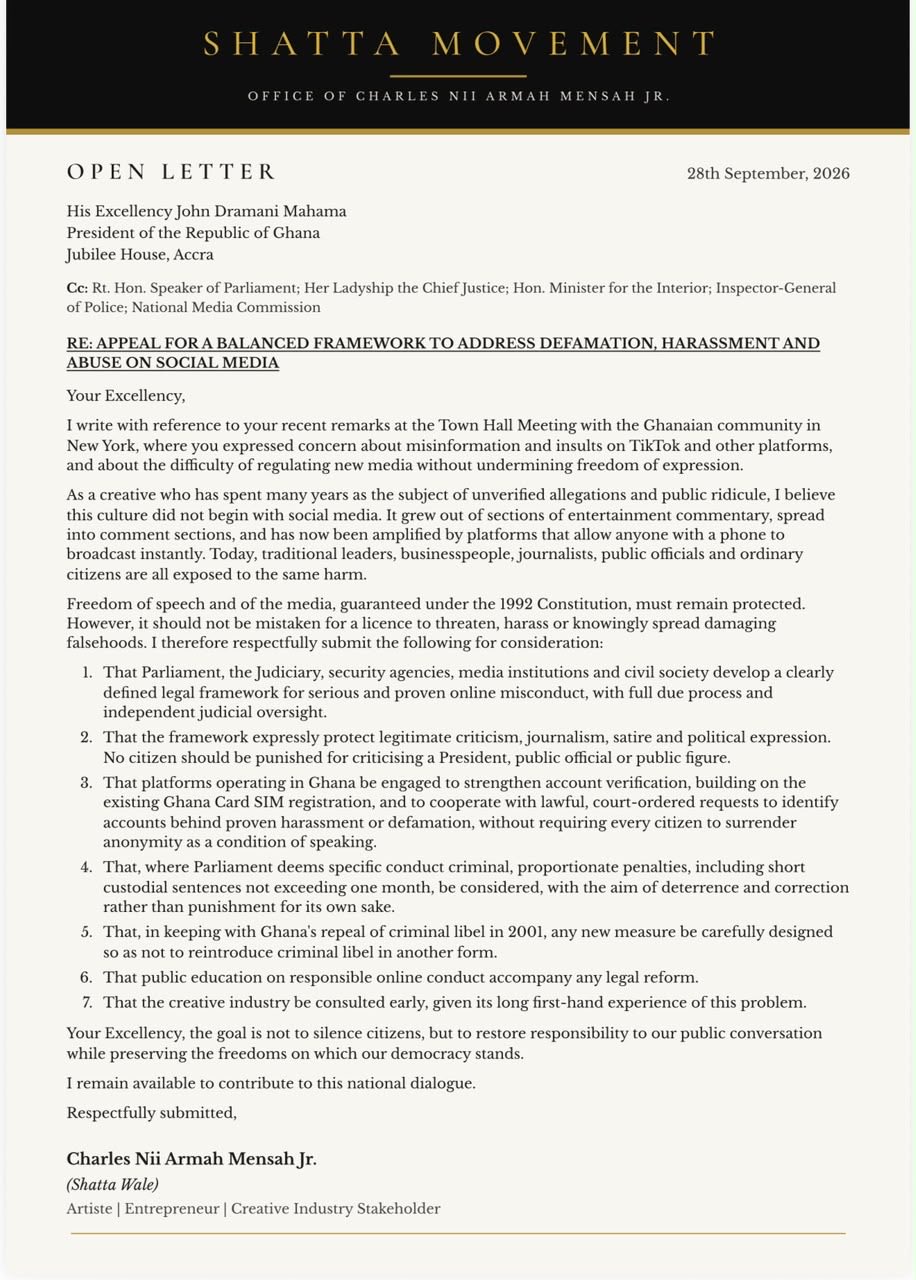

He suggested that platforms operating in Ghana could strengthen account verification, potentially building on existing identification systems, while cooperating with lawful, court-ordered requests to identify accounts involved in proven cases of unlawful conduct.
At the same time, he cautioned against completely eliminating anonymity, arguing that anonymous expression should not automatically be treated as misconduct.
Shatta Wale also urged caution in drafting any new legislation so that efforts to address online abuse do not effectively bring back criminal libel in another form.
Beyond legislation, he called for public education on responsible social media use and encouraged the government to involve representatives of the creative industry in the discussions.
For Shatta Wale, the conversation is ultimately about finding a line between accountability and freedom—ensuring that harmful online conduct can be addressed while citizens remain free to criticise leaders, express political opinions, engage in journalism and use satire.
His intervention adds a prominent voice from Ghana’s entertainment industry to what is increasingly becoming a wider national discussion about the future of social media and free expression in Ghana.


