


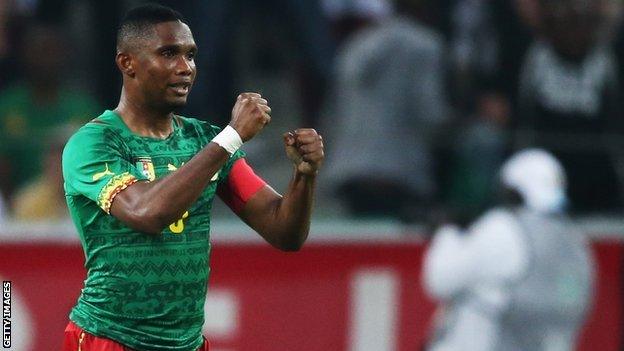
A fresh wave of controversy has engulfed Cameroonian football just weeks before the 2025 Africa Cup of Nations kicks off in Morocco, with Samuel Eto’o, the legendary former striker and current president of the Cameroon Football Federation (FECAFOOT), facing explosive accusations of meddling in national team selections for purely personal reasons.
According to a bombshell report from The Sun, Eto’o is alleged to have pulled strings behind the scenes to orchestrate the shocking exclusion of Vincent Aboubakar, Cameroon’s talismanic captain and one of its most prolific goal-scorers, from the Indomitable Lions’ squad for the tournament.
The motive, sources claim, boils down to a petty fear: Aboubakar, with his lethal finishing and growing tally of international strikes, poses a real threat to dethroning Eto’o’s hallowed status as the nation’s all-time leading scorer.
To grasp the gravity of this saga, it’s essential to rewind through the turbulent buildup to AFCON 2025, which has already been marred by internal strife and high-profile sackings.
In early December, FECAFOOT abruptly dismissed Belgian head coach Marc Brys, citing “professional failures” and accusations of him “inciting players” against the federation—a move that came mere days after Eto’o’s re-election as president.
Brys, who still insists his contract runs through the Ministry of Sports and not FECAFOOT, fired back with blistering claims of undue interference, asserting that Eto’o personally curated the squad list submitted by interim coach David Pagou, sidelining not just Aboubakar but also Manchester United goalkeeper on loan in Turkey André Onana and Napoli midfielder André-Frank Zambo Anguissa. “How can you compete in a tournament of this magnitude without a world-class goalkeeper or without Aboubakar?” Brys vented to Afrik-Foot, labeling the omissions “unbelievable” and driven by players who “dare to stand up to the president.”
He even went as far as to call Eto’o “narcissistic and self-centered,” painting a picture of a federation gripped by ego clashes rather than tactical merit.
At the heart of the scandal lies the numbers that have long defined Eto’o’s enduring legacy and Aboubakar’s relentless pursuit. Eto’o, who hung up his international boots in 2014 after a glittering career that included Champions League triumphs with Barcelona and Inter Milan, remains Cameroon’s undisputed king of goals with 56 strikes in 118 caps—a record etched through two Africa Cup of Nations titles in 2000 and 2002, plus standout performances like his five-goal haul to claim the Golden Boot at AFCON 2006.
Aboubakar, the 33-year-old powerhouse currently plying his trade with Azerbaijani side Neftçi after stints at Porto, Beşiktaş, and Al-Nassr, trails by exactly 11 goals at 45 in 117 appearances, a margin that speaks volumes about his consistency as the second-highest scorer in Lions history.
The Sun’s report zeroes in on this gap, suggesting Eto’o, now 44 and protective of his throne, viewed Aboubakar’s inclusion as a direct risk—especially with the striker’s proven pedigree in major tournaments, including the winning goal in the 2017 AFCON final against Egypt and a joint-top scoring tally of eight at the 2021 edition hosted on home soil.
The allegations paint a vivid, almost Shakespearean portrait of rivalry within Cameroon’s football royalty: Eto’o, the global icon who once bought his teammates luxury watches to celebrate World Cup qualification, now accused of gatekeeping his legacy against the very captain who has carried the team’s attacking burden in recent years.
Aboubakar’s snub has ignited fury among fans and pundits, who point to his recent form—three goals in nine caps during 2025 alone—as evidence of a calculated purge rather than a refresh.
Not everyone is buying the narrative wholesale. Veteran coach Claude Le Roy, the so-called “White Wizard” who once led Cameroon to glory, has thrown his weight behind the decision, arguing on Canal+ Sport’s “Talents d’Afrique” that excluding aging stars like Aboubakar and Onana is a pragmatic call for team cohesion and renewal.
“Expert players are assets, but they need to lift the team as a whole,” Le Roy said, dismissing conspiracy theories as overblown and emphasizing the need to build around younger talents amid Cameroon’s recent failures, including a dismal exit from 2026 World Cup qualifying.
Pagou’s 28-man squad, heavy on emerging names like a Brazilian sixth-division import, reflects this youth injection, but the absences of proven leaders have left the Lions’ preparations in disarray, with Brys even submitting a rival list to the Sports Ministry that reinstates Aboubakar and Onana.
As the December 21 opener looms, this scandal threatens to overshadow Cameroon’s ambitions in a tournament they’ve won five times but haven’t lifted since 2017.
Aboubakar, ever the professional, has yet to break his silence, but whispers from the locker room suggest resentment is festering. For Eto’o, whose presidency has been a rollercoaster of reforms and feuds since 2021—including the axing of previous coaches like Toni Conceição and Rigobert Song—the stakes couldn’t be higher.


