


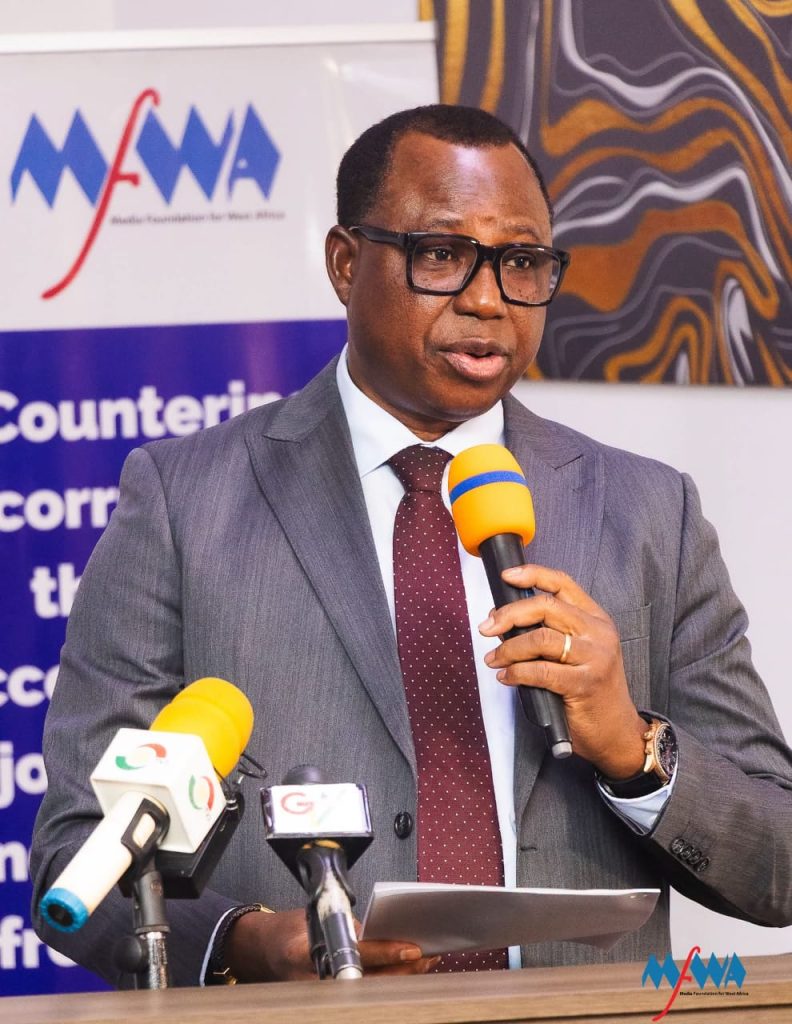
The Commissioner of the Commission on Human Rights and Administrative Justice (CHRAJ), Dr. Joseph Whittal, has warned that public confidence in Ghana’s fight against corruption is steadily declining despite the existence of several anti-corruption laws and institutions.
Speaking at a forum organized by the Media Foundation for West Africa in Accra yesterday, Dr. Whittal said growing perceptions of corruption and increasing doubts about the ability of state institutions to address it pose a serious threat to democratic governance and national development.
Addressing participants at the event, which was held under the theme, “Restoring Citizens’ Trust in the Fight Against Corruption in Ghana: The Role of the Media,” he noted that trust is the foundation upon which public institutions derive legitimacy.
According to him, although Ghana has invested significantly in accountability institutions and legal frameworks over the years, many citizens remain unconvinced that corruption cases are handled fairly, expeditiously and without political interference.
Dr. Whittal stressed that public trust flourishes when institutions consistently demonstrate transparency, integrity and accountability. He said citizens are more likely to have confidence in state agencies when corruption allegations are investigated professionally, offenders are held accountable regardless of their status, and anti-corruption bodies are provided with the independence and resources necessary to perform their mandates effectively.
He added that successful prosecutions, the recovery of stolen assets and visible institutional reforms are essential in convincing the public that no individual is above the law.
The CHRAJ Commissioner identified selective justice, prolonged investigations and weak enforcement of anti-corruption laws as some of the key factors contributing to public disillusionment. He lamented that many high-profile corruption cases receive widespread publicity but often fail to produce outcomes that meet public expectations.
Dr. Whittal also expressed concern about attacks on journalists who expose wrongdoing, citing the unresolved murder of investigative journalist Ahmed Suale as an issue that continues to cast a shadow over accountability efforts in the country.
Touching on the role of the media, he described journalists as indispensable partners in the fight against corruption. He credited investigative journalism with exposing procurement irregularities, abuse of office and illicit financial activities both in Ghana and beyond.
However, he cautioned media practitioners against reducing corruption coverage to political drama and personality conflicts. Instead, he urged journalists to focus on evidence, institutional responses and the outcomes of investigations and court proceedings. Responsible journalism, he said, must prioritize the public interest over sensationalism.
Calling for a collective national response, Dr. Whittal urged the government, Parliament, the Judiciary, accountability institutions, citizens and the media to play their respective roles in rebuilding confidence in the anti-corruption agenda.
He maintained that trust cannot be demanded by public institutions but must be earned through consistent action, transparency and measurable results.
“The fight against corruption is ultimately a fight for the soul of our democracy,” he said, warning that failure to confront the problem decisively would continue to undermine development and weaken public confidence in state institutions.


