


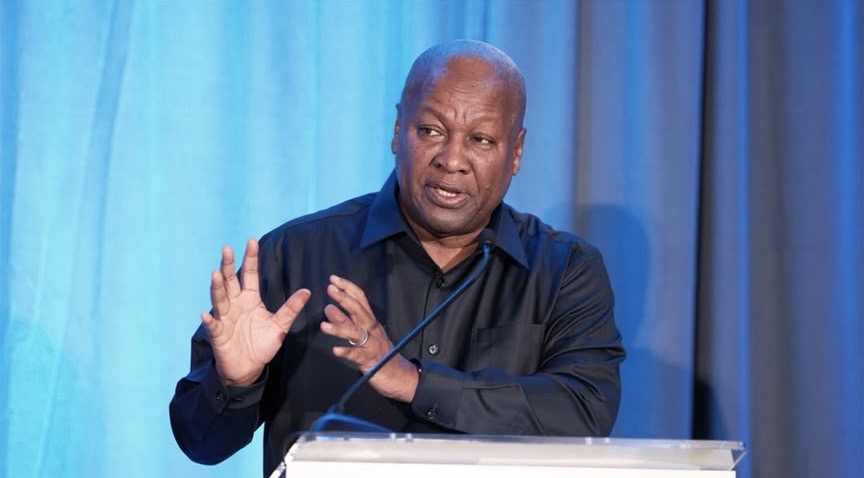
President John Dramani Mahama says Ghana’s health-sector reset will go beyond the construction of hospitals and other medical facilities to building the country’s capacity to manufacture essential medicines locally.
He said the government’s approach is to strengthen domestic industrial capacity and encourage pharmaceutical companies in Ghana to produce essential medicines, supported by guaranteed state purchasing and access to regional markets.
President Mahama made the remarks in New York on Monday, September 21, 2026, at a high-level side event on the Accra Reset: Global Reset Dialogue on the sidelines of the 81st United Nations General Assembly.
According to him, Ghana’s domestic agenda is built around economic self-reliance, local value addition, robust public health infrastructure, transparent governance and the 24-Hour Economy initiative.
He said these priorities mirror the broader objectives of the Accra Reset, which seeks to reduce the vulnerability of developing countries to external funding and supply chains.
“When we say we are resetting Ghana’s health sector, we do not mean simply building medical facilities and waiting for foreign donors to supply the essential vaccines or IV fluids,” President Mahama said.
He explained that the objective is to develop local industrial capacity and create an environment in which Ghanaian pharmaceutical companies could manufacture essential medicines domestically.
The President said this would be supported through guaranteed state purchasing and regional market access.
He argued that Ghana’s experience demonstrated the connection between domestic transformation and the broader global health reform agenda.
“The Accra Reset takes that exact logic to the international stage,” he said, stressing that a national reset without a global reset would leave countries vulnerable to weaknesses in the international system.
President Mahama said Ghana has already begun building the institutional machinery required to turn the Accra Reset philosophy into practical policy.
These include the establishment of a Presidential Council, a Guardians’ Circle and a High-Level Panel on Reform of the Global Health Architecture and Governance.
He said the next phase would involve translating the panel’s recommendations into country-level compacts involving governments, global health bodies, development finance institutions, philanthropies and the private sector.
The President also called for partnerships connecting research, regulatory oversight, local manufacturing and reliable distribution networks across the Global South.
Story by: Emmanuel Romeo Tetteh(#RomeoWrites✍️)/ Presidential Affairs Correspondent | Ghana 🇬🇭


