


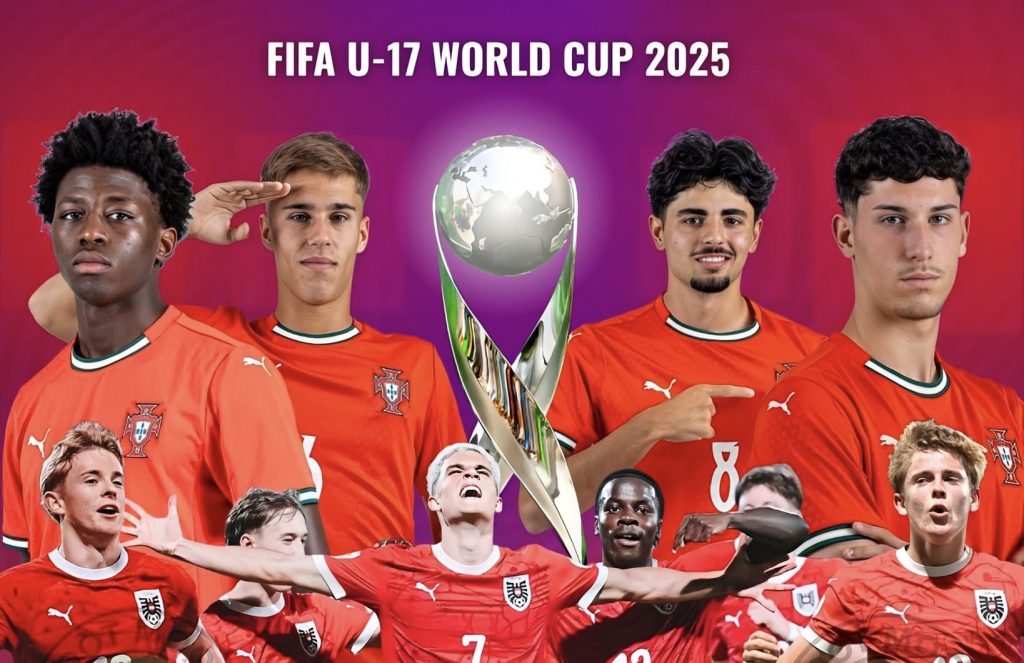
Portugal stand ninety minutes from immortality this Thursday evening when their under-17 side walk out at the Khalifa International Stadium in Doha to face Austria in the final of the 2025 FIFA U-17 World Cup.
Kick-off is at 19:00 local time (16:00 in Lisbon, 11:00 ET), and for the first time in the tournament’s 40-year history, two teams who have never previously reached this stage will contest the trophy.
Neither country has ever lifted the U-17 World Cup. Portugal’s only previous podium finish came on home soil in 1989, when a generation featuring future senior internationals like Luís Figo and Rui Costa claimed bronze.
Austria have never even made the semi-finals before. One of them will leave Qatar as champions of the first edition of FIFA’s bold new annual, 48-team format.
Bino Maçães’ Portugal arrived as freshly-crowned European champions, having demolished France 3-0 in the 2025 UEFA U-17 final in Albania with goals from Anísio Cabral, Duarte Cunha and Gil Neves.
That triumph, Portugal’s third continental title at this age group, carried them into the World Cup with genuine belief. They have more than justified it.
In the group phase they finished runners-up to a vibrant Japan side, but still hammered Morocco 6-0 and New Caledonia 6-1. The knockout rounds have been a procession of increasingly impressive performances: a hard-fought 2-1 win over Belgium in the last 32, a ruthless 5-0 dismantling of Mexico in the round of 16, a composed 2-0 victory against Switzerland in the quarter-finals and, most memorably, a semi-final in which they stared down Brazil for 120 goalless minutes before winning a nerve-shredding penalty shoot-out 6-5. Goalkeeper Romário Cunha emerged as the hero that night, but the entire squad’s composure under pressure has been striking.
Austria’s journey has been the tournament’s quiet masterpiece. Coached by Hermann Stadler, they have conceded just a single goal in seven matches, an astonishing defensive record built on discipline, organisation and the leadership of captain Jakub Pokorny.
Yet they are far from a purely defensive side. Johannes Moser, the 17-year-old FC Liefering forward, has scored eight times, including four penalties and a spectacular free-kick against Japan.
Their route has included a 4-0 thrashing of England, a tense quarter-final win over the same Japan that topped Portugal’s group, and a commanding 2-0 semi-final victory over defending European runners-up Italy despite having only a third of possession.
The two teams know each other well. They met in the quarter-finals of this year’s European Championship, Portugal winning 2-1 on their way to the title. Austria will feel they have closed the gap since then.
Tactically, the final promises fascination: Portugal’s fluid possession game, orchestrated by captain and playmaker Rafael Quintas, against Austria’s compact midfield and lightning transitions spearheaded by Moser.
Portugal, success would crown one of the finest youth generations the country has produced in decades and provide a glittering bookend to a year that began with the senior team’s Nations League triumph in June.
For Austria, it would be the greatest achievement in the history of their youth system, proof that the steady investment of recent years is bearing spectacular fruit.
By full-time on Thursday night, one nation will have its name etched on the trophy for the first time. In a tournament that has already served up surprises, drama and outstanding individual performances, the stage is perfectly set for a final that could become an instant youth-football classic.


