


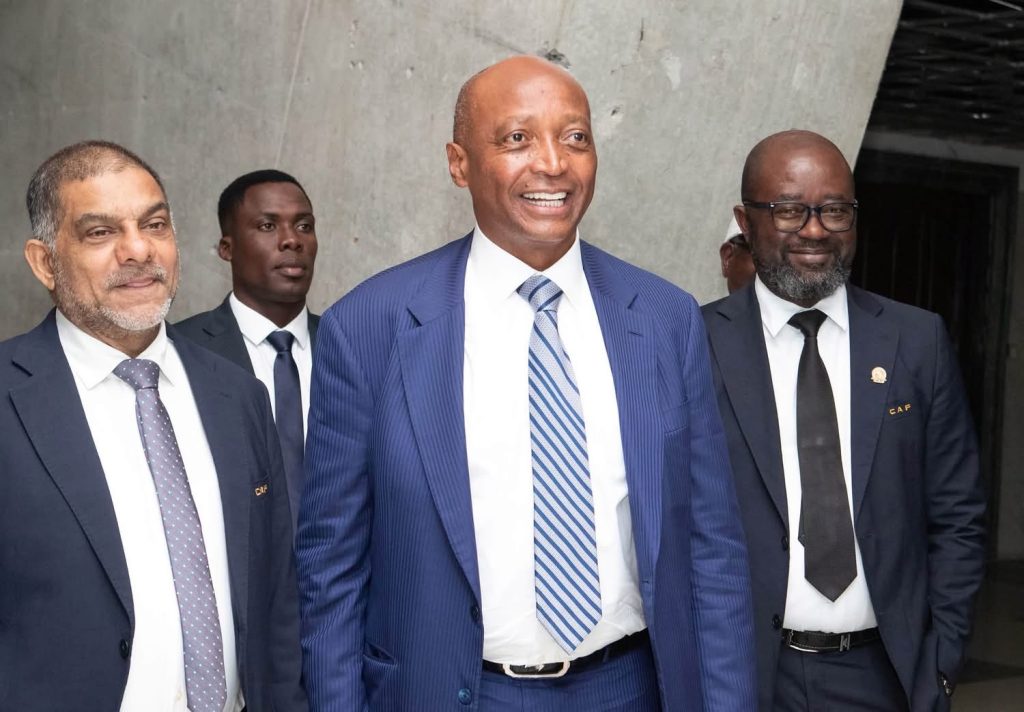
Ghana Football Association President Kurt Edwin Simeon-Okraku spent this week in Tanzania with the Confederation of African Football’s senior leadership as the governing body examined how close the country is to co-hosting the 2027 Africa Cup of Nations. As CAF’s second vice-president, Okraku travelled from Accra to stand beside President Patrice Motsepe during inspections, meetings with government officials and a public defence of the East African hosting plan.
Motsepe made a point of welcoming him. He praised Okraku for making the journey from Ghana and treated that presence as evidence that AFCON still commands the attention of football leaders across the continent, not only those whose countries will stage matches. The compliment was more than courtesy. It placed a West African administrator inside an East African readiness exercise at a moment when the tournament is nine months away and every unfinished pitch and unfinished training ground is under scrutiny.
The party that arrived in Dar es Salaam was not a ceremonial group. Alongside Motsepe and Okraku were fifth vice-president Feizal Sidat, CECAFA president Paulos Weldehaimanot and acting secretary general Samson Adamu. Tanzania Football Federation president Wallace Karia received them. Prime Minister Mwigulu Nchemba sat in on the political and logistical briefings. The working list was concrete: Benjamin Mkapa Stadium, designated training sites, hotels, airport throughput, power redundancy, broadcast rooms, spectator flow and the systems that must operate when three countries share one finals.
The 2027 tournament, branded Pamoja, is scheduled from 19 June to 17 July and will be the first Africa Cup of Nations hosted jointly by three nations — Tanzania, Kenya and Uganda. East Africa has not staged the men’s finals in more than fifty years. That historic opening is also the source of the pressure. A multi-city, multi-country format multiplies transport, security, medical and visa problems that a single-host edition never faces.
Motsepe used the Dar es Salaam stop to shut down talk of replacing Tanzania. He said there is no Plan B and no Plan C, and that there never will be. He accepted that some files are late and called the remaining months an emergency. At the same time he said he had seen progress since his last visit and argued that public reporting sometimes inflates the gaps while underplaying the work already done. CAF, he said, would stay on the ground and push the outstanding items rather than look for another host.
Tanzania is widely viewed as the most advanced of the three hosts in brick-and-mortar terms, yet the unfinished business is still long. Benjamin Mkapa Stadium has been through pitch rehabilitation, hospitality upgrades, media-area work and lighting improvements intended to reach CAF’s brightness and backup-power standards.
Training grounds around Dar es Salaam sit at uneven stages. Some sites were reported complete earlier in the year; others, including Leaders Club and Farasi, have been the subject of direct instructions from the Prime Minister to contractors to accelerate and, where necessary, extend working hours. Arusha’s new stadium project and venues in Zanzibar add another layer: matches spread across clusters that must be linked by reliable roads, utilities and security.


