


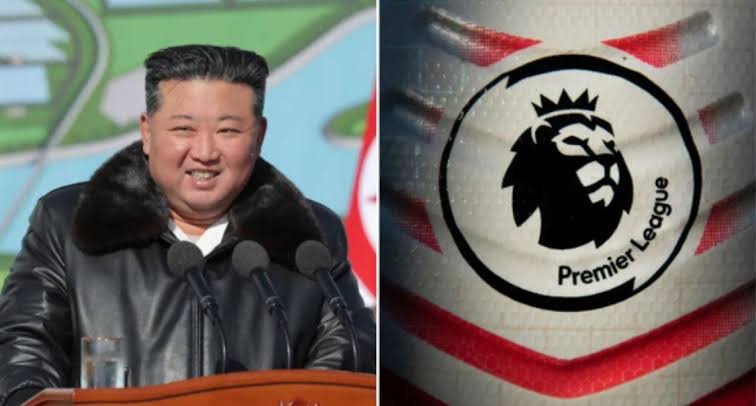
According to a report by The Guardian, North Korean leader Kim Jong-un has approved the airing of English Premier League football matches on state television, AhotorSports have sighted.
However, this unprecedented access to foreign sports entertainment comes with rigorous governmental stipulations to align the content with the regime’s ideological standards. The broadcasts, branded as the “North Korea Premier League,” will adhere to a detailed set of editing and presentation rules enforced by authorities.
Broadcast Restrictions
To ensure compliance with national policies, all footage will undergo thorough pre-broadcast editing rather than being shown live. The modifications include:
Delayed and Edited Airings: Matches will not be transmitted in real time; instead, they will be pre-recorded, reviewed, and altered to remove any undesirable elements before public viewing.
Removal of South Korean Players: Any appearances by athletes from South Korea will be entirely excised from the footage. This specifically targets players such as Kim Ji-soo of Brentford and Hwang Hee-chan of Wolverhampton Wanderers, reflecting the regime’s sensitivity to content originating from its southern neighbor.
Shortened Match Duration: Full games, which typically last 90 minutes plus stoppage time, will be condensed to just 60 minutes, eliminating extended play and potentially controversial moments.
Overlay of Stadium Text: All visible English-language signage, advertisements, or text within the stadium environment will be digitally obscured and replaced with North Korean propaganda graphics, slogans, or state-approved messaging during the editing process.
Censorship of LGBTQ+ Imagery: Scenes depicting rainbow flags, pride symbols, or any other representations associated with LGBTQ+ advocacy will be cut out to prevent exposure to what the government deems “decadent” or “reactionary” influences.
These measures underscore the regime’s determination to filter external media through a lens of ideological purity, transforming a global sporting event into a controlled propaganda tool.
North Korea’s Draconian Media Control Framework
North Korea operates under one of the world’s most repressive media environments, where state censorship permeates every aspect of information dissemination.
Foreign content is viewed as a potential threat to the socialist system, and laws are designed to shield citizens from “imperialist” or “antisocialist” influences. Ordinary citizens have virtually no access to uncensored international media, with severe penalties for any infractions.
Law on Rejecting Reactionary Ideology and Culture (Enacted 2020)
This cornerstone legislation explicitly aims to “block the infiltration and proliferation of antisocialist ideology and culture while steadfastly upholding our own ideas, spirit, and cultural heritage.” It outlaw criminalizes the importation, possession, distribution, or consumption of a wide array of foreign cultural products, with a particular emphasis on materials from “hostile” nations such as South Korea, the United States, and Japan.
Prohibited Content: This includes South Korean films, television dramas, K-pop music, Hollywood movies, Japanese anime, and similar media.
Punishments: Violations can result in harsh repercussions, ranging from public shaming and “re-education through labor” in prison camps to lengthy imprisonment, forced labor, or even execution in extreme cases. For instance, smuggling or sharing a South Korean USB drive with dramas or songs has led to families being sent to political prison camps.
The law reinforces the regime’s narrative of cultural isolationism, portraying foreign entertainment as a subversive tool that could erode loyalty to the Kim dynasty.
Radio Wave Control Law (Also Known as the “Radio Wave Management Law”; Originally 2006, Amended 2015, Revised 2023)
This comprehensive statute governs all electronic communication devices and signals within the Democratic People’s Republic of Korea (DPRK), extending control over technology to prevent unauthorized access to outside information.
Device Regulation: It requires mandatory inspection, registration, and certification of all gadgets capable of receiving signals, including smartphones, computers, radios, televisions, and satellite receivers. For example, Article 14 stipulates that retailers must modify TVs and radios to lock them into receiving only government-approved channels, rendering them incapable of tuning into foreign broadcasts.
Bans on Unauthorized Signals: The use of foreign wireless networks, satellite communications, or cross-border mobile signals is strictly prohibited. Citizens near the borders with China or South Korea are forbidden from accessing those countries’ cellular networks, with detection often leading to immediate arrest.
Broader Implications for Media: Foreign films, music, TV series—especially from South Korea, the U.S., or Japan—are completely banned for the general populace. Possession alone can trigger investigations, while viewing or distributing such material may result in prolonged detention in labor camps, torture, or capital punishment. State media is the sole legal source of information, and even tuned-in shortwave radios for BBC or Voice of America are confiscated and punished.
These laws collectively create an airtight information bubble, where the Premier League broadcasts represent a rare, heavily sanitized exception—likely intended to boost morale or project an image of openness while maintaining absolute control.


