


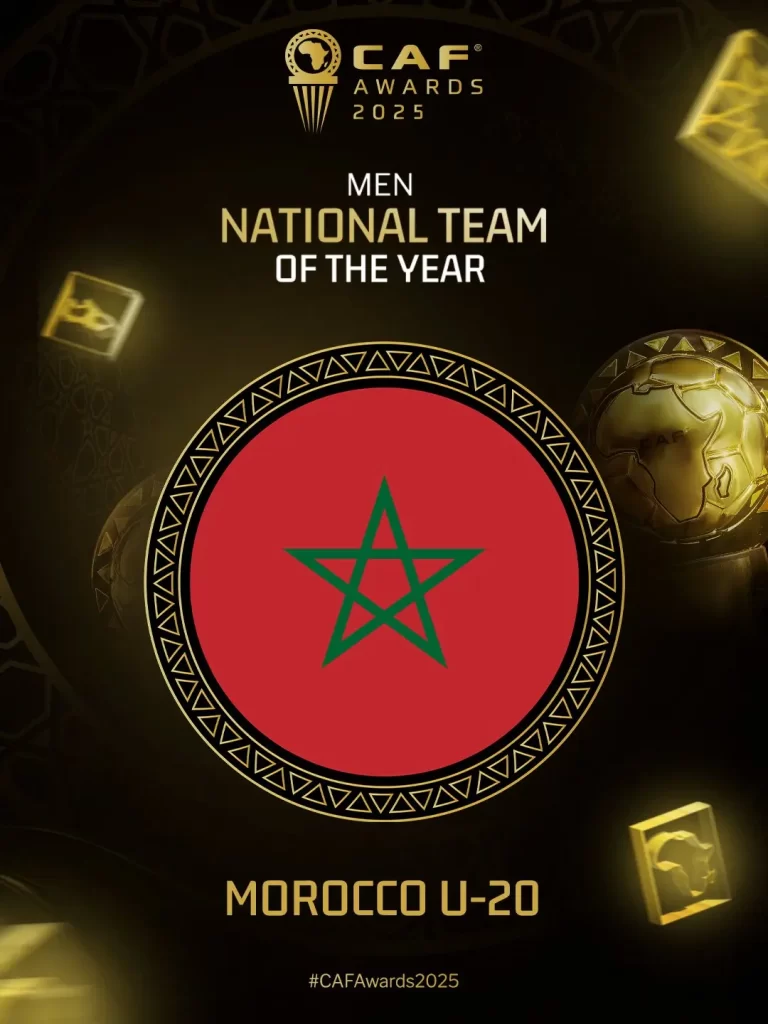
In a glittering ceremony held on Wednesday evening at the Mohammed VI Polytechnic University in Rabat, Morocco’s U-20 national football team was crowned Men’s National Team of the Year at the 2025 CAF Awards.
This prestigious accolade, presented by the Confederation of African Football, marked the perfect culmination of an extraordinary year for the young Atlas Lions, who surpassed a highly competitive shortlist that included Senegal, Egypt, and even Morocco’s senior national team.
The event, filled with the continent’s biggest football stars, saw Morocco dominate with more than 15 nominations across categories, including Achraf Hakimi’s crowning as African Player of the Year.
This latest recognition follows a remarkable 2025 in which the U-20 side, guided by coach Mohamed Ouahbi, did far more than compete; they conquered the global stage.
Their defining moment came in October in Santiago, Chile, when they lifted the FIFA U-20 World Cup, becoming only the second African nation after Ghana in 2009, and the first Arab nation ever, to claim the title.
The victory was no fluke but the result of meticulous preparation, tactical brilliance, and moments of pure inspiration.
Morocco’s journey through the tournament was nothing short of spectacular. Making their first appearance in two decades, they topped a tough group by defeating Spain 2-0 and Brazil 2-1, despite a narrow loss to Mexico.
In the knockout rounds they showed steel and flair in equal measure: a 2-1 win over South Korea in the last 16, a commanding 3-1 quarter-final victory against the United States, and a dramatic penalty shoot-out triumph over France in the semi-finals after a 1-1 draw, with goalkeeper Ibrahim Gomis saving two spot-kicks to send his team through.
The final against six-time champions Argentina on 19 October at the Estadio Nacional Julio Martínez Prádanos will be remembered for generations.
Yassir Zabiri, the 20-year-old forward from Marrakesh who won the Golden Boot with five goals, opened the scoring with a perfectly curled free-kick in the 12th minute and added a second with a powerful header from Othmane Maâma’s cross just 17 minutes later.
Morocco’s defence, marshalled superbly by Fouad Zahouani, repelled everything Argentina threw at them, and Gomis’s late save preserved a historic 2-0 victory.
Celebrations erupted across the kingdom, with thousands greeting the team in Rabat and a royal reception hosted by Crown Prince Moulay Hassan.
This World Cup triumph came on the back of a silver medal at the CAF U-20 Africa Cup of Nations earlier in the year, where Morocco reached the final before falling 1-0 to South Africa.
Throughout both tournaments they blended high-intensity pressing with technical elegance, scoring 14 goals in the World Cup while conceding just four and captivating fans worldwide.
The foundations of this golden generation lie in Morocco’s visionary long-term investment in youth development, above all through the Mohammed VI Football Academy in Salé.
Opened in 2009 under the patronage of King Mohammed VI, the academy has grown into one of the finest talent factories on the planet, combining state-of-the-art training facilities with academic education and character-building programmes.
At least five starters in Chile—Zabiri, midfield engine Houssam Essadak, versatile left-back Zahouani, flying winger Maâma, and defensive anchor Yassine Khalifi—were products of the academy, while several others contributed from the bench or during qualification.
The success has already propelled many of these young stars toward Europe’s top leagues. Zabiri is being courted by Barcelona and Benfica, Maâma—named Young African Player of the Year at the CAF Awards—has joined Watford, Essadak is attracting interest from Sunderland and Celtic, and Zahouani is on Ajax’s radar.
The squad’s collective market value has soared past €50 million, validating Morocco’s model of developing players locally before launching them onto the global market.
For Moroccan football, the implications are profound. With the senior team already a global force after their 2022 World Cup semi-final run, the integration of these U-20 champions promises an even brighter decade ahead, especially with the country set to host the 2025 Africa Cup of Nations and co-host the 2030 World Cup.
Across the continent, Morocco’s achievement serves as a powerful reminder of what sustained investment in youth can accomplish. From the streets of Casablanca to the biggest stages in the world, a new era has unmistakably begun, and the Atlas Lions, young and old, are leading the charge.


