


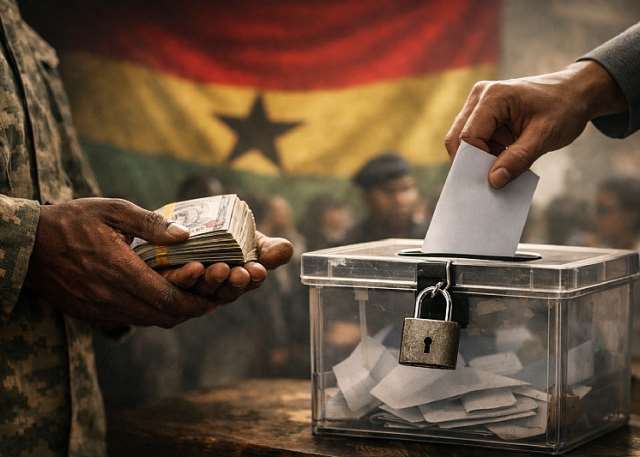
Money laundering and political financing remain among the most debated governance issues in Ghana. As democracy expands and election campaigns become increasingly expensive, public concern continues to grow over how political parties raise money, finance campaigns, and whether illicit funds are quietly influencing state institutions.
These concerns are not unique to Ghana. Across many developing democracies, weak transparency systems and fragile enforcement structures have created fertile ground for corruption, illicit financial flows, and opaque political funding networks.
The recent arrest of the Member of Parliament for Asante Akyem North, Ohene Kwame Frimpong, has once again reignited debate about the intersection between politics and financial crime.
The MP was reportedly arrested by Dutch security officials at Schiphol Airport shortly after a KLM flight from Accra landed in the Netherlands. The arrest is linked to allegations involving romance scams and money laundering investigations.
Politically, the development has sent shockwaves through Ghana’s political establishment. Yet observers note that the controversy appears to transcend partisan divisions. As many political commentators have pointed out, “this arrest has nothing to do with the umbrella or the elephant,” referencing the symbols of the National Democratic Congress and the New Patriotic Party.
The arrest has instead reopened a more uncomfortable national conversation: the relationship between politics, unexplained wealth, and financial secrecy.
One provocative question continues to linger in public discourse: can politics and money laundering truly be separated in systems where major political parties have historically faced criticism for failing to fully disclose sources of campaign financing before and after elections?
Analysts believe the Dutch investigation may have been ongoing for a considerable period, suggesting authorities may have relied on intelligence gathering and financial monitoring long before the dramatic airport arrest occurred.
Security experts speculate that Dutch authorities could be pursuing a broader transnational network investigation, with the possibility that the MP may possess information capable of assisting investigators in identifying additional individuals, institutions, or international financial connections allegedly linked to laundering operations.
Understanding Money Laundering
Money laundering is the process through which illegally obtained funds are made to appear legitimate. Criminals and corrupt officials often attempt to conceal the origin of money by moving it through banks, businesses, real estate, shell companies, or political networks. The ultimate objective is to integrate illicit wealth into the formal economy without attracting suspicion.
The process generally occurs in three stages:
Placement — introducing illegal money into the financial system.
Layering — moving funds through complex transactions to disguise origins.
Integration — reintroducing the money as apparently lawful income or assets.
In Ghana, money laundering risks are frequently associated with corruption, illegal mining (galamsey), procurement fraud, cybercrime, drug trafficking, tax evasion, and illicit financial flows.
Political Financing in Ghana
Political parties require enormous financial resources to organize campaigns, mobilize supporters, advertise policies, and contest elections nationwide.
In Ghana, party financing commonly comes from:
Membership dues
Donations from supporters
Contributions from business elites
Fundraising activities
Financial backing from influential individuals
The country’s two dominant political parties remain the:
New Patriotic Party
National Democratic Congress
However, one of the most persistent concerns surrounding Ghanaian politics is the lack of full transparency in campaign financing. Citizens are often left without clear information regarding who funds political campaigns, the size of donations, or whether financial contributors later benefit from state contracts, appointments, or political influence.
The Link Between Politics and Illicit Money
Political systems become vulnerable to money laundering when campaign finance regulations are weak or poorly enforced. Ghana’s cash-driven electoral environment has long raised concerns among anti-corruption advocates and governance experts.
Critics and civil society organizations have repeatedly highlighted issues such as:
Anonymous political donations
Shell companies concealing contributors
Foreign influence in campaign financing
Unexplained wealth accumulation among public officials
Inflated contracts awarded to political financiers
Vote buying during elections
When illicit money enters politics, democratic accountability can become distorted. Elected officials may feel greater loyalty to wealthy financiers than to ordinary citizens.
Institutions Responsible for Oversight
Several institutions in Ghana are mandated to combat corruption, money laundering, and abuse of office. These include:
Financial Intelligence Centre
Economic and Organised Crime Office
Office of the Special Prosecutor
Bank of Ghana
Electoral Commission of Ghana
Commission on Human Rights and Administrative Justice
These agencies are expected to monitor suspicious financial transactions, enforce disclosure requirements, and investigate corruption-related offences.
Challenges Facing Enforcement
Despite legal reforms and institutional frameworks, enforcement challenges remain significant.
Among the major obstacles are:
Weak disclosure systems for political donations
Delays in prosecuting corruption cases
Allegations of political interference
Limited investigative resources
Difficulty tracing beneficial ownership structures
Public distrust in anti-corruption institutions
Many governance experts argue that anti-corruption agencies require greater operational independence, stronger prosecutorial powers, and improved financial intelligence systems to function effectively.
The Role of Civil Society and the Media
Investigative journalists, policy think tanks, and civil society organizations continue to play an essential role in exposing corruption and demanding transparency.
Organizations such as the Ghana Center for Democratic Development and Transparency International have consistently advocated reforms aimed at improving political financing transparency and strengthening democratic accountability.
Media investigations have also significantly increased public awareness surrounding corruption, abuse of office, and illicit financial activities.
Conclusion
Money laundering and opaque political financing remain serious threats to democratic governance, economic stability, and public trust in Ghana.
While institutions and legal frameworks exist to combat financial crime, substantial challenges persist in transparency, enforcement, and accountability. Strengthening oversight systems, enforcing public disclosure of political donations, and ensuring independent investigations will be critical to protecting Ghana’s democratic institutions.
As the controversy surrounding the arrest of Ohene Kwame Frimpong continues to unfold, many citizens are once again demanding answers about the deeper relationship between political power, wealth, and financial secrecy in Ghana’s democracy.


