


The Media Foundation for West Africa (MFWA) convened 30 journalists from across Ghana for a three-day workshop in Accra to sharpen their use of the Right to Information (RTI) Law in investigative and accountability reporting, equipping reporters with practical skills to access public records and hold officials accountable.
The training, held at the Coconut Grove Regency Hotel, was organised by the MFWA under the theme “The Use of Right to Information Law in Investigative Journalism.” Over three days, participants were taken through legal frameworks, request drafting, case studies and gender‑sensitive approaches to corruption reporting.
Senior lecturer and legal practitioner Zakaria Tanko Musah, Esq., of the University of Media Arts and Communication — Institute of Journalism (UniMAC-IJ), emphasised that the RTI law provides journalists with a robust legal basis to access public information. He reminded attendees that every public institution is required to designate an information officer and warned that some bodies use the absence of a named officer as a stalling tactic.
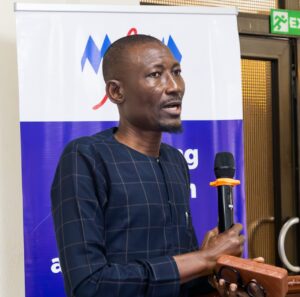

Zakaria Tanko Musah, Esq
“One of the strategies they use is to claim they don’t have an information officer when you write to them. But that’s not an excuse,” Musah said, urging reporters not to be deterred and to leave contact details with any available staff to speed up processing.
Practical skills were a core focus. Kweku Krobea Asante, of The Fourth Estate and MFWA, led sessions on drafting RTI requests. Participants completed take‑home assignments to write requests under the RTI framework — passed in 2019 — which were reviewed and refined during the workshop. Trainers emphasised brevity, objectivity and public interest as keys to successful information requests.
Aurelia Ayisi, PhD, from the University of Ghana’s Department of Communication Studies, guided journalists on “gender‑differentiated corruption,” urging them to consider how power and gender dynamics shape corrupt practices and to report such stories rigorously. “Reporting gender corruption issues also helps to put people in power on the spot,” she said.
Hands‑on case studies rounded out the program, allowing participants to apply legal and editorial guidance to real‑world scenarios and strengthen their capacity for accountability journalism.
The initiative is part of the Participation, Accountability, Integrity for a Resilient Democracy (PAIReD) program, led by MFWA and co-funded by the German Development Cooperation. PAIReD is commissioned by the German Federal Ministry for Economic Cooperation and Development (BMZ), co‑financed by the European Union and the Swiss State Secretariat for Economic Affairs (SECO), and implemented by GIZ in collaboration with Ghana’s Ministry of Finance.
MFWA, which has a track record of training journalists in anti‑corruption and accountability reporting, said the workshop aims to increase the number of reporters who can confidently use the RTI law to produce impactful investigations that enhance transparency and public oversight.
Story by: Felix Kwetey (PK Wasty)


