


President John Dramani Mahama has urged the Minority in Parliament to support the government’s $10 billion New Economy Programme, arguing that its successful implementation would benefit Ghana regardless of its political implications for the governing National Democratic Congress (NDC).
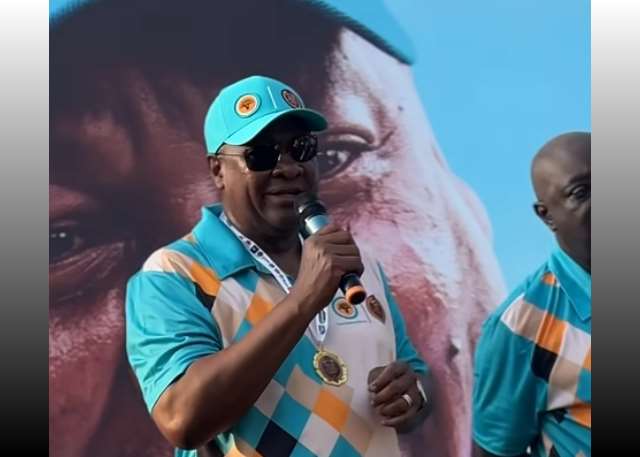
Speaking at the Head of State National Golf Tournament on Saturday, November 21, 2026, President Mahama described the initiative as a national development agenda rather than a partisan project, calling on political leaders, financial institutions and private sector players to support its implementation.
The President said the programme would involve an investment of $10 billion over four years, from 2027 to 2030, in selected sectors with significant potential to expand production, create jobs and transform the structure of Ghana’s economy.
He explained that the private sector and financial institutions would drive much of the investment, while government would provide the necessary support and guarantees to enable lenders to finance businesses and productive ventures.
The targeted sectors include oil palm, cashew, textiles and garments, and pharmaceuticals.
President Mahama urged industry leaders and financial institutions to demonstrate their commitment ahead of the programme’s planned launch next year.
He also made a direct appeal to Minority Leader Alexander Afenyo-Markin, who was present at the event, to rally members of the opposition behind the initiative.
“I expect that the opposition will come on board, the Minority, and Afenyo-Markin is sitting here. I’m telling him this is a national programme, it’s not a partisan programme. Even though it might keep you out of power for a very long time, you must support it in the interest of Ghana,” he said.
Background to the New Economy Programme
The New Economy Programme, themed The New Economy, New Ghana, Jobs and Prosperity, is a four-year economic transformation agenda covering the period 2027 to 2030.
It is designed to address structural weaknesses in Ghana’s economy by increasing domestic production, promoting local processing of raw materials, expanding industrialisation and creating sustainable employment opportunities.
According to the 2027 Budget presented by Finance Minister Dr Cassiel Ato Forson on November 12, the programme is built around eight pillars: macroeconomic stability and affordable finance, commercial agriculture, energy infrastructure, critical minerals value addition, tourism, culture and creative arts, textiles and garments, pharmaceuticals and biomanufacturing, and the technology economy.
Government has earmarked GH¢30 billion for the programme in 2027, representing 1.5 per cent of Gross Domestic Product (GDP), as part of the broader $10 billion investment commitment over four years.
The initiative is also expected to strengthen the role of the private sector in investment, innovation, production and job creation, with government support linked to project appraisal, transparency and measurable results.
Minority’s Concerns
However, the programme has faced criticism from the Minority Caucus, which has questioned its funding arrangements and whether it represents a new economic direction or a rebranding of the government’s existing 24-Hour Economy Programme.
The Ranking Member on Parliament’s Finance Committee, Dr Mohammed Amin Adam, has argued that several components of the New Economy agenda were already captured under the 24-Hour Economy framework.
He has also questioned the government’s ability to mobilise the projected $10 billion, particularly given concerns about funding and implementation of its earlier economic commitments.
The Minority has further called on the government to provide clear details on financing, implementation timelines and measurable outcomes to demonstrate how the programme will translate into jobs and improved living conditions.
The 2027 Budget also outlines the government’s commitment not to introduce new taxes.
Debate on the budget is expected to continue in Parliament, with the New Economy Programme remaining a major point of discussion between the Majority and Minority as lawmakers examine the government’s economic priorities and proposed investments.
Story by Freedom Etsey Lavoe


