


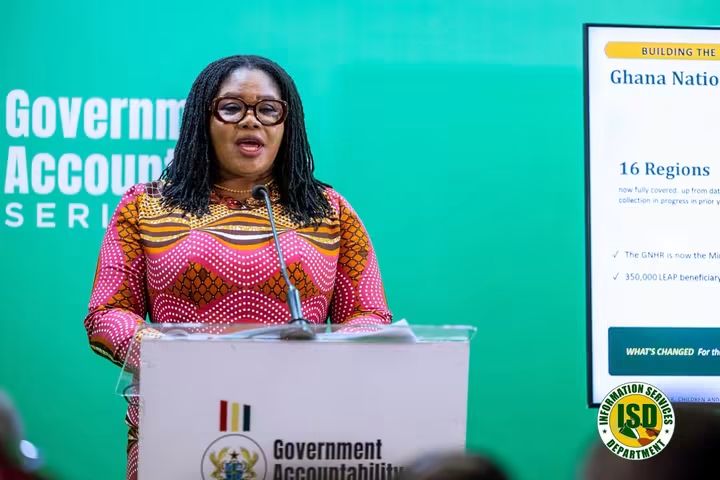
ACCRA, Ghana, 16th September: The government has increased the beneficiary ceiling of the Livelihood Empowerment Against Poverty (LEAP) programme from 350,000 to 450,000 households as part of efforts to strengthen social protection for vulnerable Ghanaians.
Minister of Gender, Children and Social Protection, Dr Agnes Naa Momo Lartey, disclosed this during the Government Accountability Series on Wednesday, September 16, 2026.
According to the Minister, the expansion follows a comprehensive reassessment of existing beneficiary households using data from the Ghana National Household Registry.
She said the reassessment resulted in more than 226,000 households graduating from extreme poverty, creating room for the programme to extend support to other eligible households.
The Ministry also reported a significant increase in LEAP grants, with the average grant rising from GH¢334 in 2024 to GH¢569.14 in 2026, representing an increase of about 70 per cent.
Dr Lartey said the grant has also been protected through an indexation mechanism intended to prevent inflation from eroding the value of payments.
September payments
The Minister announced that the Ministry began disbursing the first and second payment cycles of the 2026 LEAP programme from Monday, September 14.
Because the two cycles are being paid together, eligible households will receive twice their applicable bi-monthly amount.
Under the new rates, households with one to two members receive GH¢392 per cycle if they have a vulnerable member and GH¢380 if they do not.
Households with three to four members receive GH¢474 and GH¢452 respectively, while households with five or more members receive GH¢630 where there is a vulnerable member and GH¢594 where there is none.
Dr Lartey said about 450,000 eligible households are being retained or enrolled within the approved programme ceiling.
She assured persons who have been enumerated or assessed but have not yet completed biometric registration that they should not panic, explaining that the process is designed to onboard all 450,000 households by the end of 2026, with their entitlements.
National social protection database
The Minister also highlighted the role of the Ghana National Household Registry in improving the targeting of social protection programmes.
She said data collection had been completed in all 16 regions, covering 2,906,288 households and 11,244,027 individuals.
The database includes 508,870 households classified as extremely poor and is intended to serve as the country’s single national database for targeting social protection interventions.
Dr Lartey said the government had also strengthened the legal framework for social protection following the passage of the Social Protection Act, 2025 (Act 1148), and the Social Protection Regulations, 2026 (L.I. 2521).
She said the new framework establishes a dedicated Social Protection Fund and provides a legal basis for a shock-responsive social protection system capable of responding to emergencies such as floods and other crises.
The Minister said the reforms were intended to move Ghana towards a more coordinated social protection system based on “one law, one national registry and one dedicated fund.”
Story by: Emmanuel Romeo Tetteh(#RomeoWrites✍️)/ Presidential Affairs Correspondent | Ghana 🇬🇭


