


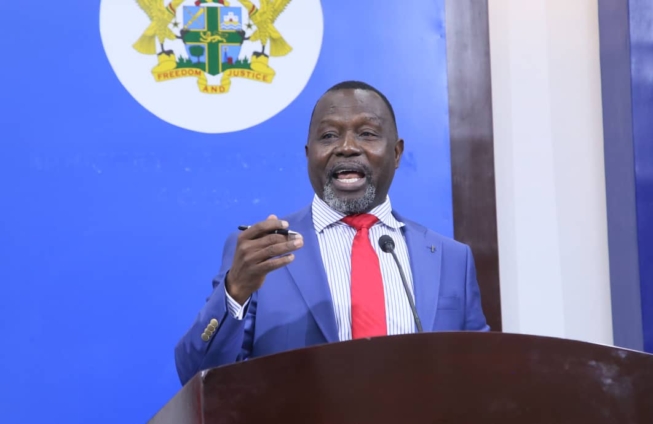
Attorney General and Minister for Justice, Dr. Dominic Ayine, has outlined the government’s position on key Constitutional Review Committee recommendations, including proposals to extend the presidential term, elect MMDCEs and introduce reforms aimed at strengthening Ghana’s democratic governance.
Presenting the government’s White Paper on the Constitutional Review Committee’s recommendations on Thursday, July 30, Attorney General and Minister for Justice, Dr. Dominic Ayine, said each recommendation had undergone extensive constitutional and legal scrutiny before the government’s position was determined.
He explained that the review considered whether the proposals required constitutional amendments or could be implemented through legislation or administrative action, while also drawing on recommendations from previous constitutional reform processes.
The White Paper outlines the government’s position on proposals submitted by the Constitutional Review Committee, chaired by Professor Henry Kwasi Prempeh, which presented its report to President John Dramani Mahama on December 22, 2025.
Among the major proposals accepted by the government are:
Extending the presidential term from four years to five years, with the tenure of Parliament also increased to five years. The government said the current four-year cycle leaves limited time for effective governance due to lengthy transition periods and election preparations. The proposed change will apply to future presidents, not the incumbent.
Reducing the minimum age to contest the presidency from 40 to 35 years, instead of the 30 years proposed by the committee, to broaden participation while maintaining a level of maturity for the office.
Holding presidential elections during the first week of November, on a date to be determined by the Electoral Commission, to provide a predictable electoral calendar and allow sufficient transition before presidential inauguration on January 7.
Setting timelines for presidential election petitions, requiring petitions to be filed within 14 days after the declaration of results and determined by the Supreme Court within 30 days. The Electoral Commission will also be required to disclose all relevant election data to the court and the parties involved.
Removing tax exemptions for sitting presidents, requiring the President to pay taxes on salaries, allowances and applicable indirect taxes, although retirement gratuity and pension will remain exempt.
Allowing dual citizens by birth to contest parliamentary elections, without renouncing their foreign citizenship, describing the current restriction as inconsistent with Ghana’s engagement with its diaspora.
Introducing a fixed tenure for the Chief Justice, who will serve a single non-renewable term of 10 years or until reaching the mandatory retirement age.
Capping the Supreme Court at 19 Justices, including the Chief Justice, instead of the current open-ended arrangement.
Electing all Metropolitan, Municipal and District Chief Executives (MMDCEs). Unlike the committee’s proposal for a phased approach based on districts’ fiscal capacity, the government opted for nationwide elections. Under the proposal, the President will nominate five candidates, two of whom must be women. Following a vetting process, three candidates, including at least one woman, will contest the election.
Creating an Independent Public Emoluments Commission to determine the salaries, allowances and benefits of Article 71 officeholders, including the President, Members of Parliament and other constitutional officeholders, replacing the current system under which a committee appointed by the President determines such emoluments.
Implementing key public financial management reforms through amendments to the Public Financial Management Act rather than the Constitution. These include reporting tax exemptions as tax expenditures, strengthening safeguards on the Contingency Fund, introducing debt sustainability rules and establishing an Independent Fiscal Council.
Abolishing the death penalty, with offences that currently attract capital punishment to be replaced by life imprisonment through amendments to the relevant constitutional provisions.
Enacting a comprehensive Human Rights Act to expand the protection of economic, social and cultural rights, including rights to healthcare, housing, food and a clean environment, without requiring constitutional amendments through a referendum.
Granting a constitutional right of abode to persons of African descent in the diaspora, subject to conditions prescribed by Parliament, as part of efforts to strengthen Ghana’s engagement with the African diaspora.
Establishing a Public Ethics Commission with powers to investigate and prosecute corruption and conflict of interest involving public officials and their private-sector collaborators through the Conduct of Public Officers Bill.
Separating the Office of the Attorney General from the Ministry of Justice, with the Attorney General no longer serving as a Minister of State. The proposal seeks to strengthen prosecutorial independence while creating a separate Minister for Justice to oversee the justice sector.
Introducing a citizen-initiated constitutional amendment process, allowing registered voters to propose amendments after securing the support of at least 10% of registered voters across the country, subject to regional and gender representation requirements.
Dr. Ayine said the implementation process will begin with the inauguration of a Constitution Review Implementation Committee, which will prepare separate amendment bills for entrenched and non-entrenched constitutional provisions.
He disclosed that the draft bills are expected to be completed by October 2026. Amendments to entrenched provisions will subsequently be subjected to a national referendum, which the government intends to hold alongside the 2027 District Assembly elections to reduce costs.
In addition to the constitutional amendment bills, the government will also introduce complementary legislation, including the Human Rights Act and amendments to the Public Financial Management Act, to implement recommendations that do not require changes to the Constitution.


