


Ghana’s improving fiscal performance may be masking a growing threat to the country’s long-term economic prospects, the Institute of Statistical, Social and Economic Research (ISSER) has said.
The institute maintains that the government’s stabilisation efforts are being driven largely by sharp cuts in spending rather than stronger revenue mobilisation.
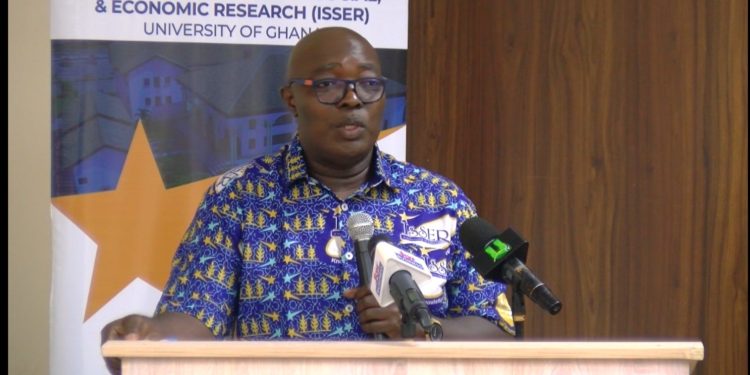
Presenting ISSER’s assessment of the 2026 Mid-Year Budget Review, Director of the Institute, Professor Robert Darko Osei, cautioned that while the government has broadly met its fiscal targets, the quality of the adjustment raises important questions about the sustainability of economic growth.
“The question you need to ask is: how were those targets achieved?” Prof. Osei said, urging policymakers to look beyond the headline fiscal numbers.
According to ISSER, total revenue and grants narrowly missed target by just 1.03% during the first half of 2026, indicating that domestic revenue mobilisation remained largely on track, albeit slightly below expectations.
Government expenditure, however, tells a different story.
ISSER’s analysis shows total spending was 20.6% below budgeted levels, suggesting that Ghana’s improved fiscal position was achieved primarily through expenditure restraint rather than stronger revenue performance.
“Revenue targets were missed by only about one percent. But expenditure was significantly lower than programmed,” Prof. Osei noted.
The sharpest reduction occurred in capital expenditure which is spending on infrastructure and other productive investments that support long-term economic expansion.
Government had budgeted approximately GH¢36.6 billion for capital projects during the first half of the year but spent only about GH¢21.7 billion, leaving capital expenditure roughly 41% below target.
For ISSER, that trend poses significant risks.
“Capital expenditure is critical for growth and development. We planned to spend GH¢36 billion, but only spent about GH¢21 billion in the first half of the year,” Prof. Osei said.
The Institute argues that prolonged underinvestment in infrastructure could weaken Ghana’s productive capacity, delay job creation and constrain future economic growth, even as macroeconomic indicators continue to improve.
ISSER also believes the slowdown in capital spending raises questions about the implementation of government’s flagship Big Push infrastructure programme, which has been promoted as a central pillar of the country’s economic transformation strategy.
“The delayed capital expenditure goes against the Big Push programme that government has emphasised,” Prof. Osei observed.
The warning comes amid weak performance in the construction sector, which expanded by only 1.3% in the first quarter of 2026 despite government’s ambitious infrastructure agenda.
ISSER says the subdued growth suggests many planned projects remain at early stages of implementation and are yet to generate meaningful economic activity.
While acknowledging that expenditure restraint has helped government outperform programme targets on the fiscal deficit and primary balance, the Institute cautions against relying excessively on spending cuts to achieve macroeconomic stability.
“The first-half fiscal performance has largely been driven by lower-than-budgeted expenditure. Revenue mobilisation has not performed particularly strongly,” Prof. Osei said.
“The key question is: at what cost? Capital expenditure was the hardest hit, and that raises serious questions about the cost of stabilisation.”
ISSER concludes that although Ghana appears to be making progress towards macroeconomic stability, sustaining that progress will require a better balance between fiscal consolidation and productive public investment.
The Institute warns that stabilisation achieved through persistent cuts in capital expenditure could ultimately undermine the very growth needed to secure lasting fiscal sustainability.


