


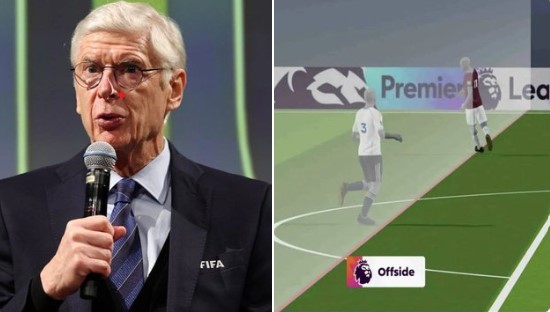
The International Football Association Board (IFAB), the body responsible for determining the Laws of the Game in association football, has officially decided against implementing any changes to the existing offside rule following their annual business meeting held in London on January 20, 2026.
This decision means the current offside law—where a player is in an offside position if any part of their head, body, or feet (excluding hands and arms) is nearer to the opponents’ goal line than both the ball and the second-last opponent at the moment the ball is played by a teammate—remains unchanged for the foreseeable future.
No amendments or major revisions will be introduced as a result of recent discussions. A key focus of speculation leading up to the meeting had been the so-called “Arsène Wenger proposal “Wenger Law”, originally put forward by the former Arsenal manager and FIFA’s Chief of Global Football Development.
This idea suggested a more attacker-friendly adjustment, allowing a player to be considered onside if any part of their body that could score a goal was level with or behind the second-last defender, rather than requiring strict alignment or clearance.
Proponents argued it would reduce marginal, millimeter-based controversies that have proliferated with VAR and semi-automated offside technology, while also encouraging more attacking play and higher-scoring games.
However, the proposal faced significant opposition, particularly from UEFA and the four British associations (England, Scotland, Wales, and Northern Ireland), who hold key voting influence within IFAB alongside FIFA.
Critics described the change as too radical, warning that it would disrupt defensive structures, force teams to drop deeper, stretch the pitch excessively, and fundamentally alter tactical balance in elite football—potentially making matches less competitive or altering pressing systems in undesirable ways.
While IFAB has agreed to continue broader testing and trials related to offside concepts, including advancements in semi-automated offside technology (SAOT) already used successfully at various FIFA tournaments and in select competitions, no shift to a new rule like Wenger’s was approved.
Instead, the focus at the meeting shifted toward other areas aimed at improving the overall flow of matches, such as measures to reduce disruptions, time-wasting, and delays around substitutions, medical treatment, throw-ins, and goal kicks.
This outcome preserves the traditional interpretation of offside that fans, players, and coaches have operated under for years, avoiding a potentially divisive overhaul at this stage. Any future modifications would require further analysis, additional trials, and renewed approval through IFAB’s voting process before they could be adopted into the official Laws of the Game.


