


The celebration of Ghana’s 69th Independence Anniversary provides an important moment to reflect on the country’s historical trajectory of political transformation, economic development, and democratic consolidation. Since gaining independence in 1957 under the leadership of Kwame Nkrumah, Ghana has pursued diverse strategies aimed at national development and socio-economic transformation. Despite notable progress in democratic governance and regional leadership, the country continues to face structural economic and institutional challenges. The contemporary policy discourse surrounding the “Reset Agenda,” associated with John Dramani Mahama, proposes a framework for renewing governance systems, strengthening institutions, and repositioning Ghana’s development path. This article situates the Reset Agenda within Ghana’s broader historical and political context, examining its relevance in addressing longstanding developmental constraints while reflecting on the country’s journey toward sustainable growth and national transformation.
1. Introduction
Independence anniversaries serve as important occasions for national reflection and policy re-evaluation. Ghana’s independence on March 6, 1957, marked a historic turning point not only for the country but also for the African continent. As the first sub-Saharan African country to gain independence from colonial rule, Ghana became a beacon of hope for anti-colonial movements across Africa.
Nearly seven decades later, Ghana commemorates its 69th Independence Anniversary amid renewed discussions about governance reform, economic restructuring, and national renewal. The concept of a Reset Agenda—promoted by John Dramani Mahama—represents a contemporary policy framework aimed at recalibrating national priorities and addressing structural challenges that have impeded economic transformation.
This article examines Ghana’s development trajectory from independence to the present and analyzes how the Reset Agenda fits within the broader context of the country’s historical development efforts. By reflecting on Ghana’s past achievements and challenges, the article highlights the opportunities and constraints shaping the nation’s future.
2. Historical Foundations of Ghana’s Development Vision
2.1 Independence and the Nkrumah Era
Ghana’s independence movement was led by nationalist leaders who envisioned a self-reliant and industrialized African state. Under the leadership of Kwame Nkrumah, the newly independent nation adopted ambitious development programs focused on industrialization, infrastructure development, and Pan-African solidarity.
During the early post-independence period, the government invested heavily in large-scale infrastructure projects designed to stimulate economic growth and modernization. One of the most notable projects was the Akosombo Dam, which provided hydroelectric power to support industrial expansion and regional electrification. Nkrumah’s administration also prioritized education, public sector expansion, and the development of state-owned enterprises.
However, economic pressures, political tensions, and governance challenges eventually led to the overthrow of Nkrumah’s government during the 1966 Ghanaian coup d’état. This marked the beginning of a period of political instability that slowed Ghana’s developmental momentum.
2.2 Political Instability and Economic Challenges (1966–1992)
Between 1966 and the early 1990s, Ghana experienced alternating periods of military and civilian rule. Political uncertainty, combined with global economic shocks, significantly affected the country’s economic performance.
The eventual transition to democratic governance occurred in 1992 with the establishment of the Fourth Republic of Ghana under the leadership of Jerry John Rawlings. The Fourth Republic laid the foundation for constitutional governance, political stability, and institutional development.
3. Democratic Consolidation and Development Efforts
Since 1992, Ghana has gained international recognition for its democratic stability and peaceful transfers of power. Successive administrations have implemented policies aimed at economic liberalization, poverty reduction, and institutional strengthening.
Governments led by leaders such as John Agyekum Kufuor, John Evans Atta Mills, and Nana Addo Dankwa Akufo-Addo have introduced various development initiatives focused on economic growth, social welfare, and infrastructure development.
Despite these efforts, Ghana continues to face persistent challenges, including:
-
Youth unemployment
-
Public debt pressures
-
Economic vulnerability to global market fluctuations
-
Institutional inefficiencies
-
Governance and accountability concerns
These challenges have fueled calls for renewed policy direction and structural reform.
4. The Reset Agenda: Concept and Policy Orientation
The Reset Agenda proposed by John Dramani Mahama represents a framework for national renewal aimed at restoring economic stability, rebuilding institutional confidence, and strengthening governance systems.
The agenda is anchored on several strategic pillars:
4.1 Economic Stabilization and Fiscal Responsibility
Economic stabilization remains a central component of the Reset Agenda. Ghana’s recent fiscal challenges highlight the need for improved public financial management, responsible borrowing practices, and sustainable economic planning.
4.2 Institutional Reform and Governance
Another major focus of the agenda is the strengthening of public institutions to improve transparency, accountability, and efficiency in governance.
4.3 Industrialization and Job Creation
Industrial development remains critical for Ghana’s long-term economic transformation. The Reset Agenda emphasizes policies aimed at supporting local industries, promoting entrepreneurship, and expanding employment opportunities for the country’s growing youth population.
4.4 Human Capital Development
Investment in education, technology, and innovation is also central to the Reset Agenda. Strengthening human capital is viewed as essential for enhancing productivity and positioning Ghana competitively within the global knowledge economy.
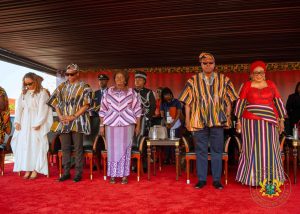

5. Independence at 69: Reflection and National Renewal
The celebration of Ghana’s 69th Independence Anniversary provides an opportunity to evaluate the nation’s progress and reconsider its development priorities. While the country has achieved notable success in democratic governance and regional leadership, the need for sustained economic transformation remains a pressing national concern.
The Reset Agenda reflects a broader national conversation about how Ghana can build on its democratic gains while addressing structural economic challenges. In this sense, the agenda aligns with the enduring aspirations that inspired Ghana’s independence movement—self-reliance, national unity, and socio-economic progress.
6. Conclusion
Ghana’s journey since independence in 1957 illustrates both the achievements and complexities of nation-building in a post-colonial context. From the ambitious development vision of Kwame Nkrumah to the democratic consolidation of the Fourth Republic of Ghana, the country has navigated numerous political and economic transitions.
The Reset Agenda proposed by John Dramani Mahama represents a contemporary effort to reassess national priorities and reposition Ghana for sustainable development. As the country commemorates 69 years of independence, the call for renewal highlights the importance of strong institutions, responsible leadership, and inclusive economic growth.
Ultimately, Ghana’s continued progress will depend on the collective commitment of its citizens, institutions, and leadership to the ideals that inspired the nation’s independence nearly seven decades ago.


