


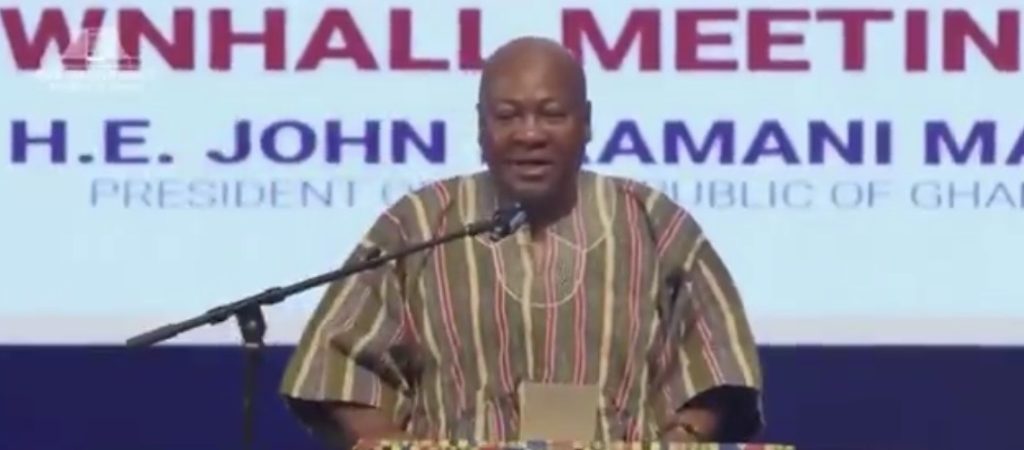
President John Dramani Mahama, Ghana’s leader, recently spoke candidly about the financial challenges of supporting fans at the 2026 FIFA World Cup, emphasizing fiscal responsibility in light of the country’s economic priorities.
His remarks addressed the high costs associated with transporting, accommodating, feeding, and ticketing supporters for Ghana’s matches in the multi-nation tournament co-hosted by the United States, Canada, and Mexico.
Ghana has been drawn into Group L alongside formidable opponents: England, Croatia, and Panama. This grouping sets up a demanding campaign for the Black Stars, who qualified strongly by topping their CAF qualification group.
The schedule begins with an intriguing opener against Panama on June 17, 2026, at BMO Field in Toronto, Canada. It then moves to a clash with England on June 23 at Boston Stadium in the United States, followed by a closing group-stage encounter against Croatia on June 27 at Lincoln Financial Field in Philadelphia.
According to Mahama, the full package to send one supporter from Ghana—including international flights, inter-venue travel across the host countries, lodging, meals, and match tickets—would cost around $11,000 per person.
Scaled across even a modest contingent of fans, this becomes prohibitively expensive for the government, especially as the administration focuses on broader economic recovery and prudent public spending. “We cannot spend our money in that manner,” the president stated, highlighting the need for tough but necessary choices amid limited resources.
Rather than broad state-funded travel for fans from home, the government is adopting a more targeted strategy. It will prioritize support for members of the official Ghana Supporters’ Union, a dedicated group with experience following the Black Stars to past tournaments in places like the UK and Germany.
Additionally, emphasis is being placed on engaging the Ghanaian diaspora in North America. Tickets will be facilitated for those already living near the host venues in cities such as Toronto, Boston, Philadelphia, and other relevant areas, allowing them to represent the nation vibrantly in the stands without imposing massive transatlantic costs on the national budget. Diaspora organizations are being mobilized to coordinate this effectively.
This approach reflects the realities of the expanded 48-team World Cup format, where Ghana’s group-stage travel alone spans two countries and multiple cities, driving up logistics dramatically compared to single-host tournaments.
Ghana enters the competition as the lowest-ranked side in Group L—facing a highly favored England side, a battle-hardened Croatia team that reached the 2018 final and 2022 semifinals, and a resilient Panama outfit—yet the Black Stars carry a reputation for punching above their weight, as evidenced by their memorable quarterfinal run in 2010.
The announcement has ignited passionate discussions across Ghanaian media, social platforms, and fan communities. Proponents view it as a responsible, forward-looking decision that channels limited funds toward team preparation, player welfare, and domestic sports development rather than spectacle.
Critics, however, lament the reduced presence of the famously energetic Ghanaian supporters—known worldwide for their colorful attire, drumming, and infectious enthusiasm—who have historically boosted national morale during major events. Some suggest exploring private sponsorships, corporate partnerships, or crowdfunding as potential supplements.
Mahama’s stance underscores a pragmatic balancing act for Ghana: sustaining its profound cultural love for football while navigating fiscal constraints in a challenging economic landscape.
As the tournament draws nearer, focus will intensify on whether the combination of official supporters and diaspora fans can generate a formidable atmosphere in Group L, and—more importantly—whether the Black Stars, under their coaching setup, can navigate a tough draw to advance beyond the group stage.


