


Vice President of the Republic of Ghana, H.E. Professor Naana Jane Opoku-Agyemang, has reaffirmed government’s strong commitment to transforming the country’s industrial landscape through deliberate investments in logistics, infrastructure, and agribusiness.
Addressing captains of industry at the 14th AGI Ghana Industry and Quality Awards Night, held under the theme “Creating a Conducive Business Environment and Quality Standards for Industrial Competitiveness in a 24-Hour Economy,” the Vice President highlighted a series of strategic initiatives aimed at positioning Ghana as a competitive global industrial hub.
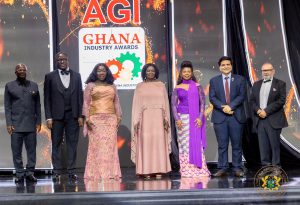

She disclosed that government is modernizing the nation’s ports, expanding transport networks, and operationalizing key infrastructure such as the Boankra Inland Port, which she described as crucial for easing the movement of goods, reducing logistics costs, and empowering local industries to produce finished products capable of competing on the global market.
According to her, these investments are not only designed to improve efficiency but also to open Ghana up for new opportunities in value addition, manufacturing, and export-led growth, in line with the country’s expanded industrial agenda.
Professor Opoku-Agyemang further urged industry players to partner government more actively, stressing that sustainable industrial development requires strong collaboration between policymakers and the private sector. She emphasized that the government’s role is to create the enabling environment, while industry must complement these efforts with innovation, compliance with quality standards, and willingness to invest boldly.
Touching on the raw materials supply chain, the Vice President revealed that through the Agribusiness Policy and the Feed the Industry Programme, manufacturers will soon enjoy more reliable access to high-quality raw materials sourced directly from local farmers. This, she said, will reduce dependence on imports, stabilize production costs, and strengthen the link between agriculture and industry.
She reiterated government’s readiness to champion a 24-hour economy that supports productivity, competitiveness, and sustained economic growth, assuring the business community that Ghana is firmly on the path toward industrial resilience and global relevance.
Story by: George Osei-Akoto Addae (Teacher Kojo) #www.ahotoronline.com/oseiakotor1@gmail.com


