


A public clash has opened over the true nature of the GH¢1 million paid to each of the 18 Ghana Premier League clubs ahead of the 2026/27 season. Sports and Recreation Minister Kofi Iddie Adams has described the money as government sponsorship of the league. Aduana FC general manager Takyi Arhin, speaking as a known GFA figure, says it is a loan the Football Association borrowed and must repay, with government only facilitating the facility.
The two accounts cannot both be literally correct. One treats the cash as a state grant or sponsorship. The other treats it as association debt. Neither the Ministry nor the GFA has yet published the underlying agreement, so the dispute currently rests on the word of the minister against the word of a club executive close to the federation.
What the minister said
Adams, who is also MP for Buem, told Max TV that the Mahama administration is sponsoring the Ghana Premier League and intends to keep doing so until clubs can stand on their own. His quoted line, widely carried on 5 October 2026, was: “Government is sponsoring it (GPL) and intends to continue to sponsor up to a point that the clubs can be on their feet.” He added that government is “interested in building our domestic clubs and leagues.”
Reports of that interview frame the GH¢1 million already received by each top-flight club as government funding. The same package totals GH¢18 million across the division. Adams presented the support as temporary and developmental rather than open-ended, and linked it to a wider effort to stabilise domestic football after years without a major commercial title sponsor. Government involvement had earlier been flagged by GFA president Kurt Okraku at the launch of the 2025/26 broadcast partner, when the state was said to have committed
A public clash has opened over the true nature of the GH¢1 million paid to each of the 18 Ghana Premier League clubs ahead of the 2026/27 season. Sports and Recreation Minister Kofi Iddie Adams has described the money as government sponsorship of the league. Aduana FC general manager Takyi Arhin, speaking as a known GFA figure, says it is a loan the Football Association borrowed and must repay, with government only facilitating the facility.
The two accounts cannot both be literally correct. One treats the cash as a state grant or sponsorship. The other treats it as association debt. Neither the Ministry nor the GFA has yet published the underlying agreement, so the dispute currently rests on the word of the minister against the word of a club executive close to the federation.
What the minister said
Adams, who is also MP for Buem, told Max TV that the Mahama administration is sponsoring the Ghana Premier League and intends to keep doing so until clubs can stand on their own. His quoted line, widely carried on 5 October 2026, was: “Government is sponsoring it (GPL) and intends to continue to sponsor up to a point that the clubs can be on their feet.” He added that government is “interested in building our domestic clubs and leagues.”

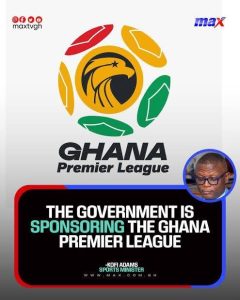
Reports of that interview frame the GH¢1 million already received by each top-flight club as government funding. The same package totals GH¢18 million across the division. Adams presented the support as temporary and developmental rather than open-ended, and linked it to a wider effort to stabilise domestic football after years without a major commercial title sponsor.
Government involvement had earlier been flagged by GFA president Kurt Okraku at the launch of the 2025/26 broadcast partner, when the state was said to have committed resources to the competition.
What Takyi Arhin said
Arhin told Sporty FM the opposite. “The GH¢1 million given to each Ghana Premier League club was not given to us by the government. It was a loan secured by the GFA and facilitated by the government,” he said. “The GFA is going to pay it back.”

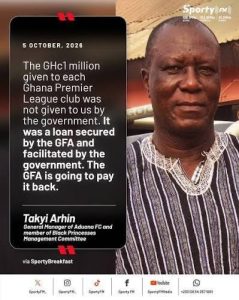
In the same interview he praised Okraku for putting money into clubs, asking who would have expected sides to wake up and receive GH¢1 million to run their operations, and he argued that Black Stars results should not be used as the sole measure of the GFA president.
The loan claim was therefore made by someone publicly aligned with the current GFA leadership, not by an opposition critic.
At the 32nd Ordinary Congress in August, Okraku had also outlined a wider incentive structure that included a record GH¢3 million prize for the eventual champions.
Why the distinction matters
A sponsorship or grant and a facilitated loan are different instruments.
• If the money is a government grant or sponsorship, it is a direct public subsidy. Clubs can treat it as income. The political claim that the state is underwriting the league is accurate, and the fiscal cost sits with the taxpayer unless later recovered in some other form.
• If it is a loan secured by the GFA and only facilitated by government, the association carries the repayment obligation. Clubs may still receive the cash, but the GFA’s balance sheet is encumbered. Calling that arrangement “government sponsorship” overstates the state’s financial commitment and understates the federation’s future liability.
Facilitation can mean several things that have not been clarified: a guarantee, an introduction to a lender, interest support, or political cover for a borrowing. None of those is the same as the Ministry transferring GH¢18 million as sponsorship. Arhin’s phrasing (“facilitated by the government,” “the GFA is going to pay it back”) points to the second reading.
There is also a recent precedent for confusion on this point. Ahead of the 2025/26 season, a GH¢1 million-per-club figure linked to a broadcast arrangement with Adesa Productions was widely rumoured to be government cash.
GFA general secretary Prosper Harrison Addo publicly denied that the state had put up the money, while acknowledging political support from the Chief of Staff, the Majority Leader and the Sports Minister for the enabling environment. The current dispute echoes that earlier gap between political credit and the actual source of funds.
The wider setting
The Premier League has operated for years without a major title sponsor. Club budgets are thin; Aduana’s own leadership has previously said GH¢1 million could cover roughly a third of the club’s annual operating costs.
The return of the Mahama administration in 2025 brought a more visible state role in domestic football, and both the 2025/26 and 2026/27 campaigns have featured a GH¢1 million allocation to each top-flight side. Prize money has also risen, with the 2026/27 champions promised GH¢3 million.
That support is popular with clubs. Arhin himself described administrators as “in love with” Okraku because of the payments and related lower-division assistance (including reported support for Division One sides). The argument is not over whether the money arrived. It is over who ultimately pays for it, and whether the public has been given an accurate description of the transaction.
What remains unresolved
No repayment schedule, lender, interest rate, guarantee letter or Ministry release has been published to settle the point. Adams spoke of continued sponsorship until clubs are self-sufficient. Arhin spoke of a repayable GFA loan. The GFA has previously presented the package as its own support initiative. Until one of the parties produces the facility documents, the public record is a direct contradiction between the Sports Minister and a GFA-aligned club general manager.
The practical questions that follow are straightforward: is the GH¢18 million a charge on the national budget, a contingent liability if government guaranteed the loan, or purely an association borrowing that happens to have had political help? Clubs need to know whether future seasons depend on another grant or on the GFA’s ability to service debt. Supporters and taxpayers need to know which description is the one that matches the paperwork.


