
The Royal Moroccan Football Federation (FRMF) has formally escalated its response to the chaotic events of the Africa Cup of Nations (AFCON) 2025 final, which took place on January 18, 2026, at the Prince Moulay Abdellah Stadium in Rabat.
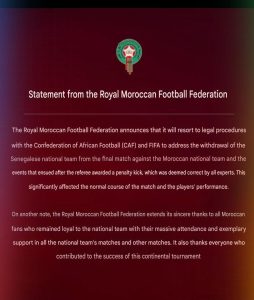
In an official statement released on January 19, the federation condemned Senegal’s brief walkout during the match and announced it is pursuing disciplinary action through both the Confederation of African Football CAF and FIFA.
The incident unfolded deep into second-half stoppage time with the score locked at 0-0. Following a VAR review, referee Jean-Jacques Ndala awarded Morocco a controversial penalty for a foul by Senegal defender El Hadji Malick Diouf on Morocco’s Brahim Díaz. Senegal’s players and staff, led by head coach Pape Thiaw, reacted furiously to the decision—viewing it as soft and biased in favor of the hosts—surrounding the referee before Thiaw instructed his team to leave the pitch and head toward the dressing room.
This created a roughly 14-minute delay filled with heated confrontations between benches, player arguments, and fan unrest that spilled onto the field, including clashes involving chairs and security interventions.
After intense efforts from officials, Senegal eventually returned to the field. Brahim Díaz stepped up for the penalty in the 24th minute of added time but delivered one of the most criticized spot-kicks in recent memory—a hesitant, half-hearted Panenka attempt that floated straight into the arms of Senegal goalkeeper Édouard Mendy, forcing the game into extra time.
There, Pape Gueye scored a powerful strike early in the first period of extra time to secure a dramatic 1-0 victory for Senegal, earning them their second AFCON title (following their 2021 triumph).
The FRMF’s statement described Senegal’s on-field refusal to continue as a serious breach of the Laws of the Game, which mandate that disputes be resolved through official post-match channels rather than disruptive protests.
They argued that the penalty was “deemed correct by all refereeing experts” after review, yet the walkout unnecessarily interrupted the game’s flow, affected player performance under immense pressure, sparked chaos in the stands of fans attempting to storm the pitch and injuries requiring stretchers, and damaged the reputation of African football on its biggest stage.
In addition to lodging the complaint with CAF—which has already opened disciplinary proceedings against Senegal coach Pape Thiaw, potentially facing a lengthy suspension that could even impact the 2026 FIFA World Cup—the FRMF confirmed it will pursue further legal procedures with FIFA to seek appropriate sanctions against the Senegalese team, players, and officials involved.
Morocco’s head coach Walid Regragui echoed this sentiment post-match, labeling Thiaw’s actions as “shameful” and accusing them of bringing disrepute to the continent.
The controversy was compounded by pre-match tensions, as Senegal’s Football Federation (FSF) had issued complaints about inadequate security upon arrival in Rabat, substandard hotel accommodations, limited training facilities, and insufficient ticket allocations for their fans, accusing the Moroccan organizers of undermining fair play.
However, the FRMF’s current focus remains squarely on the in-game walkout and its consequences.
This dramatic final, while crowning Senegal champions, has widely been described across media as one of the most chaotic and embarrassing in AFCON history, highlighting deep-seated issues around refereeing, host advantages, and sportsmanship in African football.