


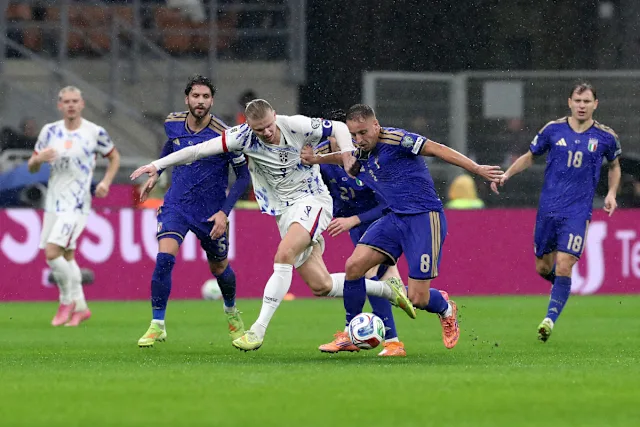
In a match that will be etched into the annals of European football as both a fairy tale and a nightmare, Norway secured their place at the 2026 FIFA World Cup with a stunning 4-1 victory over Italy at the iconic San Siro stadium in Milan on November 16, 2025.
The result not only confirmed Norway’s flawless qualifying campaign but also consigned the Azzurri to yet another torturous playoff path, marking the third consecutive World Cup cycle where Italy must navigate the high-stakes lottery of March 2026 to reach the finals.
For Norway, it’s their first appearance at the global showpiece since 1998, a 28-year drought ended in emphatic fashion, powered by the irrepressible Erling Haaland.
The Match:
The evening began with a flicker of hope for the home crowd of over 70,000, who turned out in force despite the biting November chill and the weight of recent history.
Just 11 minutes in, 20-year-old Bologna striker Francesco Pio Esposito—making only his third international start—gave Italy a dream opening. Picked out by a precise cross from Inter Milan’s Federico Dimarco on the left flank, Esposito controlled the ball with poise before rifling a low shot past Norway’s goalkeeper Ørjan Nyland into the bottom corner.
It was a moment of youthful exuberance that briefly silenced the traveling Norwegian supporters and ignited dreams of an improbable nine-goal swing needed to overtake their Nordic rivals atop Group I.
Italy, under the guidance of coach Gennaro Gattuso, dominated possession in the opening 45 minutes, registering 12 shots to Norway’s mere three.
The Azzurri’s midfield, marshaled by the tenacious Davide Frattesi and the creative Lorenzo Pellegrini, controlled the tempo, while wing-backs Dimarco and Giovanni Di Lorenzo pushed forward with intent.
Yet, for all their fluency, the final touch evaded them—Gianluca Scamacca headed wide from a Dimarco corner, and Esposito’s follow-up effort was deflected just off target.
Norway, content to absorb pressure and counter through the guile of Martin Ødegaard and the pace of Antonio Nusa, ended the half level on aggregate goal difference but trailing 1-0 on the night.
The second half, Norway emerged with renewed vigor, their high-pressing game plan—honed by coach Ståle Solbakken—disrupting Italy’s rhythm from the outset.
The equalizer arrived in the 63rd minute, a thunderbolt from 19-year-old Club Brugge winger Antonio Nusa. The Norwegian prodigy, who had terrorized Italy’s right flank all evening, collected a loose ball 25 yards out, shrugged off a challenge from Alessandro Bastoni, and unleashed a curling right-footed strike that arrowed into the top corner beyond Gianluigi Donnarumma’s despairing dive.
It was a goal of pure class, Nusa’s fourth of the campaign, and it shifted the momentum irrevocably.
From there, the game unraveled for Italy in a blur of Norwegian efficiency. In the 78th minute, Haaland—until then peripheral due to tight marking from Bastoni and Riccardo Calafiori—broke free.
A pinpoint cross from Manchester City teammate Oscar Bobb found the 25-year-old unmarked at the back post, and Haaland met it with a ferocious volley that crashed past Donnarumma from eight yards.
The San Siro fell silent as Haaland wheeled away in celebration, his 15th goal of qualifying now on the board. But the Manchester City striker wasn’t done.
Barely 60 seconds later, in the 79th minute, he struck again, latching onto a through-ball from Ødegaard, holding off Kim Min-jae, and slotting coolly under Donnarumma’s body. Two goals in two minutes, an eruption of clinical brilliance that turned a contest into a procession.
The coup de grâce came in stoppage time (90+3′), as Wolverhampton Wanderers’ Jørgen Strand Larsen—Norway’s industrious target man—capitalized on a swift counter.
Breaking free down the left, he cut inside and drilled a low shot across Donnarumma into the far corner for 4-1. It was a fitting seal on a performance that showcased Norway’s blend of youth, talent, and tactical nous. Final stats told the story: Norway had 52% possession, 15 shots (seven on target), and an expected goals (xG) of 2.8, flipping the script on Italy’s first-half dominance.
For Haaland, this triumph is profoundly personal. Born in Leeds in 2000 while his father Alf-Inge Haaland plied his trade at Elland Road, the younger Haaland will now follow in his dad’s footsteps.
Alf-Inge featured in Norway’s 1998 World Cup squad, their last before this drought, and even scored against Brazil in a group-stage thriller. At 25, with 55 international goals in 48 caps, Haaland becomes Norway’s all-time leading scorer and the face of a golden generation, alongside Ødegaard, Nusa, and Bobb.
Norway’s campaign has been a revelation. Drawn into a group with Italy, Estonia, Israel, and Moldova, they overcame an early 3-0 stumble against Italy in June—where Haaland’s late strike offered scant consolation—with seven straight wins.
Their attacking verve (33 goals scored, European best) and defensive solidity (just one conceded) mark a stark evolution from the Ødegaard-led side that missed out on Euro 2020 and the 2022 World Cup
For Italy, the defeat compounds a decade of qualifying woes that have tarnished their proud legacy as four-time world champions (1934, 1938, 1982, 2006).
The Azzurri entered the night knowing only a miracle—a nine-goal victory—would suffice for direct qualification, but even a draw would have sufficed for second place.
Instead, they limp into the playoffs, joining 15 other hopefuls (12 group runners-up plus four Nations League drop-ins) in a do-or-die format: four paths of single-leg semis and finals in March 2026, with winners earning the final four European spots.
This marks the third straight playoff odyssey. In 2017, a goalless draw and 1-0 loss to Sweden on aggregate saw them miss Russia 2018—the first absence since 1958. Four years on, a 1-0 home defeat to North Macedonia in March 2022—a nation ranked 67th to Italy’s fourth—derailed their Qatar dreams, forcing a playoff loss to Portugal.


