


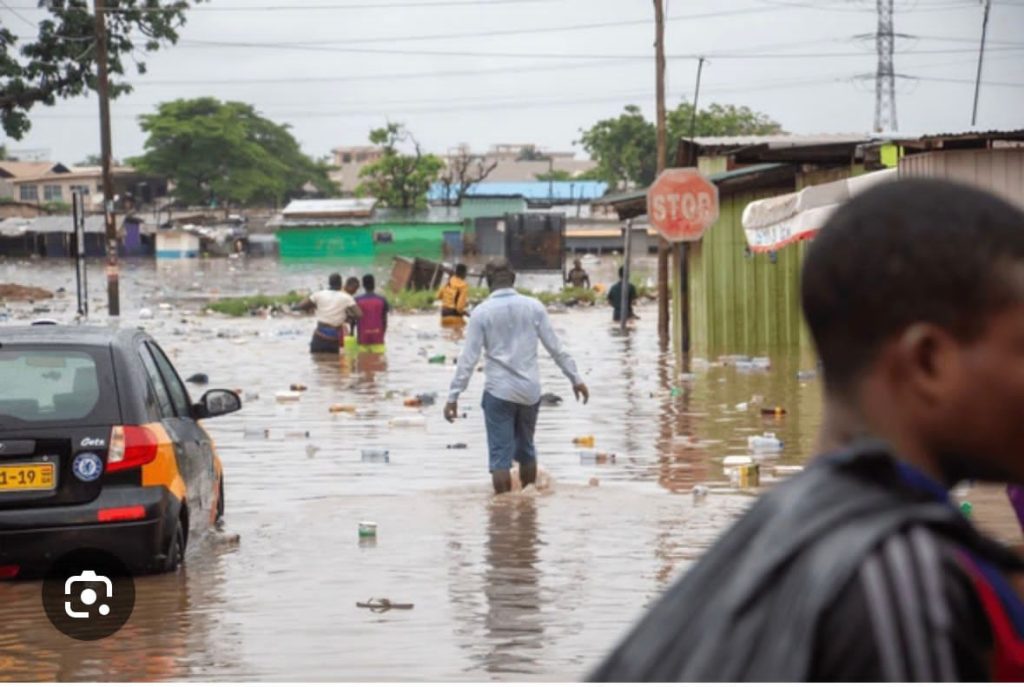
Annual floods are not merely acts of nature—they are the consequence of policy failures, weak enforcement, poor planning, and a collective refusal to confront the root causes of a crisis that continues to cost lives and livelihoods.
By Citizen Kofi Owusu | #CitizenSpeaks
As the rains return, so does a familiar ritual in Accra.
Roads become rivers. Homes are submerged. Businesses count their losses. Families are displaced. Public officials visit affected areas, promises are made, emergency responses are deployed, and the nation mourns avoidable deaths. Then, as the waters recede, attention fades until the next downpour.
The tragedy is not that Accra floods.
The tragedy is that Accra floods in ways that are predictable, recurring, and largely preventable.
For decades, flooding has been treated as a seasonal inconvenience rather than a governance challenge. Yet the evidence before us suggests that what Accra experiences is not simply a natural disaster. It is the cumulative result of planning failures, weak enforcement of regulations, political expediency, and institutional neglect.
Rainfall alone does not explain why communities repeatedly find themselves underwater. Cities around the world receive heavy rains without suffering the same scale of destruction. The difference lies in preparation, infrastructure, and enforcement.
Accra’s drainage systems have struggled to keep pace with rapid urban growth. Waterways have been obstructed by indiscriminate construction. Wetlands that once absorbed excess water have been encroached upon. Buildings continue to emerge in flood-prone areas despite regulations designed to prevent exactly such developments.
The question therefore is not whether the city receives too much rain. The question is why authorities have consistently allowed conditions that transform rainfall into catastrophe.

Part of the problem is political.
Successive administrations have announced flood-control projects, desilting exercises, and redevelopment plans. Some have produced results. Many have stalled, been abandoned, or failed to address the root causes of the problem. Long-term planning often loses out to short-term political calculations. Enforcement becomes selective.
Unauthorized developments remain untouched until disaster strikes.
There is also a culture of shared irresponsibility.
Citizens who dump refuse into drains contribute to blocked waterways. Developers who ignore planning regulations bear responsibility. Public officials who approve questionable projects must also be held accountable. Flooding persists because accountability is often dispersed until it effectively disappears.
Climate change adds another layer of complexity. Extreme weather events are becoming more frequent and more intense. This means that infrastructure designed for yesterday’s climate may be inadequate for tomorrow’s realities. Accra cannot afford to prepare for average rainfall when extreme rainfall is increasingly becoming the norm.
The conversation must therefore shift from emergency response to resilience.
A resilient city invests in modern drainage systems. It protects wetlands and natural water retention areas. It enforces planning regulations without fear or favour. It uses data, technology, and risk mapping to guide development. Most importantly, it treats flooding as a year-round policy priority rather than a seasonal public relations challenge.
The true cost of flooding extends beyond damaged property. It disrupts education, weakens businesses, threatens public health, discourages investment, and erodes public confidence in institutions. Every flood carries economic consequences that far exceed the immediate cost of recovery.
Accra deserves better than annual expressions of concern.
The city deserves leadership willing to confront difficult questions, challenge entrenched interests, and make decisions whose benefits may not be visible within a single political cycle.
Flooding in Accra is not merely an environmental problem. It is a governance test.
And after decades of recurring disasters, it is a test that the city can no longer afford to fail.
Citizen Kofi Owusu
Columnist | #CitizenSpeaks


