


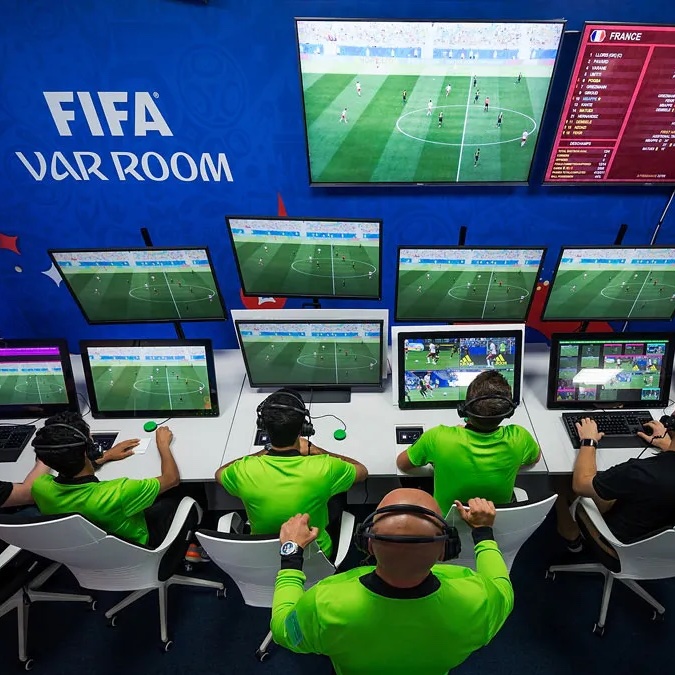
Football’s governing bodies are on the cusp of a significant technological evolution for the sport’s biggest stage. FIFA, in collaboration with the International Football Association Board (IFAB)—the entity responsible for the Laws of the Game—is seeking special dispensation to temporarily broaden the scope of Video Assistant Referee (VAR) interventions during the 2026 FIFA World Cup.
This would mark the first time VAR could review corner-kick decisions, potentially altering how one of the game’s most routine set pieces is officiated.
The proposal, which has gained traction in recent discussions, aims to enhance accuracy in high-stakes matches but has sparked debate over game flow and implementation. Below, we break down the details, rationale, challenges, and broader implications.
Under current IFAB protocols, VAR is limited to reviewing four “clear and obvious” errors: goals, penalty decisions, direct red cards, and mistaken identity.
The 2026 trial would add:
– Corner-kick reviews: VAR officials could intervene if they determine a corner was incorrectly awarded—specifically, to check if the ball fully crossed the touchline (goal line for corners) or to identify the last touch by a player.
This could lead to overturning a corner into a goal kick, or vice versa, even after play has resumed.
– Second yellow card reviews: VAR could assess whether a caution leading to a red card was justified, allowing for potential rescissions to prevent unfair dismissals.
These changes would apply exclusively on a temporary basis for the tournament, hosted across the United States, Canada, and Mexico from June 11 to July 19, 2026.
IFAB could approve them as early as their March 2026 annual general meeting, with implementation starting June 1—just weeks before kickoff. The exact protocols, including when and how interventions occur, are still being finalized and will be announced later.
This isn’t FIFA’s first rodeo with trial-based innovations. Precedents include the 2017 Confederations Cup and Club World Cup, where VAR was tested before global rollout, and semi-automated offside technology debuted at the 2022 Qatar World Cup.
FIFA President Gianni Infantino and senior officials argue that even “minor” errors in set-piece awards can cascade into match-defining moments, especially in a 48-team format with expanded knockout rounds.
Corners often lead to goals—about 15-20% of set-piece strikes in major tournaments—and tight calls on last touches or out-of-play decisions have fueled controversies:
– In the 2022 World Cup, a disputed corner contributed to a goal in a key group-stage match.
– More recently, Premier League clubs like Nottingham Forest have protested goals from wrongly awarded corners, such as Manchester United’s opener against them in late 2025.
Proponents frame it as a “safety net” for the tournament’s prestige: Imagine a wrongly awarded corner deciding the final between, say, Brazil and France.
FIFA’s board, which holds four of IFAB’s eight votes, sees the World Cup’s short duration (one month) as ideal for testing without disrupting domestic seasons.
Not everyone is on board. The proposal faced a mixed reception at IFAB’s technical panel in November 2025, with UEFA—representing European leagues—voicing strong reservations:
– Game flow concerns: Adding corner reviews could exacerbate VAR’s reputation for delays, with matches already averaging 2-3 minutes per intervention.
Critics, including England’s FA chief Mark Bullingham, worry it erodes the referee’s authority under Law 5, which prohibits changing restart decisions post-play.
– No domestic rollout: Domestic leagues (e.g., Premier League, La Liga) have rejected broader VAR expansion, fearing chaos. A World Cup-only trial might create inconsistencies, confusing players and fans.
Despite this, the second yellow card review enjoys near-universal support and is likely to pass in January 2026. Corner powers remain contentious but could proceed via FIFA’s voting clout.
This fits FIFA’s pattern of tech-driven evolution:
– Injury time-wasting trial: At the ongoing FIFA Arab Cup, injured players must leave the pitch for two minutes unless fouled by a carded opponent—another anti-delay measure.
– Discarded ideas: A “dead ball” rule for saved penalties (no rebounds) was floated but shelved.
– Unrelated buzz: Separate talks on Arsène Wenger’s offside reform (allowing attacking players marginally onside) could also debut in 2026, though it’s unrelated to VAR.
Discussions intensified ahead of the World Cup draw in Washington, D.C., on December 5, 2025, where Infantino will also award the inaugural FIFA Peace Prize.


