


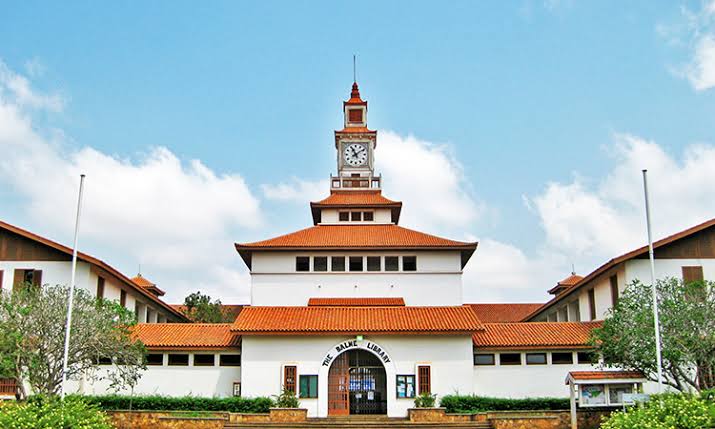
TEMA, Ghana, 19th November: The Secretary-General of the Ghana Federation of Labour (GFL), Abraham Koomson, has questioned the conduct of Acting Rent Commissioner Frederick Opoku during an inspection of student hostel facilities operated by the University of Ghana Enterprises Limited (UGEL).
Mr Koomson criticised the manner in which the Acting Rent Commissioner entered some hostel facilities at the University of Ghana amid growing concerns over high accommodation fees and students’ living conditions.
According to him, the Commissioner should have engaged the university’s management to understand the circumstances surrounding the hostel charges rather than conducting what he described as an unauthorised inspection.
“Instead of engaging the university authorities, you sneaked in and entered the hostels. Is it authorised? Under your mandate, did you go there with a court warrant?” he questioned.
He further argued that President John Dramani Mahama would not have sanctioned the manner in which the Acting Rent Commissioner conducted himself during the inspection at Alexander Adum Kwapong Hall.
Mr Koomson recalled an encounter between the Commissioner and a senior lecturer, who reportedly cautioned him that his conduct would not be welcomed by the President.
“I saw one senior lecturer confronting him and telling him that President Mahama would not like what he was doing, but he was just arguing with him. President Mahama will never send him to go and behave the way he did,” he stated.
To buttress his argument, the GFL Secretary-General cited his personal experience as a parent with children in the university, explaining that he regularly visits their accommodation facilities and takes responsibility for addressing maintenance challenges when necessary.
“My children are in the university, and because of that, almost every week I am there, sometimes twice. If the students have issues with their premises, they report to the porters and the problems are fixed. If it delays, as a responsible parent, you go there and find out why.
“I used to fix things for them, the WC, the wardrobe and other things. I was doing these because if you want your child to have a better environment to study, you must take responsibility for certain things when they are not being provided,” he explained.
Mr Koomson maintained that the University of Ghana is not anybody’s private property and argued that the Acting Rent Commissioner should have formally engaged the university’s management to understand the reasons behind the accommodation charges.
He questioned the basis of the inspection, particularly the Commissioner’s assessment of the hostel facilities, insisting that the university should have been given the opportunity to explain its operational and maintenance challenges.
“With the rooms he showed at Legon, it means he didn’t attend a university in Ghana and doesn’t understand anything. To me, he is useless and must be removed from there. How can you go to a university and behave this way? The university is not anybody’s private property.
“If you have a genuine case like the rent issue, you need to engage the management to find out why they are charging that much for them to explain it to you,” he said.
The labour leader also questioned the circumstances surrounding Mr Opoku’s appointment, suggesting that his actions could be an attempt to demonstrate his suitability for confirmation as the substantive Rent Commissioner.
“I don’t know how such people are appointed. Nobody can say it was the President who appointed him. No, he was appointed either through the Public Services Commission or whatever. Maybe he is trying to prove that he has to be confirmed as the substantive Commissioner,” he added.
Mr Koomson further argued that the rising cost of construction materials and maintenance makes it difficult for institutions to provide and maintain affordable accommodation without adequate financial support.
He said the government, which has a responsibility to support the provision of affordable student accommodation, should consider investing in hostel facilities at the University of Ghana, particularly given the institution’s vast available land.
“Today, even if you are putting up a kiosk using wawa wood, the cost involved is huge. So, indirectly, he is insulting the government because it is the government’s responsibility to provide free or affordable accommodation for students.
“If you go to Legon, there are vast stretches of land there. If the government wants to build hostels and release them free to students, it can do that,” he argued.
He also criticised the Commissioner for allegedly failing to establish how much the university spends on maintaining its hostel facilities before questioning the accommodation charges.
According to him, such an approach could discourage the university from operating the facilities if the institution is unable to recover its maintenance costs.
“You didn’t find out how much the university is spending on maintenance, and you go there to behave this way. So, what will happen if they shut down all the hostels because they can’t cope with the maintenance cost?” he questioned.
Mr Koomson consequently called for Mr Opoku to be replaced, arguing that the Commissioner should have first engaged the university authorities to understand their challenges before undertaking the inspection.
He also warned that a similar approach at privately owned hostels could provoke confrontations with their operators.
“If he is given a gun to work with, he will be killing by heart. So, I strongly advise that this man must be changed. He doesn’t deserve to be there at all. You have not engaged the university authorities to know their challenges and why they are not able to reduce hostel rent.
“If he likes, he should go round to the private hostels and behave the same way. They will beat him mercilessly,” he warned.
The GFL Secretary-General further appealed to the government to provide financial assistance to the University of Ghana to enable it to reduce accommodation charges for students.
He maintained that the university’s internally generated funds were insufficient to meet its operational and maintenance obligations, making it unfair for external authorities to dictate accommodation rates without considering the institution’s financial circumstances.
“If the government wants the University of Ghana to allow students to pay GH¢1,000 or GH¢1,200 as hostel rent, it must help the university because its internally generated funds are not enough. So, you cannot dictate from outside for them,” he said.


