


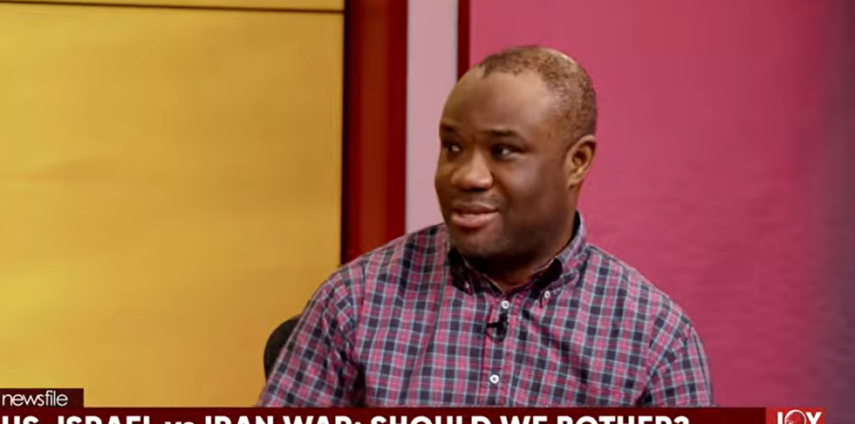
The Minister for Government Communications, Felix Kwakye Ofosu, has assured that the government will maintain fiscal discipline despite the expiration of restrictions on new domestic bond issuance.
His comments come after the Minister for Finance, Cassiel Ato Forson, announced that the limitations placed on Ghana’s domestic bond market had expired.
The announcement was made on the minister’s social media platforms and signals that government can now return to the domestic market to raise funds.
Speaking on Newsfile on JoyNews on Saturday, March 7, Mr Kwakye Ofosu stressed that borrowing itself is not inherently problematic, noting that it remains a normal part of economic management across the world.
“Borrowing is a long-standing part of economic management. Every country does that. There’s nothing wrong with borrowing,” he said.
According to him, Ghana’s economic difficulties in recent years were not caused by borrowing alone but rather by excessive borrowing and poor economic management under the previous administration.
“The problem we’ve had, especially under the NPP, was the extent of borrowing and how mismanagement of the economy made it impossible to pay, which then precipitated all the economic problems we’ve had,” he said.
Mr Kwakye Ofosu explained that as part of the country’s programme with the International Monetary Fund (IMF), restrictions had been placed on government’s ability to issue new domestic bonds for a period of three years.
With that period now expired, he said the government is legally permitted to return to the domestic market if necessary.
“As part of the IMF programme, a ban – if you like, for want of a better expression – was placed on the ability to borrow domestically for three years. That time elapsed some time last week, and therefore government can return to the domestic market,” he explained.
However, he emphasised that the development should not be interpreted as a signal that the government intends to borrow aggressively.
“It does not mean that there will be a mad rush to the domestic market to borrow left, right and centre to imperil the economy,” he said.
“Everything that is done will be done in a manner that is consistent with the level of fiscal discipline and economic prudence that we have demonstrated.”
Mr Kwakye Ofosu noted that the critical issue with borrowing lies in how the funds are utilised.
According to him, borrowing should ideally be directed towards capital investment that expands the productive capacity of the economy rather than simply financing recurrent expenditure.
“When you go and borrow, what is it for really? Are you borrowing just to meet recurrent expenditure, or are you borrowing to invest in capital expenditure and the productivity of the economy?” he asked.
He said borrowing directed at productive sectors can stimulate economic growth and generate the resources required to sustain development and finance government operations.
The minister highlighted several fiscal management reforms introduced by the government to control public expenditure and prevent a return to the economic challenges of the past.
Among these measures, he said, is the introduction of commitment controls designed to ensure that spending requests by government agencies undergo strict scrutiny.
“What that simply means is that if you are an agency of government and you bring any request for funding, it will be scrutinised and gone through with a fine comb,” he explained.
“It is only those expenditures that we deem essential or necessary that will be approved.”
Mr Kwakye Ofosu also revealed that the Finance Ministry plans to introduce a new oversight mechanism known as the Value for Money Office, which will soon be presented to Parliament for approval.
The proposed office, he said, will complement the work of the Public Procurement Authority by evaluating whether government procurement delivers genuine value for the state.
“It simply means that in addition to what the Public Procurement Authority does to ensure compliance with procurement rules, there will be an office dedicated to determining whether the value of goods or services being purchased is justified,” he said.
According to him, the initiative is intended to reduce the cost of government spending and ensure that public resources are used judiciously.
Mr Kwakye Ofosu said the government’s broader objective is to avoid repeating the fiscal mistakes that previously plunged the economy into crisis.
He noted that excessive spending relative to national revenue has historically been one of Ghana’s most persistent economic challenges.
“Every analyst of this economy will tell you that the biggest problem we’ve had cyclically has been overspending,” he said.
“We spend far more than we earn as a country, so we are always in debt.”
He also rejected claims that Ghana’s economic difficulties were solely caused by the global impact of the COVID-19 pandemic, arguing that election-year spending in 2020 significantly worsened the country’s fiscal situation.
According to him, while many countries faced economic shocks during the pandemic, Ghana’s fiscal deficit widened significantly due to what he described as election-related overspending.
He said that by the end of 2020 the fiscal deficit had risen sharply, forcing the country to eventually seek support from the IMF and undertake a painful debt restructuring programme that affected domestic bondholders.
Mr Kwakye Ofosu said the current administration has taken deliberate steps to reduce the cost of governance.
Among the measures he cited were the reduction in the number of ministers compared with the previous administration and cuts in several operational expenses at the presidency.
He noted that the government has reduced the number of ministerial appointments significantly, a move he said has saved millions of dollars in salaries, vehicles, accommodation and operational costs.
“If you have about 60 ministers fewer than your predecessor, that alone represents significant savings,” he said.
He also disclosed that several spending practices within government offices have been curtailed, including the use of satellite television services at the presidency.
According to him, the President has even scrapped fuel allocations previously granted to ministers and other senior officials as part of efforts to reduce public expenditure.
“These are widespread across government and represent significant savings,” he said.
Mr Kwakye Ofosu maintained that with these cost-control measures in place, the resumption of domestic borrowing will not jeopardise the country’s economic recovery.
“Borrowing itself is not a problem,” he said.
“It is the extent to which you borrow and how prudently you manage the resources.”


