


The Centre for Policy Scrutiny (CPS) has warned that Ghana’s recent macroeconomic stability risks becoming increasingly reliant on Bank of Ghana interventions that may not be sustainable.
It argues that lasting economic gains will require deeper structural reforms rather than continued support from the central bank.
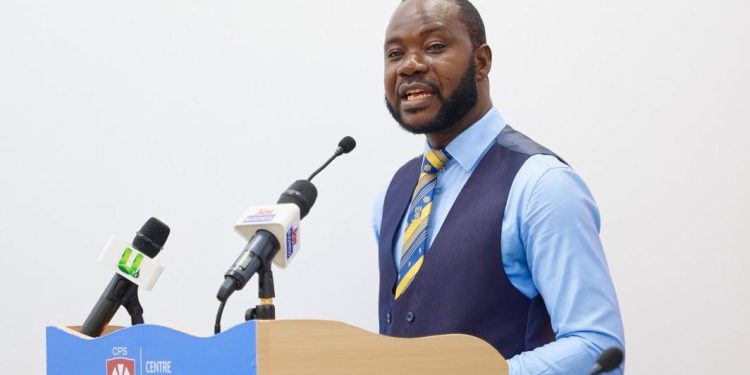
Presenting the Centre’s assessment of the 2026 Mid-Year Budget Review, Executive Director Dr. Adu Owusu Sarkodie said recent improvements in the cedi, inflation and liquidity conditions should not obscure underlying vulnerabilities in the economy.
A major concern, he said, is the Bank of Ghana’s approach to managing the exchange rate.
While acknowledging that the central bank has accumulated strong foreign exchange buffers-about US$12.9 billion in reserves alongside 24.4 tonnes of gold; Dr. Sarkodie questioned the absence of a clearly defined benchmark for when the Bank steps into the foreign exchange market.
“We all know that Ghana practices a managed floating exchange rate regime,” he said. “When it becomes excessive, then they will intervene. They have not quantified the excessive or excessiveness.”
He argued that without a transparent intervention threshold, market participants are left uncertain about what level of cedi depreciation triggers action by the central bank.
Although he believes the Bank currently has sufficient reserves to support the currency, he cautioned that such interventions cannot continue indefinitely, particularly if Ghana’s reserve position weakens because of external shocks such as a fall in global gold prices.
“So do they have the capacity now? Yes,” he said. “The question is, for how long can they intervene?”
Dr. Sarkodie also challenged the Bank of Ghana’s description of its foreign exchange operations as “intermediation” rather than intervention.
He argued that foreign exchange intermediation is traditionally performed by commercial banks seeking market returns, whereas the central bank’s role is fundamentally different.
“Whatever they are doing is still intervention,” he said. “We do not condemn the act of intervention. We just condemn their semantics.”
Beyond the foreign exchange market, the Centre questioned whether monetary policy alone can continue to anchor Ghana’s disinflation process.
Dr. Sarkodie noted that the Bank of Ghana spent heavily sterilising excess liquidity in 2025 to contain inflation, an exercise that contributed to significant financial losses and left the central bank requiring recapitalisation.
“The Bank of Ghana needs recapitalisation. Given the present position of the Bank of Ghana, they cannot continue to sterilise as they did in 2025,” he said.
Instead, he argued that inflation management must become a shared responsibility across government, particularly as recent price pressures have been driven by food supply constraints rather than excess demand.
“We saw how ginger, tomatoes and plantains were driving Ghana’s inflation,” he said. “This is not a Bank of Ghana solution. It should be a Ministry of Agriculture solution.”
The Centre also questioned the effectiveness of recent credit expansion.
Although real private sector credit growth has accelerated sharply since late 2025, Dr. Sarkodie said economic output has not responded at the same pace, raising concerns over where bank lending is flowing.
“The gap keeps widening,” he observed. “It raises certain questions. Who is getting the credit?”
He warned that if a significant share of lending is financing imports of finished goods instead of productive investment, stronger credit growth may do little to stimulate domestic output while increasing import dependence.
The Centre’s assessment suggests that while Ghana’s macroeconomic indicators have improved, sustaining those gains will require greater policy coordination, stronger domestic production and reforms that reduce the economy’s dependence on central bank intervention.


