


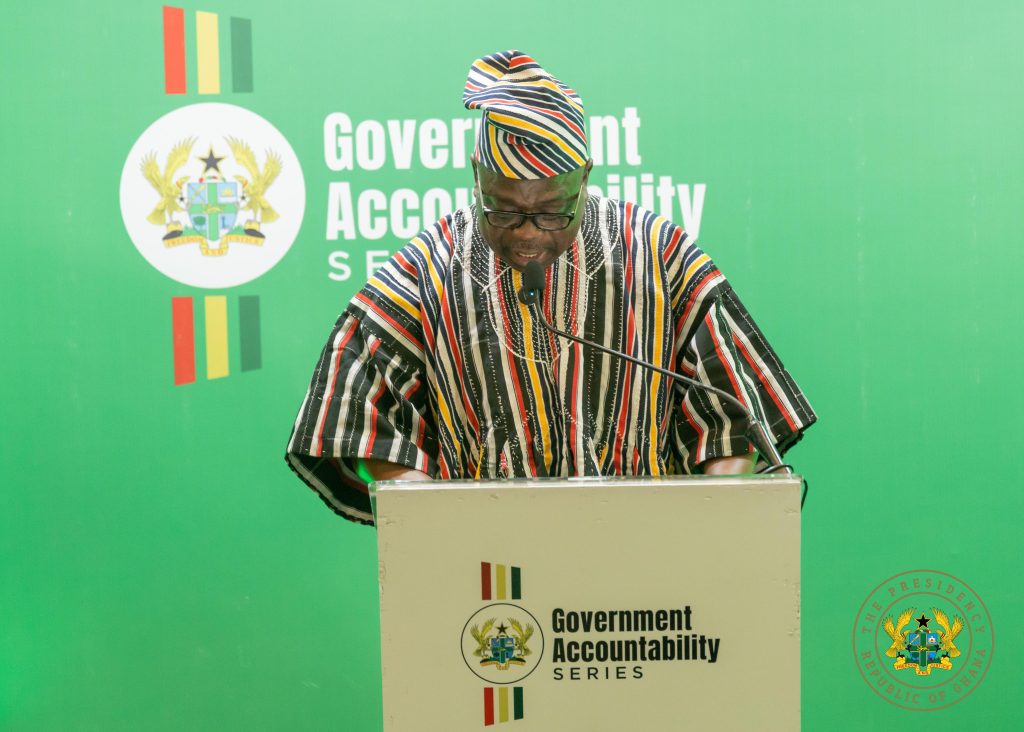
ACCRA, Ghana, 6th May: The Minister of State for Climate Change and Sustainability, Seidu Issifu, has underscored the need for strong institutional coordination to deliver an effective national response to climate change, stressing that climate action spans multiple sectors of the economy.
Speaking at the Government Accountability Series held at the Presidency on Wednesday, May 6, the Minister said:
“Distinguished ladies and gentlemen, delivering an effective national response to climate change requires strong coordination across institutions as climate action cuts across multiple sectors, including energy, water, agriculture, infrastructure, and finance”.
He noted that without such coordination, efforts risk becoming fragmented, while critical investment opportunities could be lost.
He explained that one of the early priorities of his office was therefore to establish robust institutional mechanisms to bring together key stakeholders across government.
“Without this coordination, effort risk becoming fragmented and opportunities for collaboration and investment may be missed. For this reason, one of the early priorities of the office was to establish institutional mechanisms that bring together the relevant actors across governments, the private sector, development partners, and civil society to align national climate priorities. This led to the establishment of climate and sustainability units in most institutions and agencies across sectors of the economy” he stated.
Providing further details, the Minister disclosed that on May 30, 2025, his office convened the inaugural inter-ministerial and agency technical working group meeting, which brought together ministries, agencies, financial institutions, private sector actors, civil society organisations, and development partners.
“On the 30th of May, 2025, the office convened the inaugural interministerial and agency technical working group meeting, bringing together ministries, agencies, financial institutions, the private sector, civil society organizations, and development partners” he said.
Hon. Issifu further outlined the objectives of the technical working group, emphasizing its role in aligning national climate efforts with sectoral policies and programmes.
“The objective of this technical working group are to align sectoral policies and programs with national priorities on climate change and sustainability, identify opportunities for collaboration and resource mobilization, monitor progress on cross-sector climate commitment, and provide technical inputs to inform policy and decision making, to promote coherent and synergy in the implementation of national and international obligations, and finally, to recommend scalable and bankable climate projects” he said.
Story by: Emmanuel Romeo Tetteh(#RomeoWrites✍️)/Ahotoronline.com | Ghana 🇬🇭


