


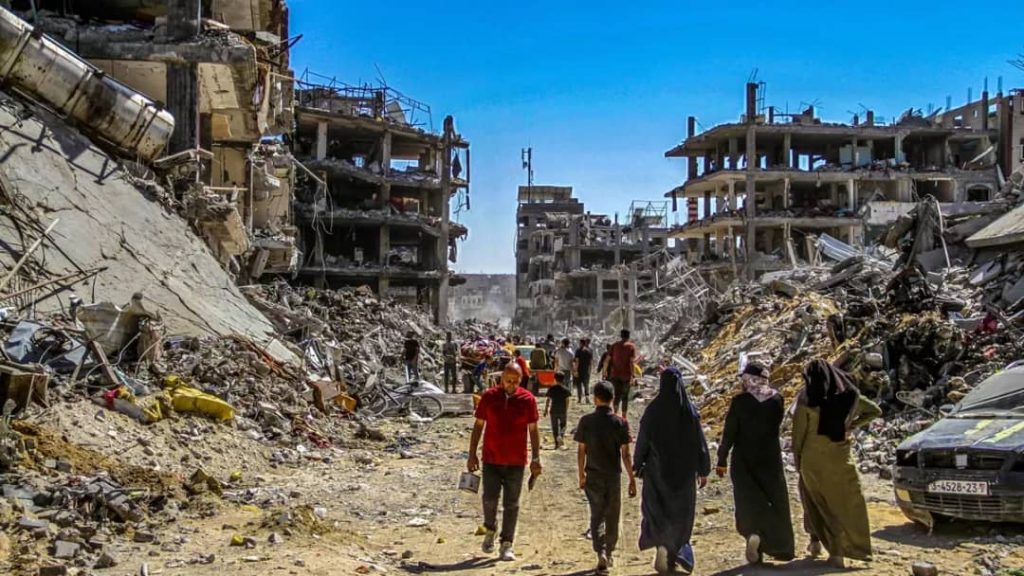
Qatar’s prime minister has issued a stark warning that the fragile ceasefire in Gaza is in serious danger of collapse, as Israel continues to carry out daily military violations that undermine the agreement and push the besieged Palestinian enclave further into catastrophe.
Speaking after high-level talks in Washington with United States Secretary of State Marco Rubio, Sheikh Mohammed bin Abdulrahman bin Jassim Al Thani cautioned that persistent breaches of the truce are eroding trust, paralyzing mediation efforts, and threatening to derail the entire framework designed to halt Israel’s war on Gaza.
“Delays, continued violations, and the absence of genuine commitment place the whole process at risk and put mediators in an impossible position,” the Qatari leader said, stressing that the ceasefire cannot survive without accountability and political will.
Qatar’s Mediating Role and the Fragile Truce
Qatar has been one of the central diplomatic brokers between Israel and Hamas, working alongside Egypt and the United States to negotiate a ceasefire after months of relentless bombardment, mass displacement, and civilian casualties in Gaza. The agreement, which came into effect on October 10, was intended as a phased process: an initial halt in fighting paired with prisoner and captive exchanges, followed by a broader political and security settlement aimed at ending the war.
However, Sheikh Mohammed warned that the agreement is rapidly fraying. He reiterated Qatar’s position that humanitarian aid must be allowed into Gaza without conditions or political obstruction and that negotiations for the second phase of the deal must begin immediately, rather than being stalled through military escalation.
These comments came during the seventh US-Qatar Strategic Dialogue, held against the backdrop of an escalating humanitarian emergency and growing international concern that the truce is being hollowed out in practice.
Hundreds of Violations Since Ceasefire Began
Despite the ceasefire, Israeli forces have repeatedly carried out strikes, raids, and targeted killings inside Gaza. According to reports, Israel has violated the agreement at least 738 times since it took effect, resulting in the deaths of at least 394 Palestinians and injuries to more than 1,075 others.
Another major topic was the proposed deployment of an International Stabilization Force (ISF) to Gaza in later phases of the agreement. This force is expected to include troops from countries such as Indonesia and Türkiye, though Israel has objected strongly to any Turkish role. The third issue was Gaza’s rapidly worsening humanitarian crisis, with Qatar urging the US to use its leverage to ensure aid flows freely into the territory.
Targeted Killing Pushes Truce to Breaking Point
The ceasefire reached a critical juncture over the weekend when Israel assassinated senior Hamas commander Raed Saad in Gaza City. The killing triggered sharp international concern and renewed fears that Israel is deliberately sabotaging the truce.
US President Donald Trump said his administration was “looking into” whether the strike constituted a violation of the ceasefire. Meanwhile, American officials revealed that the White House had delivered a stern message to Israeli Prime Minister Benjamin Netanyahu, warning him not to undermine the agreement Trump had personally championed.
Despite the rebuke, Netanyahu defended the assassination, claiming Hamas had breached the ceasefire by attempting to rearm—an accusation Hamas denies.
Winter Storms Deepen Gaza’s Humanitarian Disaster
As political tensions rise, conditions on the ground in Gaza have become increasingly dire. Severe winter storms have battered the territory, compounding the suffering of hundreds of thousands of displaced Palestinians who are forced to live in torn tents, flooded camps, or unstable ruins of bombed-out buildings.
Israel’s continued refusal to allow essential supplies into Gaza—including mobile homes, tents, blankets, and winter clothing—has dramatically worsened the situation. Gaza’s Government Media Office reports that only 39 percent of approved aid trucks are actually reaching their intended destinations. While Israel has permitted non-essential items to enter, it continues to block nutritious food and critical shelter materials.
The human cost of these restrictions has been devastating. On Thursday, a premature baby just 29 days old, Said Asad Abedin, died from severe hypothermia in the al-Mawasi area of Khan Younis, according to Nasser Hospital. His death brought the number of weather-related fatalities to 13. Earlier in the week, two-week-old Mohammed Khalil Abu al-Khair also died after exposure to extreme cold.
The United Nations estimates that approximately 30,000 children have suffered damage to their shelters during recent storms, while Israel continues to block winterization aid from entering the enclave.
Uncertain Path to the Second Phase
Hamas’s Gaza leader, Khalil al-Hayya, warned that Israel’s ongoing actions are “endangering the viability of the agreement” and called on President Trump to pressure Israel to fulfil its obligations.
The second phase of the US-backed ceasefire is far more complex than the first. It envisions Hamas disarming, Israeli forces withdrawing from Gaza, and the deployment of an international force—conditions that have proven deeply contentious. By contrast, the initial phase focused primarily on exchanges of captives and prisoners.
Netanyahu said on Saturday that Israel was approaching the end of the first phase and was working to recover the remains of Master Sergeant Ran Gvili, the last deceased Israeli captive held in Gaza.
At the same time, Israel has returned the bodies of hundreds of Palestinian prisoners to Gaza. Many of these bodies reportedly show signs of torture, mutilation, and execution, raising further accusations of grave human rights violations.
As mediators scramble to salvage the ceasefire, Qatar’s warning is clear: without immediate progress, an end to Israeli violations, and unrestricted humanitarian access, the agreement risks collapsing—plunging Gaza back into full-scale devastation.
Story by Freedom Etsey Lavoe/ahotoronline.com


