


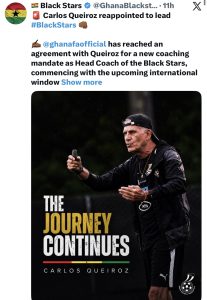
The Ghana Football Association confirmed on 2 September 2026 that Carlos Queiroz has been reappointed as head coach of the Black Stars, bringing an end to weeks of uncertainty that followed the expiration of his original short-term contract after the 2026 FIFA World Cup.

The Portuguese tactician, now 73, first took charge in mid-April after Otto Addo was dismissed following a run of poor results in friendlies. He was given a four-month mandate specifically to prepare Ghana for the expanded tournament co-hosted by the United States, Canada and Mexico.
What followed was a campaign that exceeded many expectations. Ghana opened with a 1-0 victory over Panama in Toronto, held England to a goalless draw, and despite a 2-1 defeat to Croatia still advanced as one of the best third-placed sides.
That progress marked the Black Stars’ first knockout appearance since the 2010 quarter-finals in South Africa. Their run ended with a 1-0 loss to Colombia in Kansas City, after which Queiroz issued a reflective statement that many interpreted as a farewell. He spoke of honouring the colours of Ghana and restoring respect on the world stage while stressing that lasting success would require improvements off the pitch as well as on it.
Negotiations nevertheless continued behind the scenes. Outstanding payments related to the World Cup campaign were settled with assistance from the Ministry of Sports and Recreation, removing a significant obstacle. The GFA’s Executive Council had already indicated it wanted continuity after assessing the team’s organisation and results under Queiroz.
The new agreement, reached after discussions involving the association and the ministry, installs him for the next phase of the team’s programme, beginning with the upcoming international window. Details of contract length and specific targets have not yet been released, but the first fixtures under the fresh mandate are clear. Ghana travel to Bouaké to face Côte d’Ivoire in late September in 2027 Africa Cup of Nations qualifying, then host The Gambia in Accra a few days later.
Those matches open Group C, which also includes Somalia. Ghana missed the 2025 AFCON, the first time the four-time champions had failed to reach the finals since 2004, so qualification for the 2027 edition in East Africa is an immediate priority.
Queiroz arrives with one of the most extensive international résumés in the game. Born in Mozambique in 1953, he first gained prominence by winning consecutive FIFA U-20 World Cups with Portugal’s youth sides in 1989 and 1991, developing a generation that included Luís Figo and Rui Costa. He later served as assistant to Sir Alex Ferguson at Manchester United during two spells that coincided with three Premier League titles and the 2008 Champions League, and he spent a season as head coach of Real Madrid.
As a senior national-team manager he has taken charge of Portugal, reaching the 2010 World Cup last 16, South Africa, qualifying them for 2002, Iran across two stints that included three World Cups and an unbeaten qualification campaign for 2014, Colombia, Egypt, who reached the AFCON final in 2021, Qatar, Oman and now Ghana for a second time. The 2026 tournament was his fifth consecutive World Cup as a head coach, a feat matched by few.
His reputation rests on defensive organisation, tactical discipline and the ability to extract results from sides that are not always favourites. Those qualities were evident in the short time he had with the Black Stars before the World Cup. A team that had been leaking goals and struggling for cohesion became compact enough to frustrate England and grind out a result against Panama.
The GFA has cited exactly those attributes—extensive international experience, technical expertise and existing knowledge of the current squad—as the reasons for retaining him. Continuity is seen as valuable after the disruption of the mid-cycle coaching change earlier this year.
Queiroz himself had described the original appointment as a mission rather than merely another job, and he now returns with a longer horizon that will allow him to work on squad building, youth integration and the structural issues he highlighted after the World Cup. For Ghanaian supporters the reappointment offers a measure of stability heading into a qualifying campaign that will test whether the modest but meaningful progress shown in North America can be sustained and expanded.


