


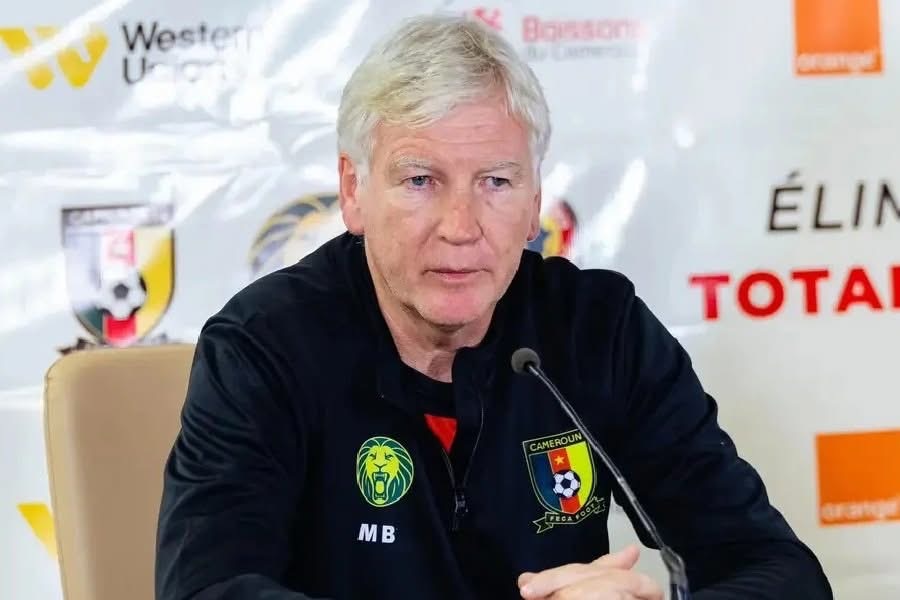
With just days until Cameroon’s pivotal 2026 FIFA World Cup playoff semi-final against DR Congo on November 13 in Rabat, Morocco, the Indomitable Lions are engulfed in administrative turmoil.
The standoff between head coach Marc Brys and the Cameroon Football Federation (FECAFOOT) revolves around the formal announcement of the national team squad, a routine procedure that has spiraled into a full-blown power struggle, severely disrupting team preparation and morale.
Marc Brys, the Belgian coach appointed in April 2024 amid significant controversy, is already in Morocco managing logistics for the neutral-site playoff tournament, which also includes Nigeria facing Gabon in the other semi-final.
He insists that traveling to Yaoundé for an in-person press conference to unveil the 26-man squad is impractical and wasteful, especially with time running out.
Local reports confirm that Brys has no intention of making the trip, prioritizing immediate operational readiness in Morocco over ceremonial formalities. He has proposed announcing the squad via video conference, a practical modern solution to avoid the more than 1,000-kilometer journey.
FECAFOOT, under the leadership of president Samuel Eto’o, remains inflexible, demanding strict adherence to protocol: no physical presence in Yaoundé means no official squad release or submission to FIFA and CAF.
This refusal has paralyzed the entire process, from notifying players to processing visas and arranging travel, leaving potential call-ups in uncertainty. Without the official list, players cannot join the training camp, and the federation cannot coordinate with clubs or international partners.
The delay poses a serious threat to Cameroon’s World Cup campaign. As one of Africa’s best second-placed teams from group qualifying, the Indomitable Lions must defeat DR Congo and then win the final on November 16 to earn an intercontinental playoff spot against a team from Asia or Oceania.
This crisis is the latest chapter in a prolonged conflict between Brys and FECAFOOT. Appointed by the Ministry of Sports without federation input, Brys has delivered strong results on the field, guiding Cameroon to a top qualifying position and securing AFCON qualification.
Yet off-field tensions have persisted, marked by suspensions, public spats, and disputes over staff appointments. FECAFOOT has repeatedly challenged Brys’ authority, while the coach has criticized the federation’s lack of support and bureaucratic overreach.
The impasse has real consequences. Club announcements have leaked names like Frank Zambo Anguissa and André Onana, but without FECAFOOT’s approval, these remain unofficial.
The team’s camp in Rabat has begun with staff present, but players cannot join without formal clearance. Rumors swirl of an interim coach taking over if the dispute escalates further.
For Cameroon, a five-time African champion, this is more than a logistical failure; it is a symptom of deeper institutional dysfunction. The clash between protocol and practicality, between federation and coach, risks derailing a golden opportunity on the global stage.
With the match just days away, the focus should be on the pitch, but instead, the Indomitable Lions are fighting to resolve a crisis of their own making.


