


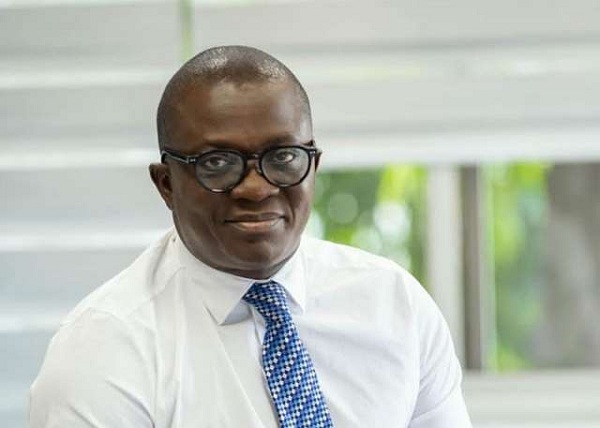
Aspiring flagbearer of the New Patriotic Party (NPP), Dr. Bryan Acheampong, has delivered a blunt and uncompromising assessment of the party’s performance in the 2024 presidential election, arguing that the outcome under Dr. Mahamudu Bawumia amounted to a clear rejection by the Ghanaian electorate.
Speaking in a wider discussion about the future leadership of the party, the former Member of Parliament for Abetifi said the electoral figures leave little room for interpretation. In his view, the numbers alone constitute a verdict against Dr. Bawumia’s candidature.
According to Dr. Acheampong, attempts to justify Dr. Bawumia’s performance by pointing to his long-standing presence on the national political stage only weaken, rather than strengthen, the case for his retention as the party’s presidential candidate.
“The facts tell a very simple story,”He said. “Everything ends at 41 per cent.”
Dr. Acheampong described Dr. Bawumia as the most heavily promoted candidate the NPP has ever put forward. He noted that Dr. Bawumia spent eight years as running mate to President Nana Addo Dankwa Akufo-Addo, followed by another eight years as Vice President—sixteen years of continuous national exposure.
“We marketed him for sixteen years, and the outcome was 41 per cent,” he stressed.
To underline his argument, the former Minister for Food and Agriculture drew a comparison with President Akufo-Addo’s first presidential contest. He recalled that Akufo-Addo, who was relatively less exposed at the time, was introduced to the electorate over a much shorter period.
“We marketed Akufo-Addo for just eight months, and he secured 49.7 per cent,” Dr. Acheampong said. “So, when people try to use long exposure as an advantage for Dr. Bawumia, they are actually making his case worse, not better.”
Beyond the headline percentage, Dr. Acheampong pointed to what he described as an unprecedented collapse of the party’s electoral map in 2024. He said the NPP failed to win a single presidential constituency in seven regions of the country.
“Volta, Oti, Upper East, Upper West, Savannah, Bono East,” he listed. “In all these regions, we could not win one constituency.”
He said the scale of the defeat was particularly troubling, given the expectations that preceded the election. Within the party, there had been strong belief that Dr. Bawumia’s candidature would consolidate and expand the NPP’s support base in the northern parts of Ghana.
“When we were supporting him in 2023,” Dr. Acheampong explained, “one of the core assumptions was that he would hold the northern vote for us.”
That expectation, he argued, was shattered on election day. Of the regions where the NPP failed to win a single presidential constituency, five were in the northern half of the country.
Dr. Acheampong went on to outline losses in other traditionally competitive areas. In the Western Region, he said, the party contested 17 constituencies but managed to win only one presidential vote. In the Central Region, out of 23 constituencies, the NPP secured just two presidential victories. The situation in Greater Accra was no better, he added.
“In Greater Accra, with 34 constituencies, we won only two at the presidential level,” he said.
For Dr. Acheampong, these outcomes are the critical factors shaping the internal debate within the NPP. He said party delegates are not judging personalities or reputations but are instead responding to hard electoral outcomes.
“These attributes and these results are what the delegates are looking at. That is the verdict they are passing,” he said.
Returning to his earlier analogy, Dr. Acheampong framed the issue in commercial terms. He argued that politics, like business, is ultimately about results.
“If you market a product for sixteen years and it produces 41 per cent, and another product is marketed for eight months and produces nearly 50 per cent, then clearly something is not working,” he said. “The marketing did not translate into sales, and when that happens, people change the product.”
When reminded that political history often shows parties sticking with candidates who lose elections, Dr. Acheampong rejected the comparison, insisting that the NPP’s own history tells a different story.
“You are mixing logic with politics and performance,” he said. “Logic alone might suggest repeated attempts, but the NPP has always been guided by performance.”
He referenced the party’s experience in the Fourth Republic, beginning with Professor Albert Adu Boahen and Dr. Kofi Abrefa Busia, before turning to former President John Agyekum Kufuor.
“Kufuor did better than Adu Boahen in 1996, so we returned him. That decision was based on performance,” he said. “He showed growth.”
Dr. Acheampong noted that Kufuor went on to win in 2000 and further improved his showing in 2004. He said a similar pattern applied to Nana Akufo-Addo.
“Akufo-Addo performed better than Kufuor’s 2004 results, which justified bringing him back,” he said. “In 2012, he did better than his own performance in 2008, so we returned him again.”
According to Dr. Acheampong, that upward trajectory continued. Akufo-Addo won in 2016 and, he added, improved on his own results in the 2020 election.
For him, the lesson is clear: the NPP rewards improvement, not mere persistence.
“The party’s history is not about habit,” Dr. Acheampong concluded. “It is about performance, and the numbers must move forward, not backwards.”
Story by Freedom Etsey Lavoe/ahotoronline.com


