


The Ghana Tennis Federation has sounded a loud alarm with an urgent press release dated May 5, 2026, desperately appealing to the government and corporate sponsors for immediate financial assistance to prevent the national teams from missing crucial upcoming competitions.

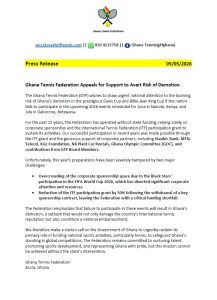
Without sufficient funding, Ghana stands at serious risk of automatic demotion in both the prestigious Davis Cup for men and the Billie Jean King Cup for women. The events in question are set for June in Nairobi, Kenya, and July in Gaborone, Botswana, representing vital opportunities for Ghanaian players to compete on the international stage and maintain the country’s presence in these global team tournaments.
For the past 15 years, the federation has operated largely without steady support from the state, relying instead on a patchwork of corporate sponsorships, grants from the International Tennis Federation, and even personal contributions from its board members.
This fragile model has been pushed to the breaking point recently due to a sharp 50 percent reduction in ITF participation grants, combined with the national sports funding landscape being heavily tilted toward football preparations for major tournaments like the World Cup.
As a result, resources that might have gone to tennis have been redirected elsewhere, leaving the federation unable to cover essential costs such as team travel, accommodation, training camps, and participation fees.
The consequences of skipping these ties would extend far beyond simple demotion. Officials warn that it would inflict lasting damage on Ghana’s international tennis reputation, undermine years of progress in talent development, and amount to a significant national embarrassment on the global sporting stage.
Young players who have shown promise and dedication could see their pathways to higher-level competition abruptly narrowed, while the sport as a whole struggles to attract new participants and investment in a country where football often dominates the spotlight.
The federation has emphasized that government intervention is not just helpful but essential to restore its traditional role as the backbone of national sports programs, especially in disciplines beyond the most popular ones.
Accompanying the appeal are striking images of the men’s and women’s national teams dressed in fresh, vibrant Ghana-branded uniforms, symbolizing the pride, potential, and readiness that could be wasted without timely action.
These visuals serve as a poignant reminder of what is at stake: not only the immediate survival of the teams in international rankings and competitions but also the long-term growth of tennis infrastructure, coaching programs, and grassroots initiatives across the nation.
With deadlines looming in the coming weeks, the federation’s message carries a tone of both urgency and optimism, hoping that authorities and private partners will recognize the value of investing in a sport that can bring international prestige and inspire a new generation of athletes.
As the situation unfolds, many in Ghana’s sporting community are watching closely to see whether this call will be answered in time to secure participation and safeguard the future of tennis in the country.


