


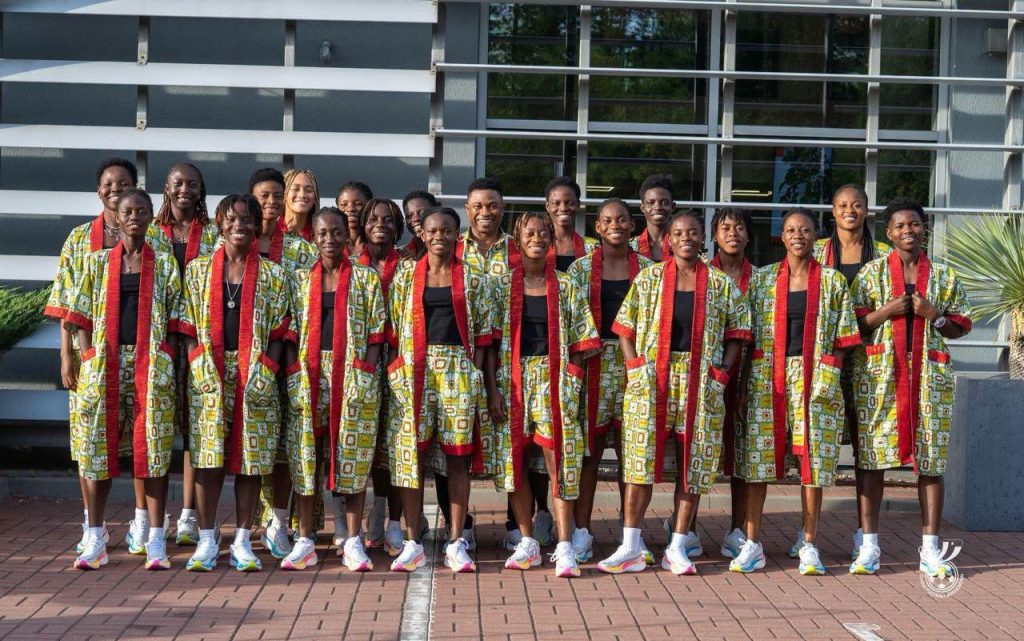
Ghana’s Black Princesses have touched down in Poland with the kind of composed, purposeful arrival that signals a team ready to treat this tournament as more than another group-stage outing. The first contingent of seventeen players and the technical staff led by head coach Charles Sampson left Accra in the early hours of 16 August 2026 and settled first in Krakow before continuing preparations around Wroclaw, where Ghana’s Ambassador to the Czech Republic, Theresa Adjei-Mensah, travelled to welcome them and remind the young squad that the President and the Ghanaian community in Poland would be watching.
The remaining players filtered in over the following days, completing a 21-player party that now occupies the official FIFA camp environment as the team acclimatises to European conditions and fine-tunes its approach ahead of the FIFA U-20 Women’s World Cup that runs from 5 to 27 September.
This is the Black Princesses’ eighth consecutive appearance at the global showpiece, a remarkable streak of qualification that has not yet been matched by a run beyond the group stage. Every previous campaign ended after three matches. The current group of players and staff have spoken openly about breaking that pattern.
Qualification itself was hard-earned: a 3-2 aggregate victory over Uganda in May, sealed by a late goal from captain Linda Owusu Ansah in Kampala, booked Ghana one of Africa’s four slots. That same captain, however, is among several key absentees through injury, forcing Sampson to reshape his leadership and attacking options around returning faces such as defender Alexandra Tay, forward Jennifer Dawah and goalkeeper Najat Abdul Salam, who bring prior World Cup experience into a squad otherwise built from the domestic Women’s Premier League and a handful of overseas-based talents.
The draw placed Ghana in Group C with France, Korea Republic and Ecuador. The Black Princesses open against Ecuador on 6 September at Arena Sosnowiec, then meet Korea Republic three days later at the same venue before closing the group against France on 12 September, again in Sosnowiec. All three matches carry the same 16:00 GMT kick-off.
The group is demanding: France arrive as one of Europe’s most consistent youth sides, Korea Republic bring organisation and technical quality, and Ecuador represent the South American challenge. Ghana’s task is to take points from the opening fixture and then compete for the second or third place that can still open a path into the knockout rounds under the expanded 24-team format.
Preparation on Polish soil has already included a 4-0 friendly win over local side Ślęza Wrocław, with goals from Jacqueline Ntoso, Priscilla Mensah, Ruth Amponsah and Diana Amoako giving the coaching staff encouraging data on combinations and set-piece execution.
A further warm-up against Mexico’s U-20 side was scheduled as the final dress rehearsal. Daily sessions in camp have focused on sharpness, tactical shape and adapting to the cooler climate after weeks at the Ghanaman Soccer Centre of Excellence in Prampram. The arrival photographs and official posts from the Ghana Football Association and the women’s national-team account show a squad travelling in coordinated kit, stepping off the plane and into training with visible focus rather than ceremony, which is precisely the style that supporters have come to expect from a side that has made qualification routine even while results at the finals have remained elusive.
What happens next will be decided on the pitch in Sosnowiec, but the weeks in Poland have already given the Black Princesses something they have not always enjoyed in previous cycles: time on the ground, matches against local opposition, and a settled base from which to chase the first knockout-stage appearance in the team’s history. The expectation at home is no longer simply to compete; it is to convert eight successive qualifications into a genuine run.


