


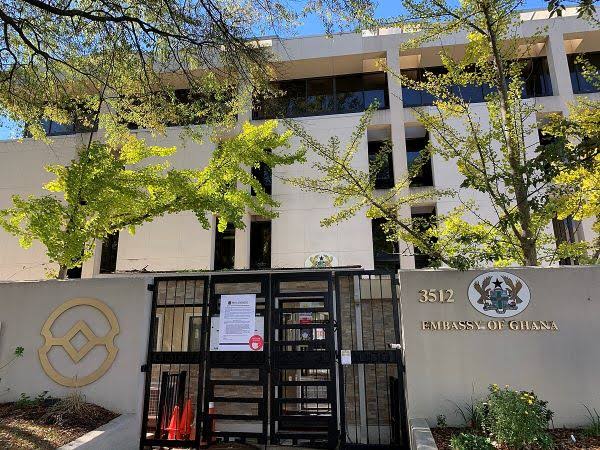
A forensic audit by the Auditor-General has uncovered nearly US$19.4 million in irregular charges paid by visa and passport applicants at Ghana’s Embassy in Washington, D.C., between 2019 and 2025.
The audit found that applicants were redirected from the Embassy’s official website to privately controlled external platforms, where they were charged additional fees for passport and visa dispatch, application support services and online payment processing.
According to the report, the irregular charges were facilitated through the manipulation of the Embassy’s website and the use of external platforms that had not been properly authorised.
Applicants charged above actual postage costs
The audit found that applicants were required to pay US$29.75 for the return of their passports or visas, while the average actual postage cost was approximately US$10.10.
This meant applicants paid nearly US$20 more than the estimated actual postage cost.
The audit identified mailing and dispatch charges as the largest component of the irregular fees.
More than 170,000 visa mailing transactions, together with thousands of passport dispatches, were recorded during the period under review.
The Auditor-General calculated that applicants paid US$6,945,554 in mailing and dispatch fees. After deducting the estimated actual postage cost of US$2,357,986.40, the excess amounted to US$4,587,567.60.
Additional application support fees
Applicants were also charged additional fees for application support services through external platforms.
The fees were set at US$67 for passport applications and US$76.78 for visa applications, despite the services not being part of officially approved government charges.
The audit further found that additional merchant fees were imposed through the Square payment platform without a formal contract governing its use.
Based on records from the Electronic Consular Information Management System (eCIMS) and AppTrack, the audit identified total transactions linked to the irregular activities amounting to US$21,337,446.70.
After accounting for actual postage costs of approximately US$2.36 million, the Auditor-General classified US$19.37 million as irregular.
Embassy website allegedly used to redirect applicants
The report identified Fred Kwarteng, an Information Technology Officer at the Embassy, as having created and operated external platforms including TravelGhana.Net and GhanaPV.org.
Other entities linked to the system included Ghana Travel Consult, Secure Data Centre LLC, Travel Global and MFG Technology.
According to the audit, applicants were redirected from the Embassy’s official website to these platforms to make payments.
The platforms also used official symbols and similar presentation styles, which the audit said could give applicants the impression that they were authorised government platforms.
Some of the redirects were reportedly implemented directly within the Embassy’s website source code, suggesting that administrative-level access was used.
The Auditor-General concluded that staff-linked entities were allowed to handle passport dispatch, visa processing communications and payment arrangements without the necessary authorisation and oversight.
Application backlog and additional costs
The audit also uncovered significant operational challenges at the Embassy.
Between June and August 2025, the Embassy accumulated a backlog of 12,721 visa and passport applications, despite applicants having paid for mailing services.
Only 4,507 applications were mailed during the period, while 8,214 were either collected personally by applicants or remained undelivered.
The backlog reportedly resulted in delays, complaints and additional administrative costs.
The audit said the Embassy subsequently spent approximately US$45,000 to post letters and clear part of the backlog, even though applicants had already paid for mailing services.
Auditor-General recommends recovery and sanctions
The Auditor-General attributed the irregularities to weak internal controls and inadequate oversight at the Embassy.
The report recommended that the irregular amounts be recovered from the key actors involved.
It also recommended that affected officers be sanctioned under the Cybersecurity Act, 2020 (Act 1038).
The findings come after Ghana’s Embassy in Washington was temporarily closed in 2025 following concerns over delays, missing documents, unclear fee structures and other operational irregularities.
The audit has therefore raised questions about the management of consular services, the use of third-party platforms and oversight of financial transactions at Ghana’s diplomatic mission in the United States.
Story by Freedom Etsey Lavoe


